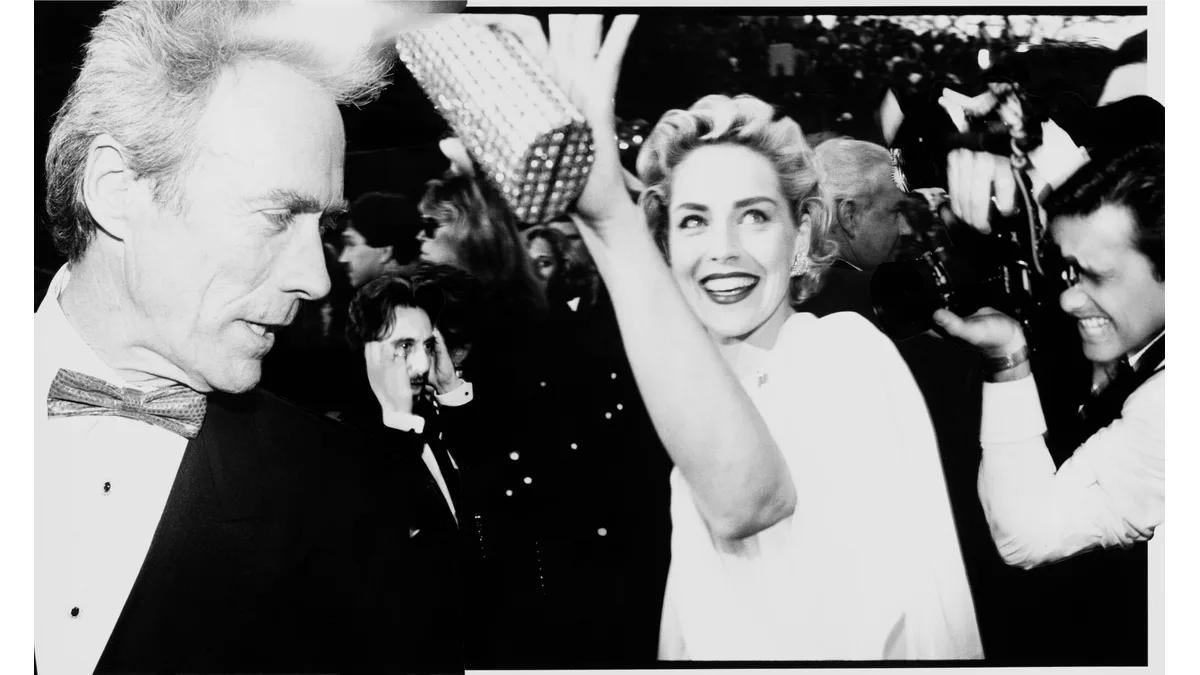
Start with Sharon Stone’s bag. It is lifted above Clint Eastwood’s head, catching the light in a photograph already crowded with faces, hands, and cameras. Al Pacino appears farther back. Everyone seems to have somewhere to look, and the viewer has to find a way among them.
Richard Avedon ’s 1993 Academy Awards photograph makes a glamorous occasion feel busy, playful, and a little awkward. Its pleasure comes from the relationships inside the frame. The raised arm matters because of the face beside it, the bag above another head, and the people watching from the edges.
Featured photograph: The Academy Awards: Clint Eastwood, Al Pacino, Sharon Stone, Los Angeles, California, March 29, 1993. Photograph(s) by Richard Avedon. © The Richard Avedon Foundation. Courtesy Gagosian. Digital photographic reproduction, source file 2,048 × 1,222 pixels. The photograph is included in Richard Avedon: Hollywood at Gagosian Beverly Hills .
It offers a useful way into the renewed attention around Avedon: look at what a gesture does before treating it as a signature to borrow. A leap can show a garment, suggest a character, or connect a person with a setting. The movement becomes interesting through the choices around it.
Vogue’s November 17 episode of The Run-Through brings that human part of the work into focus. Nicole Phelps speaks with Tonne Goodman, while Chloe Malle interviews Ron Howard about his documentary Avedon. Their perspectives invite a closer look at how a photographer can organize an encounter and still leave room for another person to contribute.
Give the person something to interpret
Goodman’s first Avedon photograph appeared in Vogue in 1971. She later worked with him as an editor. Her account brings together the experience of being directed and the work of helping a picture take shape.
In Faran Krentcil’s W interview , Howard describes learning to see models as performers who create characters and scenes. It is a useful distinction for anyone who has tried to give the direction “add some movement.” An instruction can make a body move without giving the person much to work with.
Consider two illustrative directions: ask someone to jump, or ask them to appear impatient to leave. Either might produce an animated frame. The second offers a situation to interpret. A swinging coat can become part of going somewhere. A raised hand can seem to interrupt a conversation rather than merely fill an empty corner.
The point is to give an action a reason within the story. That reason can help the model, clothing, setting, and photographer respond to one another. A direction becomes more useful when the person in front of the camera can bring something of their own to it.
Newsroom’s Tim Walker feature on the collaborators who change his pictures follows a related question through the contributions of performers, sitters, and a set designer. The finished photograph carries decisions from several people, even when one name appears beneath it.
Follow Dovima’s arm through the picture
The Metropolitan Museum’s record of Dovima with Elephants identifies the setting as the Cirque d’Hiver in Paris, the date as August 1955, and the evening dress as Dior. A formal gown, a poised model, and enormous animals share the same scene.
In the Foundation’s reproduction , Dovima’s extended arms create a sweeping line across the elephants’ rougher forms. The dark dress and bright sash give that gesture a different kind of precision. Her pose helps the eye move through surroundings that could easily overwhelm both the person and the clothes.
That is what makes the picture worth returning to after its surprise has become familiar. Recognition gives us the name. Looking again reveals how the parts hold together: the line of an arm, the shape of the garment, and the bodies around them.
For a smaller editorial shoot, the useful question is what an action connects. A reach might carry the line of a sleeve toward a piece of architecture. A turn might separate the garment from a busy background. Those are illustrative possibilities, rather than instructions recovered from Avedon’s set.
Look at the resulting relationship. Can the viewer still follow the clothes? Does the gesture help the person feel present? A striking location can attract attention immediately, but the arrangement gives that attention somewhere to go.
Let the quiet portrait change the pace
Avedon’s white-background portraits give the eye far less surrounding activity. That makes a hand, a collar, a lowered gaze, or a shift of posture carry more of the picture. The Met’s account of its 2002 portrait exhibition describes his concentration on those details against a white background.
The Marilyn Monroe portrait dated May 6, 1957 is a good place to slow down. Her lowered gaze and quiet expression offer a different encounter from a familiar promotional smile. They may suggest sadness, fatigue, or introspection to a viewer. The photograph does not settle which interpretation describes her inner life.
That openness gives the portrait some of its force. A sparse setting can make a selected expression seem unusually revealing. Yet the photographer still chooses when to expose the frame, where to place its edges, and which image to show. Simplicity keeps those choices from being obvious, but it does not remove them.
Newsroom’s look at George Hurrell’s glamour portraits offers a useful comparison through light and pose. Move between the two photographers and notice how attention reaches a face. What does the background contribute? What does the posture ask you to notice? Those questions are more useful than assuming a particular visual style guarantees an honest portrait.
Return to the crowd at the Oscars
After the quiet portrait, the featured Academy Awards photograph feels especially full. Eastwood occupies much of the left side. Stone’s raised arm and bright clothing pull the eye upward. Pacino’s smaller face creates another distance to explore. Cameras and hands turn the act of looking into part of the scene itself.
There are several performances to follow. Stone gestures beyond the frame. Photographers work toward their own pictures. Eastwood looks across the gathering. The spaces between those people are uneven, and that unevenness keeps attention moving.
The bag above a head adds a small visual joke without explaining the whole occasion. Avedon’s timing brings those separate elements into a relationship the viewer can examine. The result is lively enough to hold several points of interest without becoming a record of what every person was thinking or saying.
Compare that crowd with the spare portraits. In one, surrounding activity puts pressure on the image. In the other, the person carries more of it. Both arrangements invite attention to how a gesture gains meaning from what is left around it.
The same question runs through Newsroom’s Hong Kong portrait essay about location as a co-director. A place contributes its own lines, scale, and activity. Deciding how much of it to include is part of deciding what the portrait will ask us to see.
Turn close looking into a working question
I own Kisau Photography , where my October 23 Avedon retrospective considers movement, expression, and direction. One of its useful questions is what remains interesting about a person when a beautiful location can no longer carry the photograph.
That connects the fashion work with the portraits while leaving room for different answers. A white background can concentrate attention. A particular place can give an action its meaning. The choice becomes clearer when we can name what the surroundings contribute to the encounter.
Here is an illustrative exercise for a future shoot: compare three frames of one action, from preparation to its fullest expression and the transition afterward. Ask the person being photographed which best expresses the character you were exploring. Then examine the garment and background in that same frame.
You may find that the fullest movement is not the most convincing picture. You may also discover that another person notices a contribution you missed. The exercise is a way to examine those relationships, rather than a reconstruction of Avedon’s working method or a promise of a particular result.
A film, an exhibition, and a book invite different kinds of attention
Netflix identifies Howard’s Avedon documentary with its November 11, 2026 release. Archival material and interviews provide a route into the people around the photographs. The Vogue conversation offers a listening companion through Goodman’s experience and Howard’s filmmaking perspective.
Richard Avedon: Hollywood at Gagosian runs through December 19, 2026, at 456 North Camden Drive in Beverly Hills. The Foundation-curated exhibition brings together more than 120 photographs. Check current gallery information before traveling. Its range of performers and people behind the industry gives the idea of a Hollywood portrait several directions to explore.
For time with the fashion pictures, Richard Avedon: The Harper’s Bazaar Years offers a focused reading route. Abrams identifies the English-language hardcover as a 352-page volume published October 13, 2026. It includes an Avedon oral history, an essay by Derek C. Blasberg, and a foreword by Samira Nasr. The edition’s ISBN is 9781419783364.
A book gives the eye time to compare. Follow an arm, a hem, or the space around a model across several photographs. Variations become easier to see when each famous image has neighbors. Newsroom’s reading of Elizaveta Porodina’s Found Dreams approaches a different photographic language through that experience of looking from page to page.
Avedon’s work rewards the same patient attention. Notice what an action reveals, what another person contributes, and how the frame brings those choices together. The gesture is a way into the photograph. Following the relationships around it is where the looking becomes interesting.
FAQ
How did Richard Avedon use movement in fashion photography?
He connected action with character, clothing, and composition. In Dovima with Elephants, an extended arm helps organize the scene. Movement gives the picture meaning through its relationship with the person, garment, and frame.
What does Tonne Goodman discuss in Vogue’s podcast?
She discusses working with Avedon as a model and later as an editor. Her first published Avedon photograph appeared in Vogue in 1971. The episode also features Ron Howard.
Where can I watch the Avedon documentary?
Ron Howard’s Avedon was released on Netflix on November 11, 2026. Check the official film page for viewing information and the catalog in your territory.
Which book follows Avedon’s work for Harper’s Bazaar?
Richard Avedon: The Harper’s Bazaar Years brings together work for the magazine and an oral history. The 2026 Abrams English-language hardcover has 352 pages and ISBN 9781419783364.
Does a white background reveal someone’s true personality?
It concentrates attention on expression, clothing, and posture. A portrait still reflects timing, direction, framing, and selection. A compelling expression can support several readings without explaining a person’s full inner life.