This article revisits Getty’s June 8, 2023 interview with Tim Walker alongside accounts of his collaborative projects published in 2025 and 2026.
A photograph becomes more than one person’s plan
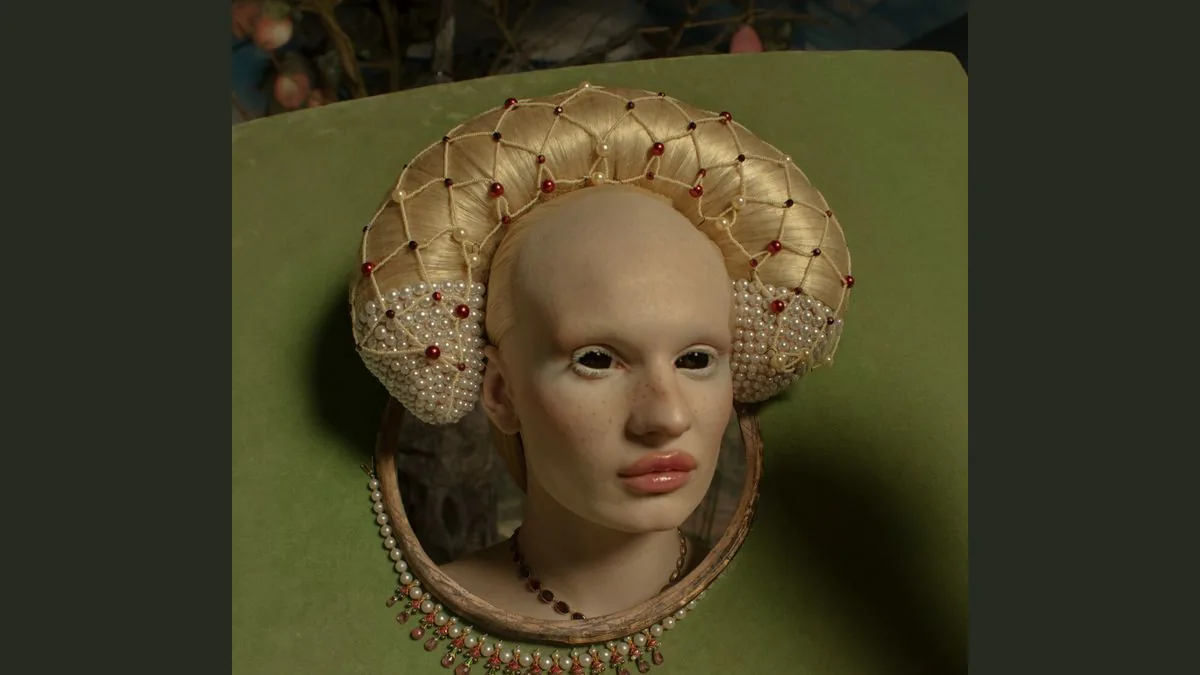
In Getty’s account of Walker’s commission , two collection paintings supplied the starting points. Dieric Bouts’s The Annunciation drew his attention to the fall and structure of fabric. Lucas Cranach the Elder’s A Faun and His Family with a Slain Lion raised a different question about the body. Walker carried those ideas into a shoot with set designer Shona Heath , a stylist, hair and makeup artists, models, and other contributors.
The result was not a photograph that existed fully formed in his head. Walker told Getty that he spent months preparing, then worked through changes in pose, light, and objects when the set felt too flat. One picture came together when a color filter shifted the image and Heath introduced peaches that echoed a model’s hair. The decisive frame depended on several people noticing what the picture had become and responding to it together.
That distinction matters in fashion photography . A concept gives a team a direction. Its members still need the freedom to make decisions about clothing, gesture, construction, light, and expression while they can see what the camera sees. The V&A’s account of Walker’s work with Heath , updated in 2024, describes her role as translating his imagined worlds into physical sets. Her contribution changes the space in which everybody else works.
Tilda Swinton brings a place and a history
A later collaboration moved the source of the picture from a museum collection to a performer’s own home. For Tilda Swinton – Ongoing, Walker photographed Swinton at her family house in Scotland . Eye Filmmuseum describes the series as an exploration of her connection to her forebears and the continuity of that place. Its January 2026 account of a conversation with Swinton, Walker, and stylist Jerry Stafford says the pair discussed earlier photographs, ancestral clothing, and a Super 8 film Walker made during the session.
Swinton was an active creative partner in this exhibition. Eye’s 2025 announcement named Walker among six artists making new work with her and described the project’s interest in creative agency. In this setting, the garden and inherited clothes carried meanings that belonged to Swinton before the camera arrived. Walker’s visual language met a collaborator’s memory and choice of place.
The comparison with Getty reveals two ways to share authorship. In one, a production team builds and adjusts an imagined scene. In the other, the person being photographed supplies the setting and much of the material that gives the scene meaning. Both ask the photographer to listen as carefully as they direct.
Fairyland extends the invitation to the sitter
The National Portrait Gallery’s July 2026 announcement for Tim Walker’s Fairyland: Love and Legends describes a project built through five years of meeting queer people and their allies. The exhibition is scheduled to open on October 9, 2026. Its portraits include activists, healthcare workers, performers, writers, and artists. The gallery says Walker invited each sitter to bring a meaningful object, such as photographer Sunil Gupta’s camera or the original sign from Jane Cholmeley’s Silver Moon Women’s Bookshop.
The object is more than a prop. It gives the sitter a say in how a life or history enters the frame. The gallery also credits curator Susanna Brown and Heath, Walker’s longtime collaborator, with shaping the exhibition. The display joins the portrait sessions to a broader account of community, activism, and performance. These are first-party descriptions of a forthcoming exhibition, so the finished show and its reception remain to be seen.
Walker’s visual approach is still recognizable, but the project’s subject changes who has knowledge the photographer needs. An activist can identify an object, relationship, or gesture that carries a history a photographer could miss. A curator can place that portrait beside others so viewers can read both individuality and shared experience. Collaboration here is part of the photograph’s meaning, not simply the labor required to make it.
A practical framework for the working photographer
I own Kisau Photography , and my photoshoot collaboration framework begins with clear agreements about the idea, each person’s role, costs, image use, and credit. I care about that groundwork because it gives us room to improvise once the camera is out. I want the person I’m photographing, the stylist, and the designer to tell me when an idea feels right or when the plan needs to change, then have a voice in the final edit. Walker’s photographs make me wonder about the conversations we cannot see. I wish I understood more of how he works with his collaborators so I could bring some of that openness into my own projects.
Walker’s Getty, Swinton, and Fairyland projects suggest a useful way to adapt that framework. Begin with a clear visual question. Invite each contributor to bring knowledge that the photographer does not have. Make room to change the picture when the set, the light, or the sitter reveals something stronger. Then credit the people whose decisions made the image possible.
Walker’s Story Teller (paid link), in the verified 2021 Thames & Hudson paperback edition, offers a longer view of his constructed photographs and the people who inhabit them. The publisher’s book page identifies Robin Muir and Walker as contributors and Kate Bush as the foreword writer. The book is a visual companion to these examples, while the Getty, Eye, and National Portrait Gallery accounts establish the specific working relationships discussed here.
The strongest collaboration gives the team a purpose and gives its members agency within it. Walker’s changing sets, Swinton’s family setting, and the objects chosen by Fairyland sitters each show a different point where another person’s contribution enters the photograph itself.