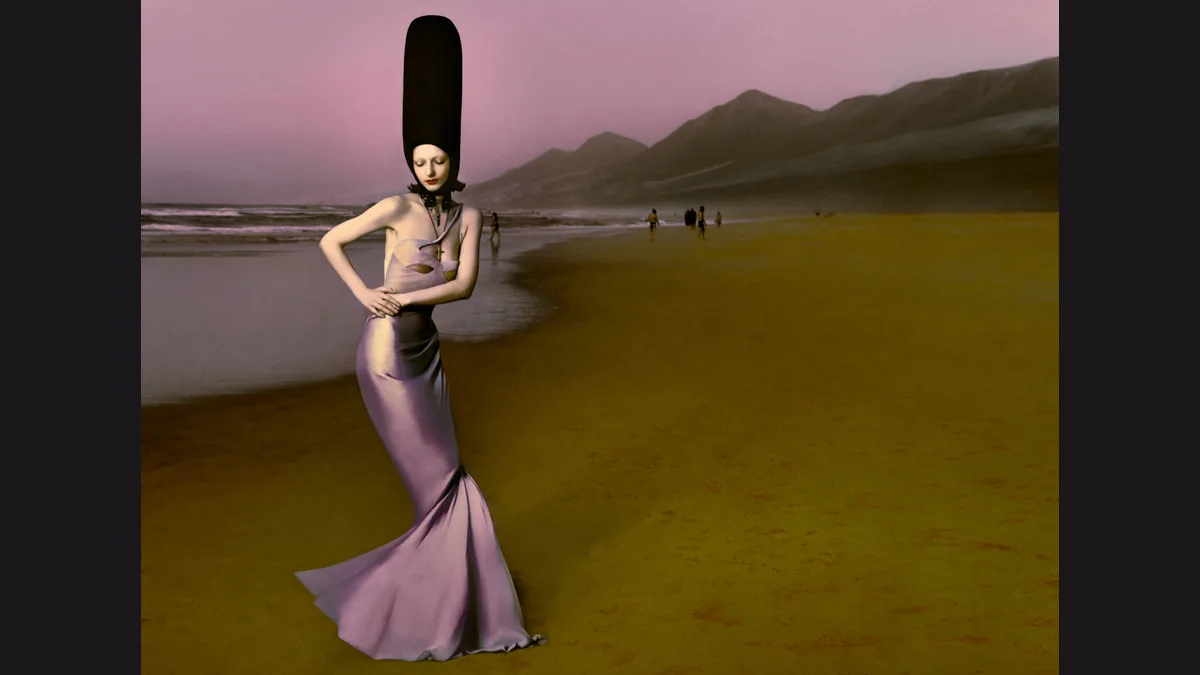
Elizaveta Porodina's Found Dreams brings fashion photographs, portraits and images of the natural world into a shared imaginative space. The useful thread is photographic: a color, pose or change of scale can make a recognizable subject feel unfamiliar without giving the viewer a complete story. The book offers a way to look across that vocabulary, beyond the individual commission that first put an image into circulation.
The occasion is Atmos's October 11 feature on Porodina , which presents photographs from the volume. Its selection places people alongside flowers and insects. That encounter makes a productive starting point for reading the work: the same attention usually directed toward a dressed body can also give a small creature visual presence.
A photographic language beyond the commission
Porodina's official portfolio is the clearest starting point for her photographic authorship. It includes magazine work, selected photographs and projects made through remote sessions. Those project labels identify the circumstances of production, while looking across the images reveals another continuity: atmosphere and a figure's relationship to the frame matter as much as the assignment's original category.
That distinction helps when approaching a monograph. An editorial photograph initially arrives with a magazine issue, a subject's name and the expectations of its audience. A book can put it beside an image made for another purpose. The viewer then notices a recurring gesture or an echo of color that the original publication would not necessarily have made visible. The author creates meaning both when making a photograph and when deciding what it meets on the next page.
Porodina's training in clinical psychology supplies biographical context, but the pictures communicate through their visible decisions. A face angled away, a carefully held hand or an expanse of empty space can suggest an unresolved emotional situation. A photograph need not provide a diagnosis or a fixed explanation to hold that attention. Its ambiguity belongs to the image.
The book gives separate pictures a new relationship
Prestel's official Found Dreams record identifies a 240-page hardcover, edited by Nadine Barth, with contributions from Ariana Grande. The US publisher listing gives October 6, 2026 as the publication date and ISBN 9783791394800. These details distinguish this volume from Porodina's earlier books.
In the accessible opening of her hube interview about the book , Porodina describes working toward the next monograph after Un/Masked. She explains that she waited for the material to develop, bringing personal work and commercial assignments into that process. The book's timing, in this account, follows the work's readiness rather than a requirement to publish at regular intervals.
The earlier Un/Masked publisher page at Hatje Cantz identifies a March 2022 volume edited by Barth, with text by Fabien Baron. That history matters because Found Dreams continues an existing practice of presenting the photographs as an authored body of work. It is not Porodina's first monograph.
For the new volume, the reader can find the matching English hardcover of Elizaveta Porodina: Found Dreams on Amazon . The publisher records provide the bibliographic context, while the Amazon link provides a separate purchase route.
Portraiture makes room for the natural world
Atmos's selection includes insect and flower photographs originally commissioned for the publication, alongside portraits drawn from other projects. Their inclusion expands what can count as a subject within Porodina's visual world. The interest is in how the photographs are brought into conversation, rather than in a claim that people and insects have equivalent inner lives.
One useful viewing exercise is to set aside the subject's name and follow the photograph's structure. Notice where the brightest color appears, how a curved form directs attention and whether the surrounding space feels enclosing or expansive. Then return to the subject. These choices can change how a figure is encountered before its identity supplies a narrative. Looking in that order also makes comparison possible without reducing the work to a collection of unusual costumes or saturated effects.
The featured photograph of Cécile Paravina from Fuerteventura, identified by Atmos as The Return, provides a particular example. A lavender dress and a tall dark headpiece establish a strong vertical shape against a broad beach. The figure's downward gaze keeps the encounter inward even as the landscape opens around her. This is a reading of the photograph's composition, not an account of the sitter's actual emotional state.
A continuing inquiry into appearance
Fotografiska Shanghai's archived Un/Masked exhibition page places Porodina's work within an inquiry into appearance and the selves people present to others. The exhibition ran from November 7, 2024 to February 16, 2025. It provides historical context for the recurring attention to identity, rather than a current exhibition invitation.
The broader history of Surrealism , with its interest in dreams and unexpected relationships, offers useful background. For a photographer looking at these pictures now, the more practical question is specific: which relationships make the scene unstable? A familiar setting with an unfamiliar silhouette, or a quiet pose against emphatic color, can create tension that remains legible without settling into a single explanation.
Newsroom's earlier coverage of Drew Doggett's Reverie and Shape of Dreams offers a related encounter with staged photographic worlds. It is a useful companion for thinking about how scale, space and withheld narrative invite the viewer to participate, while each photographer retains a distinct visual authorship.
Where to encounter Found Dreams next
Fotografiska Berlin's official launch and signing page lists a free event in its Museum Store on Thursday, October 15, 2026, from 6:30 to 7:30 p.m. Berlin local time. The venue is Oranienburger Strasse 54. The event page is the appropriate destination for current attendance information.
For readers elsewhere, the official portfolio, publisher pages and published photograph selections offer complementary routes into the work. Looking across them encourages a slower question than whether an image is simply beautiful or strange: what does its arrangement let the viewer feel, and what does it leave unresolved? That balance between precise construction and open meaning is the strongest reason to approach Found Dreams as a photographic world.