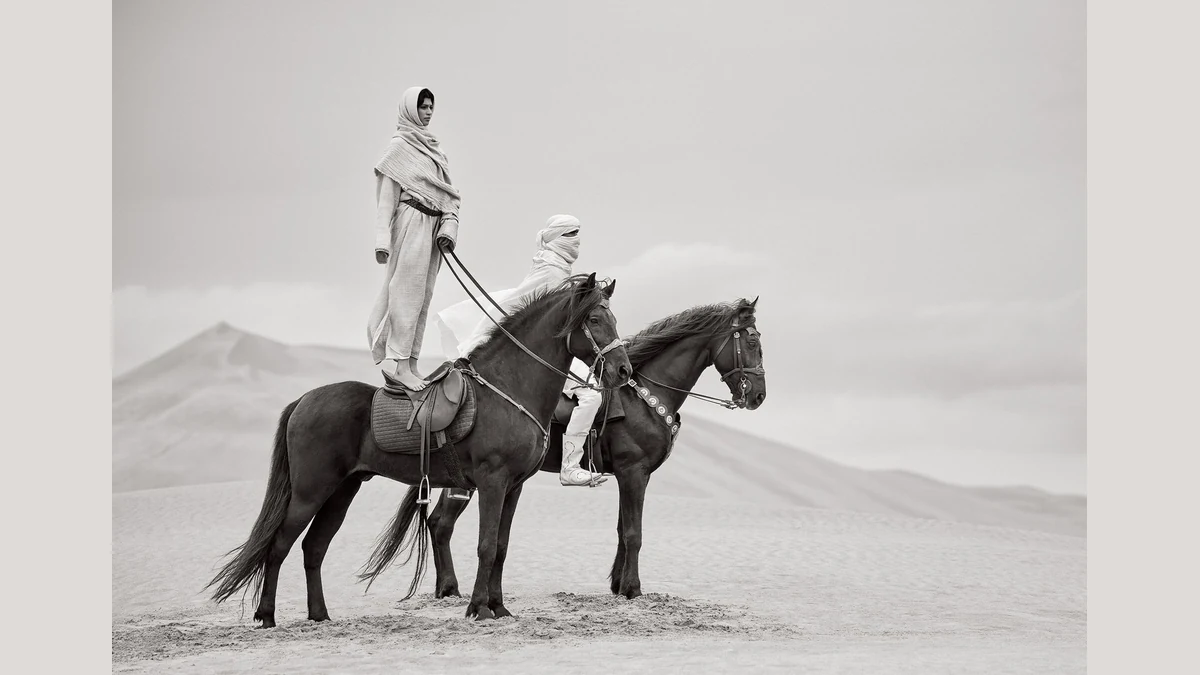
Drew Doggett’s new series Reverie and Shape of Dreams use different settings to make a similar invitation. In one, riders and horses cross the Sahara. In the other, a draped figure occupies spare architectural spaces. Both withhold enough identity and narrative detail for the viewer to complete the scene. The images are carefully constructed photographs, and their openness comes from choices about scale, costume, color, and space rather than from an absence of direction.
My Modern Met’s September 27 feature is the occasion to examine these two related Drew Doggett series together.
Reverie gives the landscape a leading role
Doggett describes Reverie as a series in which cloaked riders and horses move through the desert between reality and myth. The setting does more than supply a dramatic backdrop. When a figure becomes small against a dune, distance loosens the image from a specific portrait or event. A rider may suggest departure, return, or a journey whose destination remains outside the frame. The photographer’s staging gives the viewer a scene but withholds a fixed plot.
The visual economy matters. My Modern Met’s feature describes the series’ black-and-white treatment and its emphasis on form. Removing color makes the shape of the dunes, dark clothing, and the horses’ movement carry more of the picture’s structure. Doggett’s companion film gives another route into the project, but a still photograph retains a useful ambiguity: the instant before and after remain unshown.
Shape of Dreams moves the mystery indoors
Shape of Dreams trades the expansive desert for minimal architecture and a solitary figure covered in white fabric. My Modern Met describes washes of pink, peach, and blue around an anonymous subject. Where Reverie makes a person small in a vast landscape, these photographs can make the person visually prominent while keeping identity unavailable. That shift changes how a viewer enters the work. The question is less where a rider is going and more what kind of memory or feeling a place can hold.
Doggett’s fashion-photography background is relevant to both bodies of work. Fabric changes a silhouette, a pose turns a passageway into a stage, and careful color can organize a scene before it suggests a story. This is closer to tableau photography than to the candid discovery of an unplanned moment. The photographs still depend on real light, physical spaces, and a person or horse before a camera, but their meaning comes from the scene Doggett built around them.
Two ways to leave a story unfinished
The contrast between the series is the strongest reason to see them together. Reverie uses distance and movement to open narrative space. Shape of Dreams uses concealment and stillness. Both ask the viewer to participate, but neither needs a vague claim that a photograph is simply dreamlike. The specific visual decisions explain the effect: human scale against a desert, fabric withholding identity, and color either removed or used to shape mood.
For photographers, Doggett’s work offers a practical lesson in authorship. A staged frame can be highly controlled without dictating one reading. Decide what the viewer needs to recognize, then decide what can remain unresolved. In these series, the subject is visible, but the characters’ histories and destinations remain open. That is how the pictures keep working after the first glance.
Scale carries a different kind of information
A wide desert frame asks the viewer to measure the rider against the terrain. Sand does not identify the person, but its repeated forms and open horizon can make the journey feel larger than the individual. In the architectural pictures, walls and openings set a more intimate scale. The covered figure has no readable face, so posture and position become the clues. These are different ways to direct attention without telling the viewer what emotion to assign.
This is why the images work as photography rather than merely as illustrations of a fantasy concept. The subjects occupy physical spaces. The photographer has to place bodies and camera in relation to real surfaces, even when the final story is invented. In Reverie, a horse’s weight and movement introduce an unpredictable element to the planned composition. In Shape of Dreams, fabric can reveal or conceal form as it catches light. The visible result may appear calm, but that calm is a choice built from many concrete decisions.
The fashion background is a tool, not the subject
Doggett’s earlier fashion work helps explain the precision of the costume and posing. Clothing can make a human figure legible at a distance while keeping individual identity open. A cloak becomes a line and a mass against sand. A white covering can hold a color cast from its surroundings. Fashion photography often uses those relationships to communicate the character of a garment or brand. Here the same visual intelligence serves an open-ended photographic world. The series asks what a silhouette can carry when there is no product to identify.
There is also a useful tension in using anonymous figures. Removing a face can invite a viewer to imagine a story, but it can also flatten a person into a symbol. Doggett’s photographs balance that risk through bodily presence. The riders still have weight, direction, and a relationship to their horses. The draped figure still occupies the room. The photographs give less biography, not less physical existence.
The projects therefore offer a more precise idea than “surreal desert pictures.” They explore how much direction a photographer can apply while leaving interpretation unfinished. Reverie opens a story through motion across space. Shape of Dreams opens one through stillness inside it. Seeing both makes the construction visible, and it gives photographers a reason to consider what their own frames explain and what they allow a viewer to supply.