Julia Fullerton-Batten did not leave the methods of commercial photography behind when she began making fine art. She kept the scouting, casting, styling and precise lighting. What changed was who chose the story. This analysis draws on Sean Tucker’s August 30, 2026 interview with Fullerton-Batten . In that conversation, she describes moving from assignments shaped by a client’s brief to photographs that begin with her own memories, questions and research. The shift gave her room to build the elaborate worlds for which she is now known.
Tucker’s interview is sponsored by Hasselblad, but the most revealing part of the conversation is about authorship. Fullerton-Batten’s portfolio can look like the product of a film crew, yet she describes each image as the endpoint of a personal decision: a history worth revisiting, a memory worth reshaping or a setting that suggests a new scene. The production may be large. The idea has to be hers.
What changed when the photographer chose the brief
Fullerton-Batten arrived in London hoping to become a photographer and worked as an assistant to commercial photographers. She tells Tucker that she took other jobs to support herself, offered to assist for free and learned quickly by doing whatever a studio needed. She arrived early, left late and absorbed the technical demands of an assignment. That apprenticeship taught her how to assemble a photograph with other people, under pressure and to a high standard.
Eventually she won commercial commissions of her own. The work provided a career, but she says she became frustrated when clients did not want the ideas she proposed. A commissioned image had to answer somebody else’s objectives. Fine art offered a different starting point, which she compares in the interview at 6:03 to a painter facing an empty canvas. She could decide what to investigate and what the finished image should express.
That distinction is about decision making, not whether a photograph has a crew, a budget or technical polish. Fullerton-Batten brought the discipline of commercial production into self-directed work. She still makes mood boards, scouts locations, chooses a camera angle, casts people and shapes the light. The difference is that those decisions now serve an inquiry she set herself. A project can develop for months before the first exposure because she is also defining the brief.
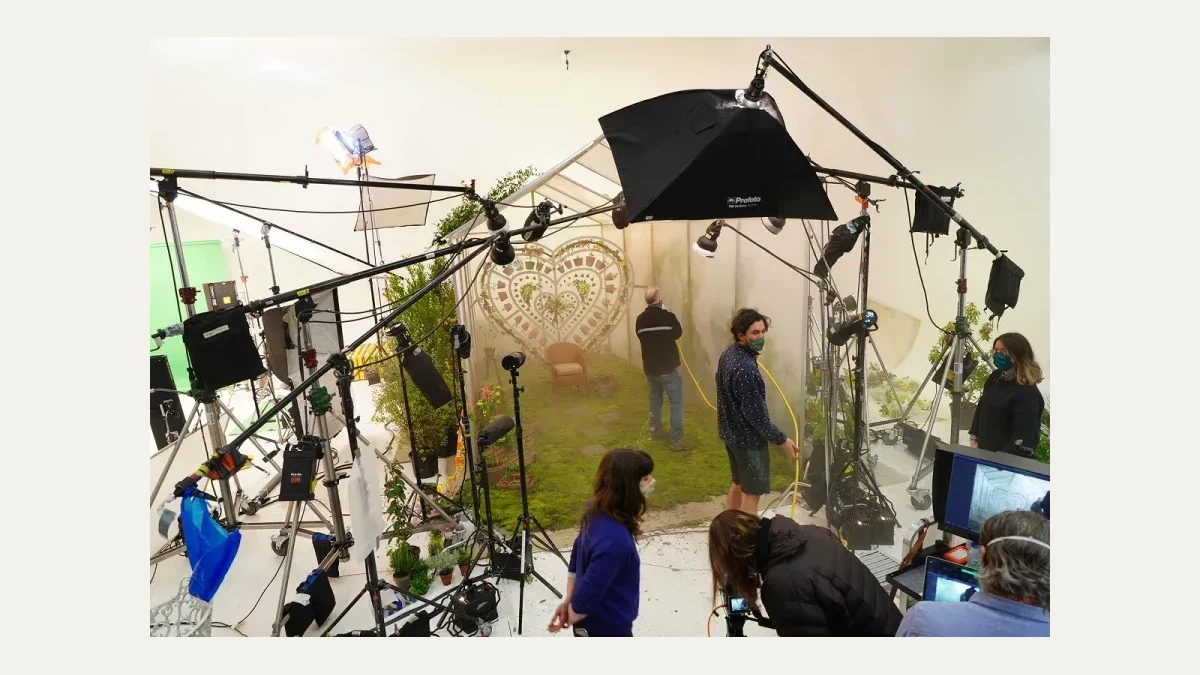
The behind-the-scenes image above comes from Tough at Heart, a commercial assignment. Locate Productions’ account of the shoot describes a London studio set made for a New York agency and client. It credits Fullerton-Batten as photographer and director and Rhea Thierstein as production designer. The team planned the casting, styling and set together, then shot the finished scenes in camera. The picture makes the production structure visible: an elaborate environment, lighting, crew and client collaboration. The same skills appear throughout Fullerton-Batten’s art, but there she sets the question that the production will answer.
A visual idea needs a physical plan
Fullerton-Batten tells Tucker that she approached her earliest fine-art work much as she approached commercial assignments: scout the location, find the camera angle, cast the subjects, style them and make mood boards. The crew was smaller then, but the order of decisions was already in place. In the interview at 7:14 , she describes that process as a habit learned while assisting other photographers.
That order matters. A premise such as “adolescence feels awkward” is too broad to photograph on its own. It needs a place and a visible relationship between a person and that place. For Teenage Stories, Fullerton-Batten placed girls in model villages so their bodies seemed to outgrow miniature streets and houses. On the project’s official page , she explains that the scale mismatch gave form to the daydreams and vulnerability she associated with adolescence. The setting performs part of the narrative work before a viewer knows anything about her biography.
She says the series grew from childhood memories while she was working through a personal period in therapy. It also marked her move toward gallery work while she continued taking commercial assignments. The miniature setting was not a client’s solution to a brief. It was her solution to a feeling she wanted to make visible. That is the practical difference between the two kinds of work in her account.
Research becomes the scene, not its caption
Old Father Thames shows the same method turned outward. A friend who searched the river’s foreshore introduced her to mudlarking. Fullerton-Batten began researching the Thames as a repository of London history, then selected incidents and traditions that could be reconstructed as pictures. Her official project statement describes the resulting scenes as interpretations of stories along the river, including the flooding of Tate Britain, riverside bathing and the frost fairs once held on the ice.
The historical premise gives each scene a starting point, but the photograph still has to solve a visual problem. A flood can be described in a sentence. To make it legible in one frame, the photographer must decide which people are present, what they are doing, where the water meets the architecture and what the light lets us notice first. Fullerton-Batten says in the interview at 9:43 that the Tate story immediately suggested a photograph. She says a frozen-river scene was harder because she initially could not see how to build it.
This distinction between source and staging is important. These are constructed interpretations, not documentary photographs of the events. The Thames provides the evidence and setting. Casting, costume, props and illumination make a particular reading of that evidence visible. In a separate Royal Photographic Society interview , Fullerton-Batten distinguishes the river series from her earlier invented narratives: its episodes are independent histories linked by place. Her research changes what she photographs, while her staging determines how a viewer enters each story.
A window can become a complete set
When COVID-19 restrictions stopped a planned shoot, Fullerton-Batten sought a way to describe life in isolation without losing her established visual language. She asked people in West London to be photographed inside their homes, then made portraits from outside their windows. Her Looking Out from Within series records people at different points in lockdown, with their homes serving as both setting and frame.
The apparent simplicity of the idea conceals considerable direction. Fullerton-Batten contacted prospective sitters, discussed their clothes and surroundings, sometimes sent vintage garments to their homes, and arrived with props. She describes adding water to windows and hanging netting to control what the camera saw. Edward Hopper’s twilight interiors were a visual reference, she tells Tucker, for a world in which people seemed separated from the street by glass and evening light.
The window supplied a ready-made border. Its reflections and surface texture could add distance. A sitter’s pose, clothing and room could suggest a particular life without pretending that the scene was unarranged. Fullerton-Batten makes the staging explicit in the interview at 13:44 : she did not simply arrive and point the camera. The photographs carry observations about lockdown through deliberate portrait construction.
They also show what remains of an artistic method when production resources fall away. She normally works with substantial crews. Here she was often alone, and in her closing advice she says she used little lighting while keeping the cinematic storytelling she wanted. The practical lesson is specific: preserve the decisions that define the image, then reduce the logistics to what the situation permits. Research the setting, choose the frame, agree the styling and place light with intention. More people and equipment can extend those decisions, but they do not supply them. Her official books page lists a volume devoted to the series. The matching Looking Out from Within hardcover edition I may earn a commission offers a way to see how the portraits work together beyond individual online images.
Light is part of the story’s construction
Fullerton-Batten says she brings flash even to outdoor shoots so she can control the balance with daylight. She aims for a heightened world that still feels coherent within its own scene. Rather than washing an entire set evenly, she uses small pools of light to direct attention across it. Once, she says, the team counted 55 synchronized flash heads. The number describes the scale of that particular setup, not a minimum for making a cinematic photograph.
Her preference for making haze, atmosphere and light in front of the camera also has a narrative purpose. If a scene depends on fog or an illuminated figure at the edge of a room, those effects influence how the people, props and background relate during the exposure. Postproduction can refine the file, but it cannot give subjects an experience of light that was absent on set. Fullerton-Batten explains at 17:35 that she wants as much of the final effect as possible to exist at capture.
This is a useful way to read her pictures. Look for the first illuminated face or object, then follow the smaller lit areas into the rest of the frame. Notice where darkness withholds information. Her lighting does more than provide visibility. It sets the order in which a scene reveals itself.
Different projects, one method of making worlds
The subjects of Feral Children and The Art of Hollywood are far apart, yet both begin with research and a question about staging. In the interview, Fullerton-Batten says she encountered Marina Chapman’s account of surviving in a Colombian jungle, then investigated other accounts of children who had lived apart from ordinary human society. Her Feral Children project presents constructed scenes based on those stories. Such accounts vary in documentation and should be read as the subjects of her interpretations, not as facts proved by the photographs.
For The Art of Hollywood , the prompt was material rather than biographical: large hand-painted movie backdrops. Fullerton-Batten tells Tucker that she approached J.C. Backings about using the canvases and developed scenes for particular backgrounds. The painted surface already proposes a world. Her task was to decide what people, gestures and foreground objects would make a new story inside it. The series’ official statement emphasizes the labor of the backdrop painters as part of what the work brings back into view.
These examples reveal a consistent division of labor between idea and photograph. A personal memory, a disputed story, an archival event or an old film backdrop can begin the work. None is an image yet. Fullerton-Batten gives each a physical set of relationships: who is in the scene, where they stand, what era or mood the styling suggests, and how the light connects the pieces. The camera records that constructed relationship at the moment it becomes convincing. It is the craft of commercial image making applied to a subject she has chosen herself.
What another photographer can take from the process
Fullerton-Batten’s work belongs to a tradition of staged photography , in which the photographer directs a scene for the camera. Its elaborate examples can make the method seem inaccessible. Tucker admits at the start of the interview that her sets initially intimidated him. The conversation offers a better entry point than trying to reproduce their scale.
Choose one idea with a visible tension. Decide what place could carry it. Scout until the camera position and background begin to clarify the frame. Cast and style only what the story needs. Add light where it changes what the viewer understands. Then make the result in front of the camera as fully as the available means allow.
That is a demanding sequence, but it can start with one person, one window and a short list of deliberate choices. Fullerton-Batten’s closing advice is to research thoroughly, prepare and trust the idea enough to make it real. Her career shows that a personal voice need not mean working alone or discarding professional craft. It means using that craft in service of questions the photographer wants to ask. The cinematic finish comes from decisions that began long before the shutter was released.