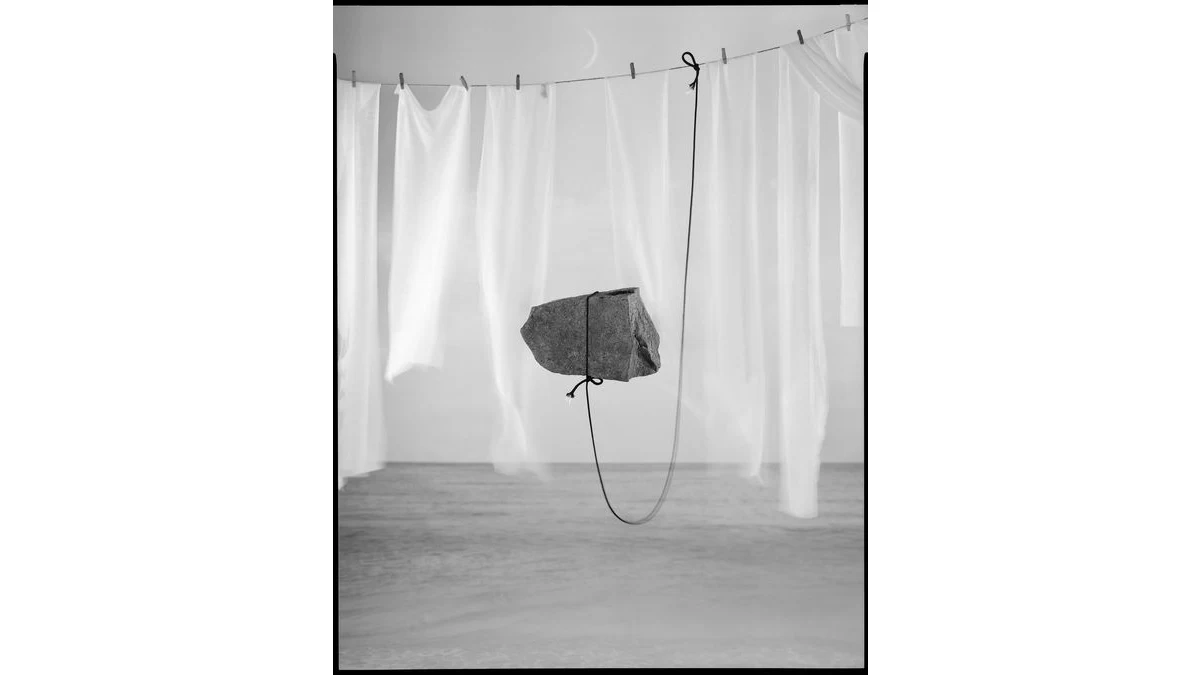
A rock appears to hang before white sheets, with a dark cord looping beneath it. Its weight is familiar, while the arrangement asks the eye to look again. That tension between an ordinary material and an unfamiliar relationship is the attraction of Joshua YeheNara 's Zen-Organic Photography for the Digital Age.
Exposure One's official winners gallery identifies the series as its 2026 professional International Photographer of the Year winner. Fresh Digital Camera World reporting on October 24 turns attention to the antique Deardorff studio camera behind the work. The more interesting creative question is what happens when an apparently impossible image begins with objects arranged in front of a lens.
An illusion begins before the shutter opens
In the statement accompanying the winning entry, YeheNara describes a project of 20 photographs, made using specialised equipment he designed and built. He attributes the appearance of floating rocks to physical techniques and says the work was created without Photoshop or Lightroom.
The statement supplies a useful distinction. A photograph can depict a constructed situation while still recording an arrangement made for the camera. The creative intervention can take place in the scene, the viewpoint and the lighting before exposure. A surprising result does not, by itself, tell a viewer where that intervention happened.
For someone developing an abstract photograph, that shifts the starting question. Instead of beginning with an effect to apply later, begin with the relationship the image should make unfamiliar. Here it is the apparent relationship between a heavy object and gravity. In another project it might be scale, contact, balance or distance. The subject remains recognisable while one of its expected relationships becomes uncertain.
YeheNara's published statement leaves the complete construction method undisclosed. The visible cord is part of the photograph's puzzle: it invites an explanation while its looping shape asks the viewer to follow the line again. The contrast between that thin line and the substantial stone gives the arrangement its visual tension.
What the large camera changes
Digital Camera World reports that YeheNara uses an 11×14 Deardorff studio camera, with the camera weighing about 45 pounds and its original stand about 350 pounds. Those figures describe a substantial studio apparatus, with the support system forming a large part of the working setup.
The scale makes preparation visible as part of the practice. Moving a camera, aligning a scene and examining the frame become distinct decisions. In large-format photography , the size of the recording material and the camera's working arrangement also help define the practical process. Size alone does not establish artistic quality, but it can change which choices are easy to make quickly.
Imagine a simple tabletop study of two stones. Move the viewpoint slightly and a visible gap can disappear. Change the light and a dark edge can merge into the background. The materials have not changed, but the picture's account of their relationship has. This hypothetical exercise illustrates why a carefully prepared viewpoint can matter as much as an unusual object.
A slower apparatus may encourage that attention, yet the lesson does not require buying one. A tripod and a familiar camera can hold a viewpoint while the photographer studies what happens inside the frame. The transferable idea is to give each adjustment a clear purpose, then judge it through the resulting picture.
The format descriptions need care
The two source records offer different claims about the recording format. Exposure One's winning-entry statement identifies 8×10 black-and-white film. Digital Camera World's October 24 article describes an 11×14 camera body and a 10×14 film back. The precise configuration used for the winning photographs remains unclear from those records.
A camera body's nominal size and the film actually fitted to it are related details, but they are not interchangeable specifications. Interchangeable or modified backs can complicate the description. Without a direct clarification, choosing one account and silently discarding the other would give readers more certainty than the evidence supports.
The renewed attention to the equipment follows the award itself. Digital Camera World's October 24 feature looks behind an already recognised series, giving the apparatus a fresh place in the discussion. The organiser's record and the artist's photographs let the viewer connect that equipment story with the work it helped produce.
The relationship is interesting without requiring the camera to explain everything. A large sheet of film can record a finely prepared scene, but the decision to place a stone against pale fabric is still a compositional choice. Equipment sets working conditions. The arrangement gives those conditions a purpose.
Give the viewer one problem to solve
The floating-rock premise suggests a practical way to read an abstract photograph. First identify what is immediately recognisable. Then ask which visible relationship prevents the scene from settling into an ordinary explanation. Finally, consider which information the frame gives you and which information it leaves outside.
That approach keeps attention on the photograph's visual relationships. An antique camera is an intriguing object, but a viewer does not need its specification sheet to notice the stone, the cord and the space around them. The picture establishes the question before the equipment story supplies context.
The same attention to alignment appears in Newsroom's portrait-composition exercise. A small camera move can separate a doorway from a cheek without changing the person or the background. Here, too, the photograph depends on how objects at different distances meet in a flat frame. A familiar object can become strange through a carefully chosen relationship.
YeheNara's gallery offers a route to the project, while his camera photographs show the scale of his working tools. Looking at those records together brings the apparatus and the visual idea into the same conversation without confusing one with the other.
For a photographer planning a new series, the useful challenge is modest and demanding: choose one physical expectation, then build a picture that makes the viewer examine it again. The object can be ordinary. The precision lies in deciding exactly what the frame lets it become.