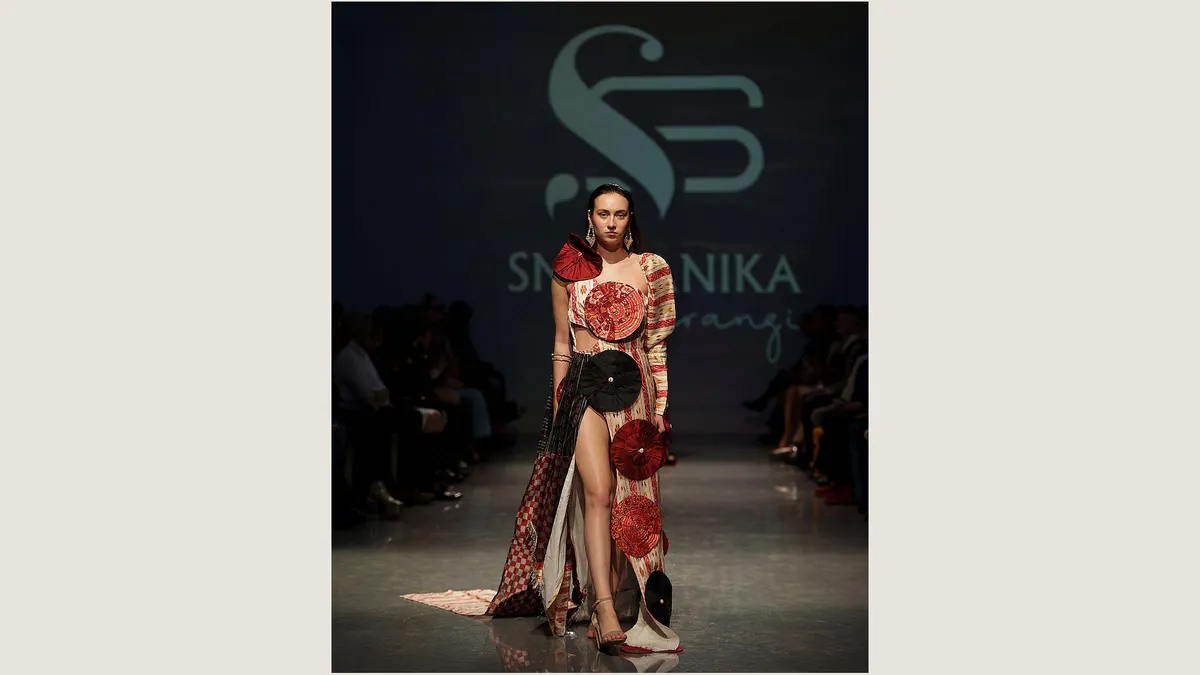
A red circle rises from one shoulder. More circles travel down the garment, interrupting its long, trailing line. The earlier runway photograph gives Drape Dead Elegance a recognizable presence before a reader reaches the name. It also offers a starting point for following designer Smaranika Sarangi’s September 2026 route from New York to London.
The itinerary linked an Asian NYFW presentation on September 12 with London listings for Histoire Blanche on September 15 and FMC on September 19. Read as a September record, the sequence shows how an independent designer can bring work into several different rooms within eight days. The listings describe the planned settings, rather than a review of everything shown in them.
A New York programme and an earlier visual record
The Asian NYFW programme listed Sarangi with Aiflorae at Lavan Midtown on September 12, 6:00 PM. Multiple independent labels shared the evening. For a reader following the designer, that programme supplies a specific point on the map: one collection entering a room where discovery was part of the appeal.
Sarangi already had a visual record to bring to that audience. An earlier Harper's Bazaar Vietnam feature introduced Drape Dead Elegance through a previous collection. The September appearance belonged to a developing practice, with earlier photographs available for anyone curious about the work behind the name.
A runway adds time to the photograph’s account of a garment. A trailing panel follows a step. A projecting shape changes as the body turns. A sequence of looks can connect details that appear separately in still images. Those are useful things to watch for when following a designer whose earlier work gives drape and ornament such visible roles.
For later images from these dates, compare the same documented garment where its identity can be established. Distance, lighting and running order can change how a projection or trailing panel reads. The itinerary identifies places to look for that evidence. It does not establish that the same collection appeared unchanged in every room, or turn a listed event into an eyewitness account.
Two London rooms on the September itinerary
The first London listing was Histoire Blanche London , produced by High Society MGMT , on Tuesday, September 15, with a scheduled window of 1:00 to 3:00 PM. High Society describes Histoire Blanche as an international runway series that brings selected designers into one programme.
The schedule supplied to Newsroom placed the presentation at Asia House, 63 New Cavendish Street. Asia House’s venue page confirms the address. The public ticket listing originally left the venue unannounced, so the event placement rests on that supplied schedule. Together, the records identify the intended setting without turning the venue page into evidence that a show took place.
A room changes how a garment meets its audience. Proximity can bring a surface or fastening into view. A longer runway gives movement more time to register. In following the London chapter, those differences offer something more interesting to look for than a repeat of the New York pictures.
FMC’s place in the wider fashion-week programme
The second London listing was the London Fashion Week FMC runway show on September 19 from 5:30 to 9:00 PM. It named Sarangi in the lineup at London Scottish House, 95 Horseferry Road. Historic England independently confirms the building and address . Its record supplies the architectural identity, while the organizer supplied the event details.
The date sat within the British Fashion Council’s September 17 through 21 London Fashion Week window. FMC was independently produced, a distinction worth keeping beside any reference to the BFC’s official schedule . The general history and terminology help explain the wider constellation of shows and presentations around a fashion week.
That wider programme can give a smaller label another point of contact with viewers. Here, the two London listings offered separate audiences and production settings within a few days. They belong in the itinerary on their own terms, with their organizers named, rather than borrowing the status of an official appointment.
The FMC hours covered the full programme, rather than Sarangi’s individual slot. All three September dates are now historical. Their listings remain useful records of the planned sequence, with the usual limits of a schedule rather than an eyewitness account.
Circles and trailing fabric give the eye a route
The featured image comes from ELLE Bulgaria's February 2026 Asian NYFW coverage . Cream, red and black connect the circular details to the long fabric below. The earlier look gives us something specific to examine while keeping it distinct from the September collection.
ELLE credits the production to Asian NYFW and names John Mumm, Samantha Grant, and Christian Rivera as lead photographers for the coverage, without assigning this individual frame to one photographer. The portrait-format original is shown complete within the landscape presentation.
Another earlier design appears in Kisau Photography’s International Spotlight: A Sarangi Design in Hong Kong , with model Chow at Kowloon Walled City Park. A location editorial gives a garment architecture and surroundings to work against. The runway photograph concentrates attention along a path toward the camera. The two settings offer different ways to read the designer’s work.
Follow the clothes between their settings
Newsroom’s earlier analysis places Asian NYFW within New York’s independent runway map. The London Fashion Week article on craft, repair, and circularity follows another conversation around the season. Sarangi’s itinerary connects those cities through one designer’s work, with a prior collection history available to explore.
In the featured frame, the circles hold their shape while the long panels gather and trail. That contrast gives the eye a route through the look, from shoulder to floor. It is a concrete detail to carry into the earlier collection records and any later presentation of Drape Dead Elegance.
This article relies on public programme records and publisher-supplied scheduling information.