A worn cuff can become a place to begin again. Mend it quietly and the shirt keeps its familiar outline. Add a contrasting patch and the repair changes the design. That small choice offers a way into London’s September fashion conversation: making and remaking both give cloth another possibility.
Selvedge’s September preview approached the coming shows through textiles, construction, repair and care. Published ahead of the September 17 to 21 programme, it offered a material-led way to read the season. A stitch, a fold or a recovered panel could carry as much interest as the complete silhouette.
The preview follows Paolo Carzana, Phoebe English, Bethany Williams, Anciela, Nicholas Daley, Petra Fagerström and Dahlia Razzook. Their practices take different routes through natural materials, London production, textile transformation, decomposition, bespoke cloth, pleating, printing and embroidery. The pleasure is in those differences. Each technique changes what a garment can look like, how it moves or what can happen to it later.
The calendar also included a September 11 evening at Conway Hall. Out of Fashion: Conversations, Craft, Clothing & Circularity was scheduled as two panels hosted by Safia Minney, with Selvedge founder and editor Polly Leonard among the speakers. From this article’s September 6 vantage point, that was a forthcoming discussion of making, mending, clothing care and circular wardrobes.
Watch what the cloth can do
A pleat is a compact piece of engineering. Folded cloth can hold volume close to the body, then open as someone moves. Embroidery adds more than a motif: its density changes the surface and can affect the weight of the fabric. Following the technique gives the eye something specific to enjoy, even before the whole look has passed.
Selvedge highlights Paolo Carzana's engagement with fabrics, threads, dyes, and buttons derived from the earth, and Phoebe English's use of surface, structure, and textile engineering within a London studio practice. Nicholas Daley brings bespoke textiles and music into menswear. Petra Fagerström works between digital and hand pleating, while Dahlia Razzook layers silk, digital printing, and hand embroidery into elaborate surfaces.
Carzana’s material choices and Fagerström’s pleating do different creative work. One account cannot stand in for all the others. Asking what a technique contributes to this garment makes the comparison more interesting: perhaps a shifting outline, a richly worked surface or a textile whose structure becomes its main expression.
The official London Fashion Week schedule placed catwalks, presentations and other formats across September 17 to 21. Each offered a different view of the making. Movement can reveal a pleat opening. A closer photograph can reveal the stitch. A presentation may give a viewer longer to follow how one surface meets another.
Give the worn cuff another possibility
A worn cuff, a damaged fastening or a torn pocket creates a design problem with an existing garment attached. What can be reached without taking the whole piece apart? Will a replacement change its fit? The repair can preserve a familiar line or introduce a visible new one, depending on the damage and what the wearer wants to keep.
Selvedge points to TOAST’s Renewed By collaboration with Bethany Williams, where textile handcraft transforms one-off garments. Another maker enters the object’s history. The result can offer a fresh reason to wear something that already exists, with the intervention becoming part of its appeal.
There is room for both a nearly invisible mend and a patch that announces itself. A contrast thread can draw attention to the place that needed care. A close color match can let a much-loved detail remain the center of the garment. Continued use can take more than one aesthetic form.
Care begins before damage too. Washing, storage and friction affect what survives, while construction affects how easily someone can intervene later. A seam that can be reached and a fastening that can be replaced give an owner practical ways to keep a favorite piece in use. Those are small design decisions with a long working life.
Follow the garment beyond collection day
The circular economy includes several routes for clothing: maintenance, repair, reuse, remaking, take-back and material recovery. A programme becomes easier to understand when it names the route it can actually support. A repair service and a fibre-recovery process meet the garment at different moments and need different resources.
Anciela's installation, as described by Selvedge, considers what happens to textile after disposal and follows material as it breaks down. That is a different proposition from remaking an existing garment, designing for repair, or operating a take-back scheme. Each addresses another point in the life of clothing, and each calls for its own evidence.
The appearance of a surface cannot supply its complete fibre history. Recovered cloth still leaves questions about the rest of a collection. Even a repairable garment needs someone with the information, skill and access to carry out the repair. Those details let readers connect an appealing design idea to what can happen in use.
You can admire the intervention and stay curious about its reach. Who can use the service? Which materials can return? What happens after collection? Answers give circularity a place and a scale, alongside the immediate pleasure of the clothes.
Three surfaces, three different invitations
The British Fashion Council placed the London programme from September 17 to 21. Our September fashion calendar sets those dates within the international season. Selvedge’s preview adds another way to follow the appointments: trace a material decision from the designer’s account into the finished garment.
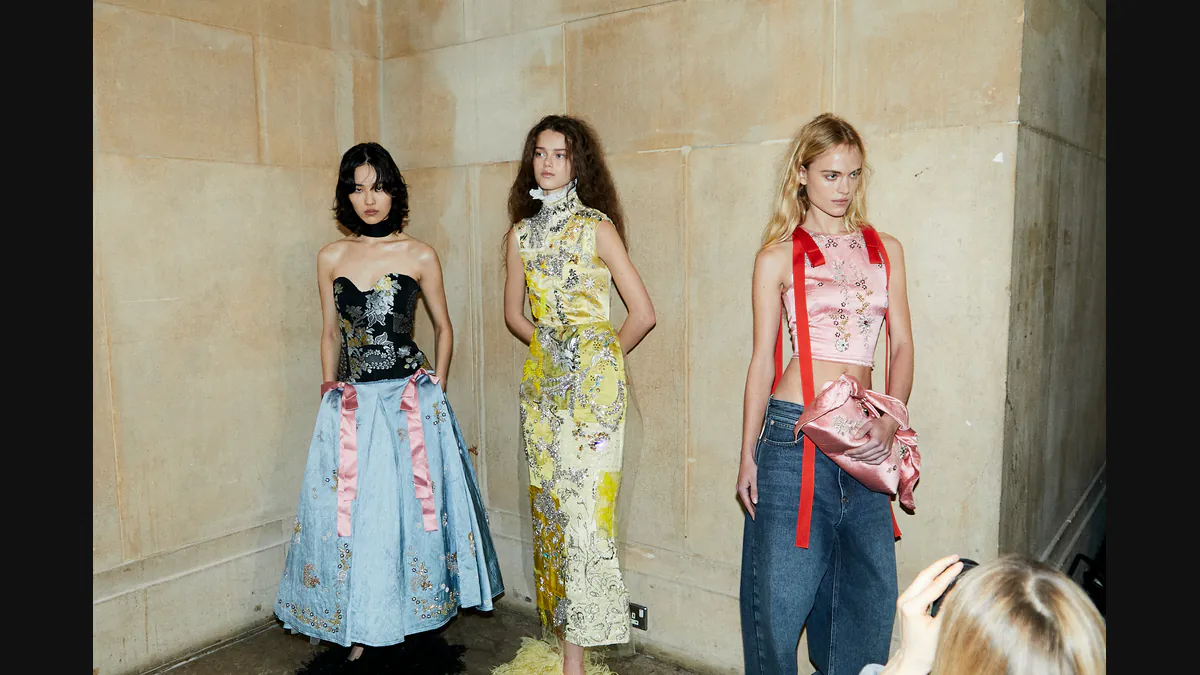
The official London Fashion Week photograph here is an earlier image, rather than a view of the September collections. A pale blue skirt carries pink ribbons beneath a dark floral bodice. Beside it, a yellow-green dress gives the decoration a different field. On the right, pink satin and long red ribbons sit against denim. Surface, color and placement create three distinct relationships.
Those contrasts invite a closer look without telling us who made each stitch or how each fabric was sourced. The designer’s account supplies another part of the story. Put the two together and an embellished surface becomes more than a general impression of handwork.
Back at the worn cuff, the choice is still open. A discreet repair can protect the line you already love. A visible one can give the sleeve a new point of interest. Both begin by paying attention to the garment that is there.