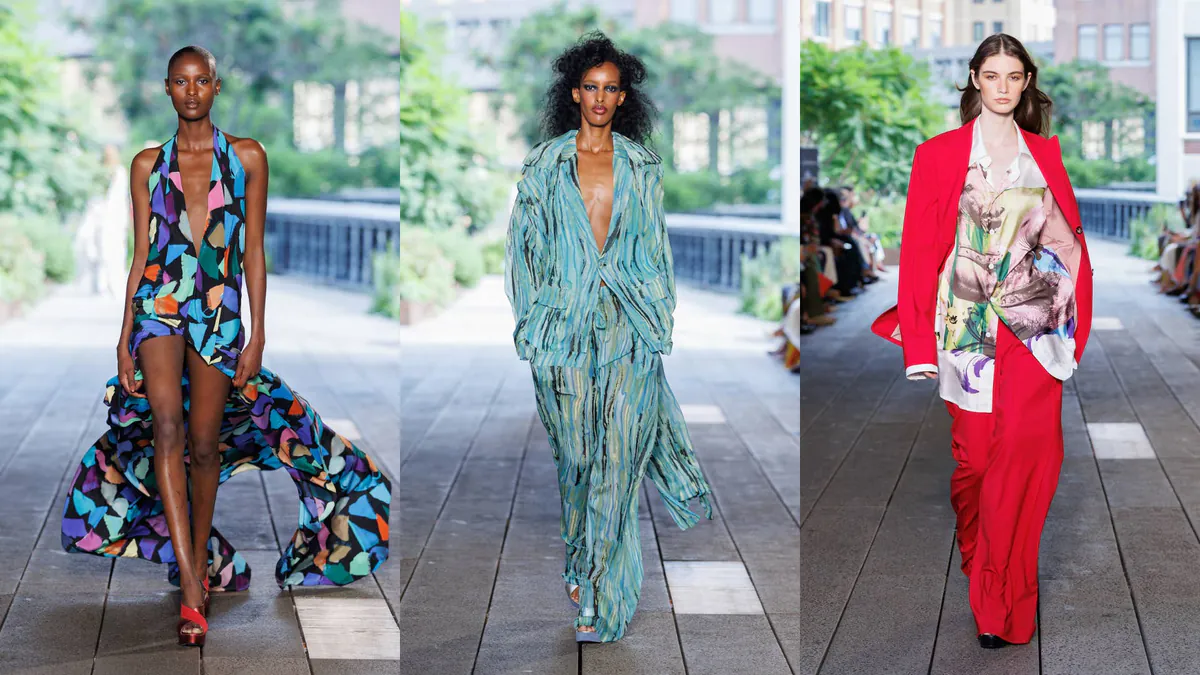
New York Fashion Week ended with a clearer Spring 2027 proposition than it began with: expressive clothes built from useful pieces, house histories treated as material rather than doctrine, and spectacle returning without erasing wearability. The week’s defining tension was pleasure disciplined by construction.
This completed-week assessment covers the official September 10 to 15 calendar, relevant September 9 shows, and clearly identified independent events. It separates observable runway patterns from retail demand, which cannot yet be measured.
Joy became a method, not just a mood
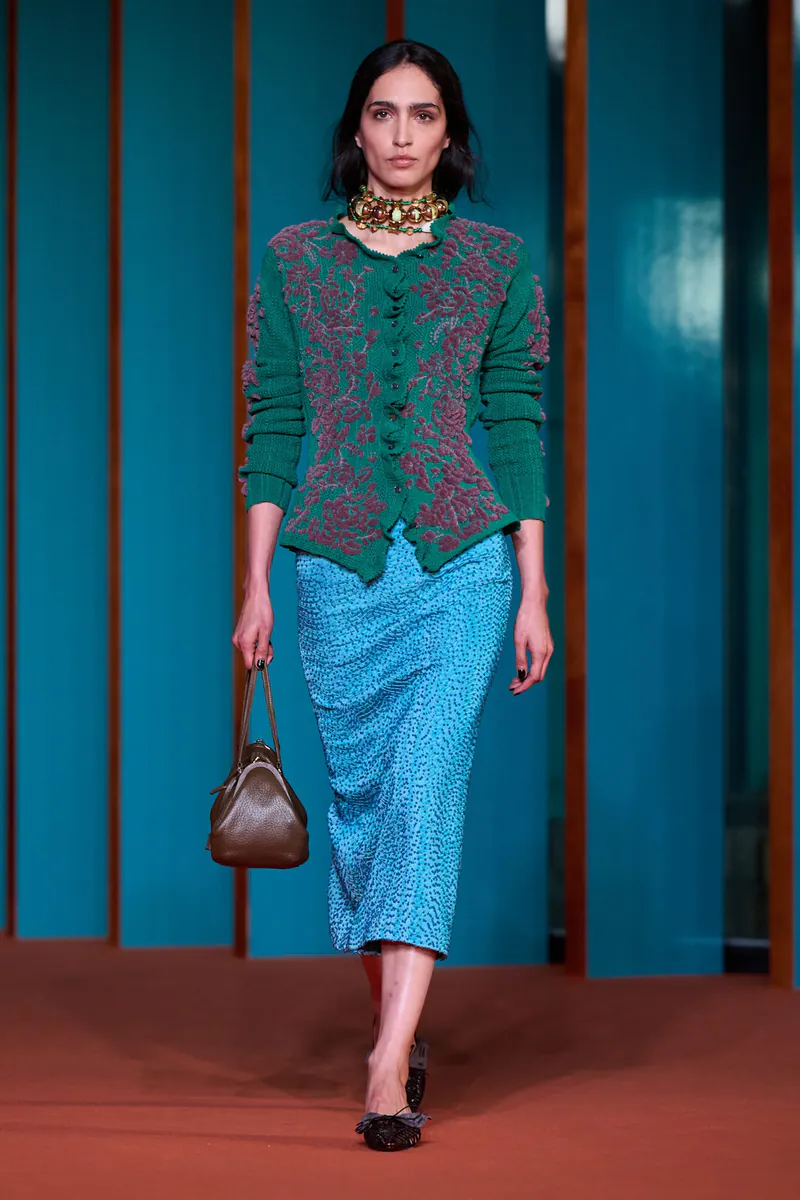
The strongest trend was not one color or hemline. It was a way of combining apparent opposites. Tory Burch placed embroidered knitwear and decorative surfaces beside pencil skirts, cardigans, and tailoring. Harper’s Bazaar read the collection as “opulent femininity” meeting American pragmatism.
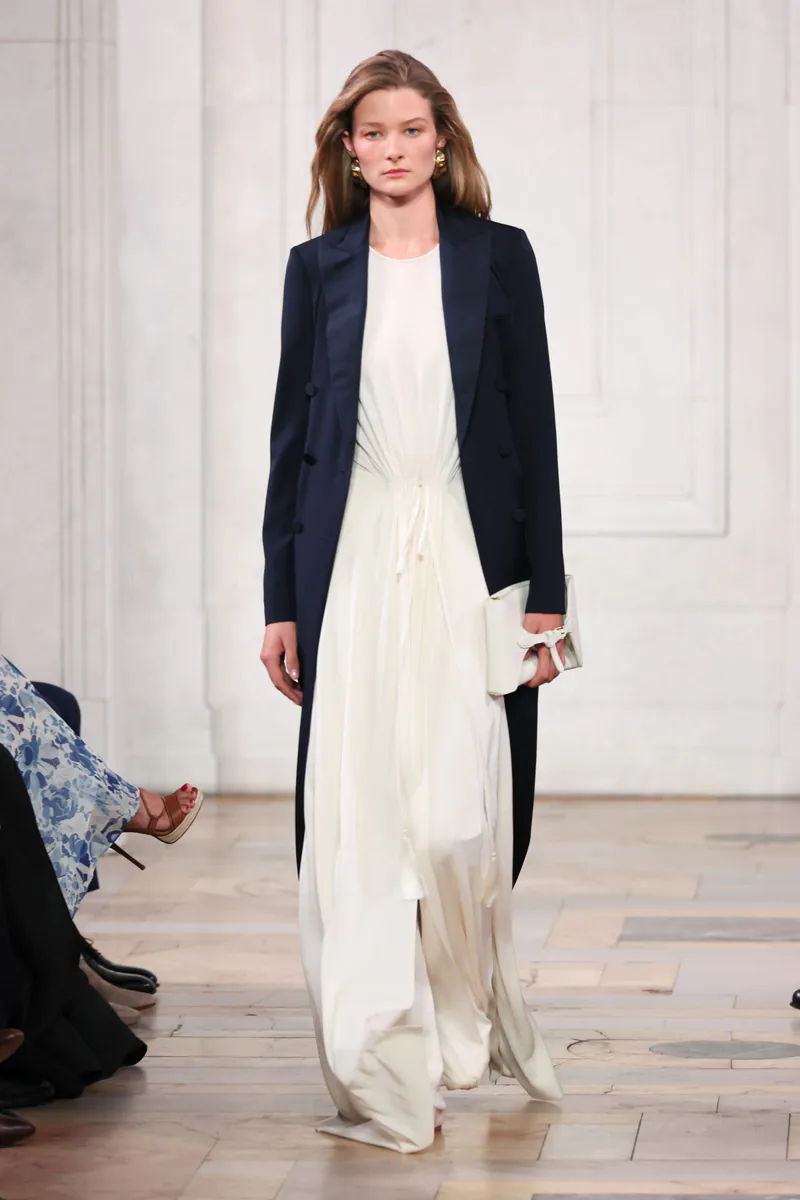
Ralph Lauren made a related argument through polished prep, distressed denim, Victorian romance, and controlled tailoring. ELLE’s review described a collection that moved between sharp suits and relaxed drape without losing the designer’s identity.
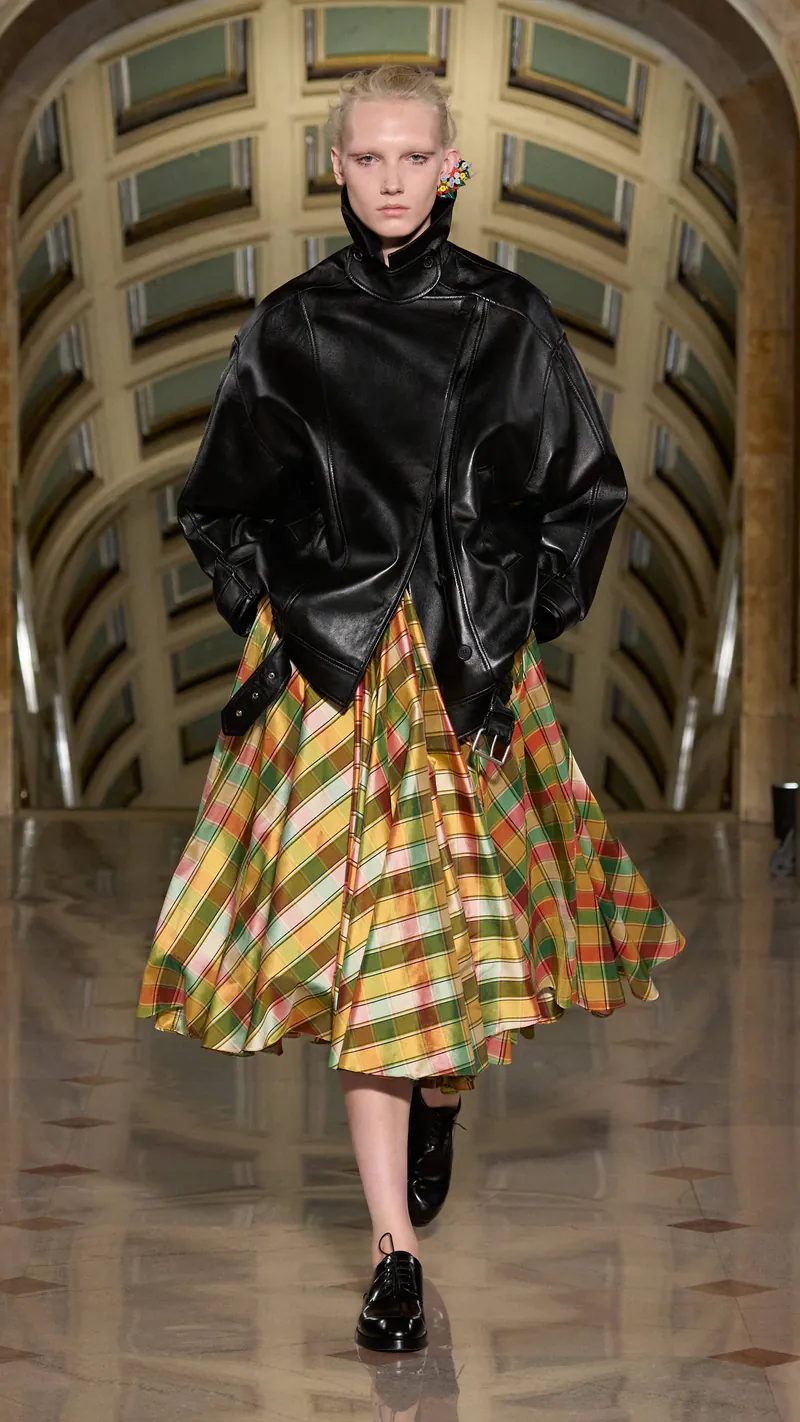
Altuzarra sharpened the contrast. Fashionista documented menswear shirts, exposed bras, silk skirts, motorcycle jackets, and generous circle skirts. Vogue’s runway report independently noted the emphasis on joy, color, and freedom. The checked circle skirt under a black biker jacket became a useful shorthand for the week: romance did not require fragility, and a practical layer did not have to flatten delight.
The final Associated Press recap found the same broader movement across Tory Burch , Ralph Lauren , and Eckhaus Latta : color, movement, contrast, and a renewed pleasure in getting dressed. That does not make exuberance universal. Khaite emphasized internal construction, corsetry, leather, and crinoline, while other collections preferred restraint. The shared signal was a willingness to make personality visible again.
House codes were edited instead of preserved under glass
The official calendar opened with one of the week’s largest authorship stories. Diane von Furstenberg returned to the New York runway after nearly a decade, with Henry Zankov presenting his first collection as artistic director. Fashionista and Marie Claire documented how wrap dresses, archival prints, vivid color, and fluid fabrics were recut through Zankov’s textile-minded eye.
The point was not nostalgia. It was the possibility that recognition and revision can coexist. Lauren’s self-editing worked similarly, while anniversary seasons at Michael Kors , Carolina Herrera , and Coach made longevity part of the week’s story. The Associated Press noted 45 years for Kors and Herrera and 85 for Coach. In each case, the more useful question was not whether an archive appeared, but whether familiar codes gained a present-tense purpose.
That distinction matters in a season crowded with returns and debuts. A successful house reset does not discard its visual language. It decides which parts still have energy, then changes the grammar around them.
The closing shows restored scale
The September 15 program changed the article’s midweek reading in one important way. It showed that New York’s practical turn did not mean the end of theatrical fashion.
Sabyasachi returned to the New York schedule with a 72-look collection titled “Bengal Byzantine Broadway.” Vogue’s collection record and post-show coverage documented a wide vocabulary of Indian craft, jewelry, eveningwear, tailoring, and American dress codes. The return expanded the week’s conversation about heritage beyond American house archives. Here, historical reference worked across Bengal, Byzantium, and Broadway, with New York as the meeting point.
Thom Browne then closed the official calendar at The Shed. Vogue’s review described a giant chrysalis, caterpillars, insects, and a garden setting built around metamorphosis. Beneath the production was Browne’s continuing argument for exact tailoring: bees, butterflies, and patterned wings landed on highly controlled jackets and shoulders.
The finale did not overturn the week’s romance-versus-utility pattern. It enlarged it. Browne paired narrative fantasy with rigorous construction, while Sabyasachi translated decorative abundance through repeatable house codes. The closing day confirmed that spectacle was back as a serious design tool, provided the clothes could carry its weight.
Fur policy became a governance story
The most consequential material change was established before the shows began. The Council of Fashion Designers of America barred animal fur from its official New York Fashion Week schedule starting this season. The CFDA announcement includes an exception for items associated with Indigenous traditional and subsistence practices.
The week then exposed the limits of treating one material rule as the end of the debate. At the COS show, PETA protesters challenged the use of wool. Video showed CFDA chief executive Steven Kolb physically restraining protesters. Associated Press reporting says Kolb apologized and took leave pending an investigation, while PETA planned a meeting with him.
The incident became one of the week’s biggest stories because it moved the discussion from runway materials to institutional conduct. The fur prohibition remains a meaningful baseline for the official calendar, but it does not resolve questions about wool, leather, synthetic alternatives, supply chains, or how fashion organizations respond to protest.
New York’s wider platform network still needs precise labels
The official CFDA schedule remains the institutional center, but the city’s fashion activity is larger than one calendar. That wider network can give emerging designers access to audiences and production opportunities that the central schedule does not.
Designer Smaranika Sarangi presented Drape Dead Elegance with Aiflorae at Asian NYFW on September 12, according to the organizer’s listing . Asian NYFW states that it is independent and not affiliated with the official New York Fashion Week calendar. Sarangi’s appearance belongs in the week’s platform story, with that distinction kept visible.
Newsroom’s separate Sarangi update follows the designer from New York to her London dates, and the official Drape Dead Elegance profile carries her current posts. The latest public posts were reviewed again through September 17. They establish current activity but do not provide explicit editorial reuse terms or a separately documented photographer license. No latest-collection image is reproduced here because a public social post is not, by itself, a rights clearance.
That decision is especially important for independent designers, whose work is often circulated without the licensing infrastructure attached to large runway agencies. Linking the official profile lets readers follow the collection without misrepresenting permission.
Bach Mai’s show exposed a different visibility gap
Bach Mai appeared on the September 14 schedule and the label’s official social account published current show activity. The CFDA member profile gives the institutional context for Mai’s work, while the Bach Mai official site remains the best destination for the house itself.
Unlike the widely reviewed closing shows, a detailed independent Spring 2027 collection review and a current photograph with explicit reusable editorial rights were not located by the September 17 cutoff. The absence should not be filled with an older collection or an unattributed screen capture. Bach Mai remains part of the completed calendar, but the responsible treatment is a verified mention and official links rather than false visual certainty.
The contrast is instructive. Fashion-week visibility depends not only on showing, but on the speed and clarity with which accurate credits, collection notes, and licensable images reach editors. Smaller houses can deliver a strong presentation and still leave a thinner public record than global brands.
What the finished week established
NYFW Spring 2027 did not settle on one uniform. It established a working method. Designers repeatedly paired romance with utility, ornament with familiar clothes, and historical reference with contemporary authorship. The week’s strongest images came from friction rather than purity.
The closing shows added scale to that conclusion. Sabyasachi turned cultural and house memory into a global return. Thom Browne made metamorphosis literal while keeping tailoring exact. DVF showed how a new author can handle famous codes without embalming them.
The institutional story was less celebratory. A fur-free official calendar marked real policy change, while the COS protest and its aftermath showed that material ethics and organizational behavior remain unsettled. Beyond the central calendar, Sarangi’s Asian NYFW appearance and Bach Mai’s thinner post-show record underlined how unevenly visibility and image access are distributed.
What cannot yet be claimed is equally important. Runway recurrence is not proof of consumer demand. Independent events do not share one standard, audience, or commercial reach. Spring 2027’s clearest New York signal is therefore not a prediction about what everyone will buy. It is a design proposition: pleasure feels most convincing when construction, context, and accountability are visible with it.
For readers who want the history behind the modern calendar, Eila Mell’s New York Fashion Week: The Designers, the Models, the Fashions of the Bryant Park Era (paid link) is a photographic and interview-led account of the years when the tents gave the event a shared center. The publisher’s edition page identifies the 304-page Running Press edition by ISBN 978-0-7624-4355-0.
Season reference: These Spring 2027 collections were shown during New York Fashion Week in September 2026. The official CFDA schedule ran September 10 through 15, with relevant pre-calendar and independent events identified separately.