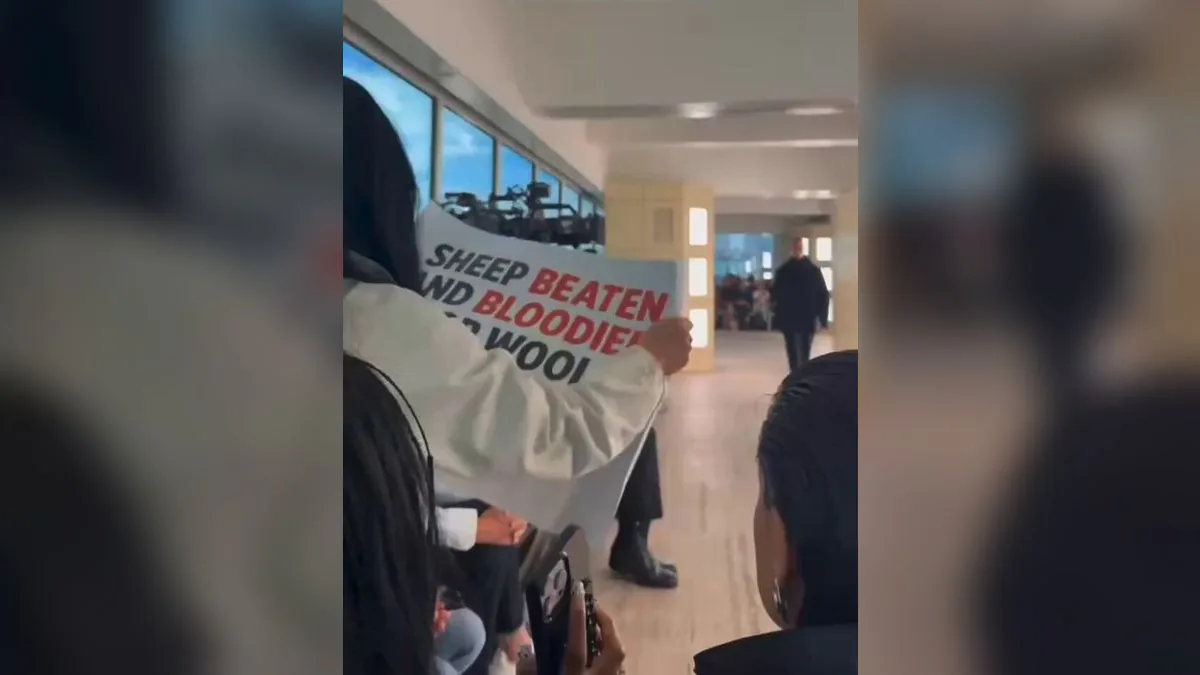
PETA's protest at the COS show during New York Fashion Week was, in my view, the wrong way to challenge the use of wool in fashion.
Caring about animal welfare does not require approving every action taken in its name. There are ways to question a company's sourcing practices and demand accountability without taking over a presentation that other people have worked and paid to produce.
On September 13, 2026, supporters of People for the Ethical Treatment of Animals interrupted the COS presentation at New York Fashion Week . Steven Kolb, then president and chief executive of the Council of Fashion Designers of America , physically intervened. Kolb later apologized, took leave, and resigned on September 18. The Associated Press reported his resignation , while Reuters also documented the departure and its connection to the confrontation .
His conduct deserves scrutiny. Examining his response should not mean overlooking the decision to disrupt the show. I believe we can defend an event's boundaries while also questioning whether the force used against the people involved was justified.
This is an opinion about protest tactics, event boundaries, and the distinctions I believe matter. It is not a determination of anyone's civil or criminal liability.
Why disrupting a NYFW runway show is the wrong tactic
When I think about a runway, I think about designers, models, stylists, makeup artists, photographers, and production teams working toward a shared result. I do not see an empty stage waiting to be claimed by whoever has the strongest objection.
The financial investment deserves recognition too. Vogue documented New York Fashion Week production budgets ranging from $125,000 to more than $300,000 in 2019, excluding runway samples. Those are historical examples, not a verified budget for this particular COS show.
Spending that money does not buy immunity from criticism. It should, however, count for something when we consider the decision to interrupt a presentation. My objection is not that a brand's investment is more important than animal welfare. It is that concern for animals does not automatically justify commandeering another person's work.
I would apply that principle to a major brand and an independent designer alike. A company should answer serious questions about its materials and suppliers. The size of the business should not determine whether we respect the boundaries of its event.
Nor do I accept that opposing a disruption means protecting fashion from uncomfortable conversations. I want those conversations to happen. I simply do not believe that taking over a runway is the right way to conduct them.
Can protesters disrupt a private fashion show?
The right to protest does not ordinarily include a constitutional right to use someone else's private venue without permission. The First Amendment generally constrains government, not private hosts. In Manhattan Community Access Corp. v. Halleck , the Supreme Court explained that providing a forum for expression does not, by itself, turn a private organization into a government actor subject to First Amendment restrictions.
New York's highest court addressed a related distinction in SHAD Alliance v. Smith Haven Mall . It held that the state constitution's free-speech provision did not require a private shopping mall to permit leafleting where the necessary governmental involvement was absent. These decisions concern constitutional access rights. They do not create a blanket exemption from other laws governing private conduct.
That does not make every disruptive attendee a trespasser merely because they express an objection. Under New York law, trespass involves knowingly entering or remaining unlawfully. Penal Law Section 140.00 addresses permission to be present, restricted areas, and, for premises open to the public, a lawful order to leave personally communicated by the owner or another authorized person. Section 140.05 defines trespass in the basic form.
Admission, access restrictions, and instructions to leave therefore belong in any legal assessment. I would not substitute the word "protester" for an examination of those facts.
My editorial position is straightforward. Being entitled to criticize a company should not be confused with being entitled to interrupt its presentation. PETA should make its case forcefully, but I would draw the boundary at taking control of the show.
Could security or Steven Kolb lawfully restrain protesters?
Potentially, but neither a security uniform nor an executive title settles the question.
New York Penal Law Section 35.20(2) permits a person controlling premises, or someone lawfully entitled to be there, to use nondeadly force when reasonably believed necessary to stop what they reasonably believe is criminal trespass. The degree of force must also be reasonably believed necessary for that purpose. The provision is not a general authorization to use force against anyone who causes a disruption.
Would I object to security using lawful, necessary, and proportionate restraint to remove someone disrupting a show? No. I would expect organizers to protect their event. But I would not approve every physical action simply because a security guard carried it out.
I would apply the same standard to Kolb. I do not believe intervention becomes inherently wrong because an executive acts rather than a security professional. Equally, his position does not justify whatever response he chooses.
The relevant distinction is between justified intervention and conduct that exceeds its justification.
What happened before the physical restraint?
Fashionista's report from the venue said security peacefully escorted most demonstrators out. Its team also recorded Kolb taking signs, covering people's mouths, and using his legs to restrain a woman. Kolb later acknowledged that he should have left the situation to security.
Those details deserve scrutiny, but so does the sequence of events. Why were other protesters peacefully escorted out while these two encounters became physical? Were the people Kolb restrained asked to leave, and did they refuse? Or did he intervene before they had an opportunity to comply?
I would want those questions answered before reaching a conclusion about the necessity of restraint. Asking them should not become a way of insinuating that a refusal occurred.
The individuals' accounts also belong in that examination. The Associated Press reported that Andrija Barak was among those assigned to disrupt the runway, while Mason Melito was among those filming. The Guardian reported Melito's account that Kolb grabbed Barak as soon as she stood up.
I would examine those accounts alongside the available footage and other witness evidence. I would not assume both people were doing the same thing, and I would not dismiss their accounts because they complicate a defense of Kolb.
Why the method of restraint matters
Even a refusal to leave would not resolve whether every subsequent action was necessary. Moving someone away from a runway, holding them in place, and covering their mouth are different actions. I would examine each rather than group them together under the word "removal."
Covering a mouth raises a particular legal issue. New York Penal Law Section 121.11 addresses blocking another person's nose or mouth with the intent to impede normal breathing or blood circulation. That intent is an element of the offense. A report that someone's mouth was covered does not, by itself, establish every element or resolve any applicable defense.
Self-defense is a separate justification. Section 35.15 generally requires a reasonable belief that force is necessary against the use or imminent use of unlawful physical force, subject to limitations that include rules concerning the initial aggressor. A disruption alone does not establish those conditions.
Civil liability deserves consideration too. Unjustified intentional offensive contact can support a battery claim. Intentional confinement may support a false-imprisonment claim where the person is aware of the confinement, does not consent, and the confinement lacks legal privilege. In Wieder v. Home Depot U.S.A., Inc. , a New York appellate court upheld findings of battery and false imprisonment involving a store security guard while addressing the damages separately.
My argument is therefore not that security personnel may do anything while an executive may do nothing. It is that everyone's actions require a justification appropriate to the circumstances. Criticizing PETA's tactic does not require deciding anyone's civil or criminal liability.
Better ways to protest wool use in fashion
Rejecting the runway disruption does not require dismissing concerns about animal welfare. PETA linked its campaign to alleged mistreatment at a NATIVA -certified wool operation associated with the supply chain of H&M Group , COS's parent company. PETA called on COS and H&M to stop selling wool. Those are the organization's allegations and demands, not findings established by the confrontation at the show.
PETA's underlying campaign page publishes the investigation footage and its account of conditions at the farm. NATIVA describes its certification as providing traceability and standards for animal welfare, land management, and ethical work. Ecocert's certification summary describes chain-of-custody requirements and farm practices. The existence of a standard and the allegation of failures under it are both material to the story.
H&M Group told ABC News that it took certification breaches seriously and defended its certified-sourcing practices. It said investigations by the certification body had resulted in suspended licenses for one wool farm and one mohair farm, which could no longer sell certified materials.
That is where I would like to see the discussion concentrated. What does the evidence establish? Which suppliers were involved? How were problems identified? What changed afterward? What do the certifications require, and how effectively are those requirements enforced?
Those questions give a company something specific to answer. They also give journalists, customers, and people working in fashion something concrete to examine.
PETA's announcement described approaches beyond the runway, including investigation footage, consumer pressure, and a Times Square billboard near H&M's location. Those are approaches I would rather see it develop. Brief reporters on the evidence. Publish questions for the company and its responses. Invite designers to examine alternative materials and discuss the practical requirements of using them.
A demonstration outside the venue is another option, but "outside" does not mean anywhere without restrictions. The New York Civil Liberties Union's protest guidance explains that peaceful protest on public streets, sidewalks, and parks is protected, subject to rules that include keeping pedestrian traffic and building entrances unobstructed. Private property generally requires the owner's consent.
I am not asking PETA to make its criticism comfortable. Nor am I suggesting that it accept a company's assurances without examination. I am asking it to distinguish between applying pressure and commandeering a presentation.
For me, a persuasive campaign would make the evidence difficult to dismiss, the demands clear, and the proposed changes open to serious evaluation. It would give people a reason to engage beyond their reaction to a confrontation.
Why PETA's NYFW protest backfired for me
The protest received attention. The Associated Press later reported Kolb's resignation and PETA's decision to pursue a meeting after initially planning to file a police report.
But visibility does not answer the question that interests me. Did the tactic strengthen the case PETA wanted people to consider?
For me, it backfired. I came away more critical of the decision to interrupt the show, not more persuaded that taking over a runway was justified. That is my reaction, not a claim about every viewer or a measurement of the campaign's overall effectiveness.
I remain willing to examine evidence about wool production. I do not need to approve a protest tactic before taking that evidence seriously. Equally, I do not need to excuse every aspect of Kolb's response before recognizing the legitimacy of protecting an event from disruption.
What I reject is the idea that a worthwhile cause automatically makes the chosen method worthwhile. The method carries its own responsibilities, including consideration for people who have not agreed to have their work interrupted.
My position is that PETA was wrong to disrupt this show. Protest outside in a lawful location, present the evidence, challenge the sourcing claims, and press for specific changes. Make the argument difficult to ignore without taking away someone else's opportunity to present their work.
Animal welfare deserves a serious conversation. I would rather see that conversation strengthened by evidence than displaced by a confrontation.
FAQ: PETA's NYFW protest and fashion-show security
Why did PETA protest the COS show at NYFW?
PETA protested COS's use of wool and alleged mistreatment of sheep in a wool operation connected to its parent company's supply chain. The organization demanded that COS and H&M Group stop selling wool.
What happened to Steven Kolb after the PETA protest?
Kolb apologized, took leave, and resigned as CFDA president and chief executive on September 18, 2026, following the confrontation. His resignation does not itself determine the legal merits of his actions.
Does free speech give protesters the right to disrupt a private event?
Not automatically. The First Amendment generally applies to government conduct, not private hosts. Whether someone may remain at an event also depends on permission, access conditions, and applicable law. A private event does not become a constitutional public forum simply because it provides a platform for expression.
Can security or an attendee physically remove a protester in New York?
Under specified conditions, New York law permits certain people lawfully on premises to use nondeadly force reasonably believed necessary to stop criminal trespass. That does not authorize force merely because someone is protesting, and it does not excuse excessive restraint.
Did the people Kolb restrained refuse to leave?
The reporting cited here does not establish that either person refused a request to leave before Kolb intervened. Fashionista reported that security peacefully escorted most other demonstrators out. Those facts should not be turned into an assumption that the people Kolb restrained resisted removal.
Can a New York Fashion Week show cost more than $100,000?
Yes. Vogue's 2019 reporting documented examples costing $125,000 to more than $300,000 before runway samples. Those historical figures do not establish the budget for COS's September 2026 presentation.
What alternatives to runway disruption does this article support?
I favor lawful demonstrations outside the venue, documented investigations, media briefings, consumer campaigns, and direct engagement with brands. My preference is for advocacy that challenges wool sourcing through evidence and specific demands without interrupting another team's presentation.