This feature revisits Anthropic’s November 6, 2026 research article at the publisher’s request. It examines the reported experiments as earlier research, rather than a new announcement.
Claude had written down the wrong location for a landmark in Pokémon. The next time it needed directions, that saved note helped send it the wrong way again. Remembering had made the mistake available for reuse.
In Anthropic’s account of agent memory , a later offline pass compared the note with the original session transcript, found the error, and corrected it. Claude could then navigate using the revised record. It is a useful place to begin thinking about AI memory: what happens when the thing worth remembering turns out to be wrong?
A saved lesson needs something to check it against
An intelligent agent acts toward a goal. Carrying information from one session to another can give it a useful starting point. Anthropic’s research concerns external records Claude can read later, rather than changes to the model’s underlying weights.
A transcript and a lesson do different jobs. “The last attempt failed” records an outcome. “This route is impossible” turns an outcome into a rule. The second may be useful, but keeping the first gives a later session a way to reconsider it.
The Pokémon example makes that distinction visible. A mistaken landmark became part of the agent’s working understanding of the game. Going back to the transcript gave it something more specific than another guess about where it had gone wrong.
The same separation appears in our HomeBody robot-memory article. Remembering where an object was leaves other components to handle movement and execution. A memory can inform an action without proving that the action will succeed.
What changes while an AI is “sleeping”?
The sleep metaphor covers several different mechanisms. Looking at where the information ends up makes them easier to tell apart.
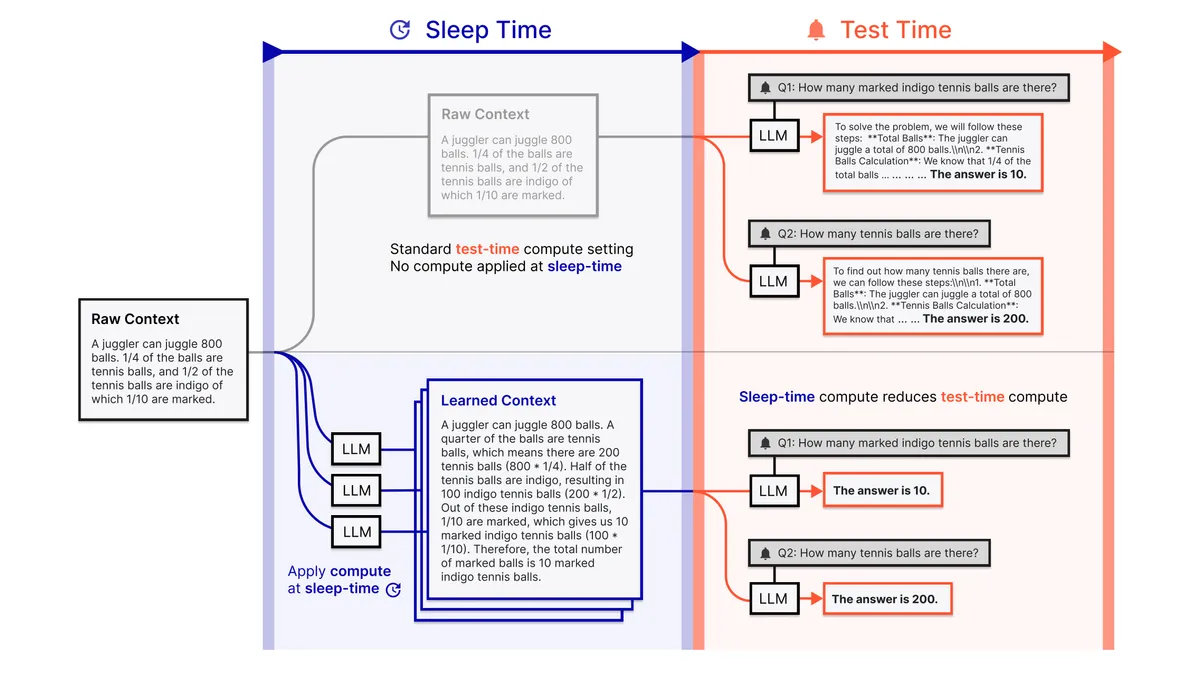
The Letta and UC Berkeley sleep-time compute paper explores processing known context before the next question arrives. Its opening illustration uses a word problem about a juggler’s tennis balls. Work done on that information can be reused across later questions. The result is prepared context that sits between the original material and an answer.
Anthropic’s example also works with information outside the model’s weights, but its offline pass checks and revises memory notes. It gives a saved interpretation another encounter with the record it came from.
Google Research’s October 27 sleep framework describes consolidation into numerical parameters, including updates to designated memory components. That puts information in a different place from a saved file. Two systems can share the language of sleep while changing different parts of the machinery.
These are research approaches in particular experimental settings. The Letta paper is an arXiv preprint. The comparison helps explain the mechanisms, rather than establish how reliably every personal assistant will remember.
Give a useful note a way back to its source
Consider an illustrative photography-planning note: “The studio has daylight all afternoon.” It sounds helpful until the next booking involves another room or another season.
Keeping the original message, room, and observation date beside the note would give a future session something concrete to check. A useful saved instruction should make its source, scope, and reason for revision understandable. A long transcript can lose that context too if nobody knows why it was kept.
Memory also leaves a separate question about permission. Our 72-eggs agent story follows what can happen when an assistant prepares an order. Remembering a preference helps shape a cart. Showing the actual items and quantities lets a person decide whether to buy it.
For a developer-oriented introduction, Anjanava Biswas and Wrick Talukdar’s Building Agentic AI Systems includes agent memory architecture and context management in its publisher’s chapter list . This is the 2025 first edition, ISBN 9781803238753, which predates the November research.
The small design choice worth carrying forward is the connection between a note and the evidence behind it. A saved lesson becomes more useful when the next session can understand why it was written and what would justify changing it.
FAQ
Does AI agent memory change the model’s weights?
External memory notes can carry information between sessions without changing the model’s numerical weights. The Google sleep framework discussed here uses parameter updates. The answer depends on where the system stores and consolidates information.
What can help an agent correct a saved mistake?
In Anthropic’s Pokémon example, an offline pass compared the memory note with the original session transcript and revised the wrong landmark. The example supports keeping a checkable source behind a saved interpretation, rather than treating every note as an established fact.
Does AI “dreaming” mean the system is conscious?
The term describes offline computation in these accounts. The cited research examines ways to organize or learn from information and does not establish consciousness.