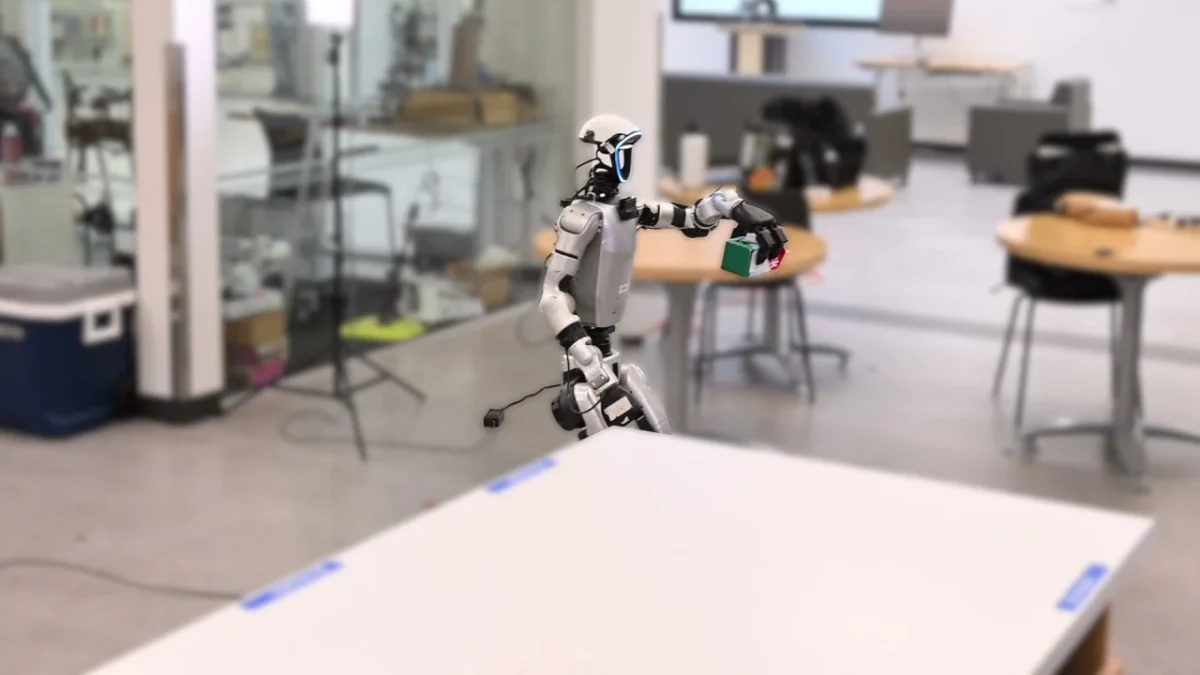
The HomeBody research team has shown a humanoid robot moving through an unfamiliar kitchen, remembering places it has seen, and calling reusable motor skills to complete multi-step requests. The project is a useful technical case for a narrower question than whether humanoids are ready for homes: how much of a task can a vision-language model coordinate when perception, memory, and physical control are deliberately separated?
A high-level model chooses among skills
HomeBody's public project page describes a three-part pattern often used in robotics: a visual-language model reasons about a goal, a learned action model translates that plan into commands, and a controller coordinates the body. The researchers instead connect the high-level model to a library of skills. The model can request actions such as navigating to a place, picking up an object, opening a drawer, and placing an item. Lower-level code handles the physical execution of each skill.
That division is the project's central design choice. It does not mean a language model drives every joint directly. The project describes grasp planning, camera calibration, motion planning, and whole-body control beneath the skill interface. An instruction such as "get my medicine" becomes a sequence of calls with specific targets and hands. If an action fails or the robot's view changes, feedback can inform the next choice. The reasoning model is an orchestrator, while specialized systems remain responsible for movement.
The distinction matters because a fluent plan is cheap to produce compared with a reliable grasp. A model can decide that a carton belongs in a bin, but the robot still needs to locate it, reach it safely, and verify that the action worked. HomeBody's architecture makes those separate failure points visible rather than folding them into a single claim of autonomous intelligence.
Memory extends the robot's view
The team's project description begins with exploration. The robot gathers observations from cameras, LiDAR, positions, and selected waypoints, then builds a spatial representation of a kitchen it has not been trained for specifically. The page describes a digital twin used to support later decisions and retained keyframes that help the model find objects no longer in its immediate view.
In one demonstration, the robot is asked to tidy several coffee bags and discard specified cartons. In another, it retrieves medicine that is initially out of sight, opens a drawer with one hand, hands the item to a person, and uses the other hand for a separate disposal task. These are the researchers' demonstrations, not independent trials by Newsroom. Their value is that they show the system coordinating repeated navigation and manipulation within one environment rather than completing a single isolated grasp.
Memory is not simply a transcript of the instruction. It is a way to connect what the robot saw during exploration with what it can currently see. If the medicine disappears behind a drawer front or leaves the camera frame, the system needs a location hypothesis to decide where to move next. The project page's visual comparisons of reconstructed and real viewpoints help readers inspect the spatial-model claim. They do not, on their own, provide a measured success rate across unfamiliar homes.
What the public release does not establish
The public page is dated September 2026, and the team's code repository was newly created on September 26. At this stage, the page says the paper is coming soon and the repository says code is coming soon. The visible material includes videos, diagrams, and implementation descriptions, but does not yet provide a reproducible package or a peer-reviewed evaluation. The described tasks are promising demonstrations of a particular system in a kitchen, not evidence that the same setup will generalize to every home, object, or person.
The project uses a Unitree G1 humanoid as its physical platform. Hardware capacity matters here because two-handed manipulation, sensors, and locomotion set the range of tasks the high-level model can request. Yet the release does not isolate how much of the observed performance comes from the model, the skill library, the robot hardware, the prepared environment, or human engineering choices. A controlled comparison would be needed to answer that.
The familiar idea of an embodied agent helps frame the work: intelligence is tested through perception and action in a physical setting. The next evidence to watch is not another polished clip. It is the promised paper's task definitions, failure accounting, comparisons with alternative architectures, and enough code or system detail for others to repeat the results.
Our earlier analysis of Nvidia's physical-AI platform described simulation and development tools as one layer of a broader robotics market. HomeBody shows what that layer looks like inside a research prototype. It combines a simulated spatial model with a real robot and a high-level planner. The useful lesson is architectural: separating memory, decision-making, and motor skills can make long tasks easier to organize and easier to inspect. The public evidence is still too limited to judge reliability beyond the demonstrations the team chose to publish.