A portrait on a phone usually arrives at the size of the screen. A museum photograph arrives with its own scale, surface, mount, and history. The National Portrait Gallery ’s Photographic Memory: Fifty Years of Collecting creates an opportunity to attend to those differences across a collection that began admitting photographs in 1976.
PetaPixel’s October 3 report brings the forthcoming exhibition into current photography coverage. The museum’s own announcement establishes its dates and scope: more than 120 photographic portraits, arranged chronologically, on view from November 14, 2026, through November 7, 2027.
Curated by Ann Shumard , the exhibition will occupy the museum’s second floor in Washington, D.C. Its span from the Daguerreian era to contemporary work makes the photograph’s changing physical form a particularly useful thread to follow.
Begin with the object’s scale
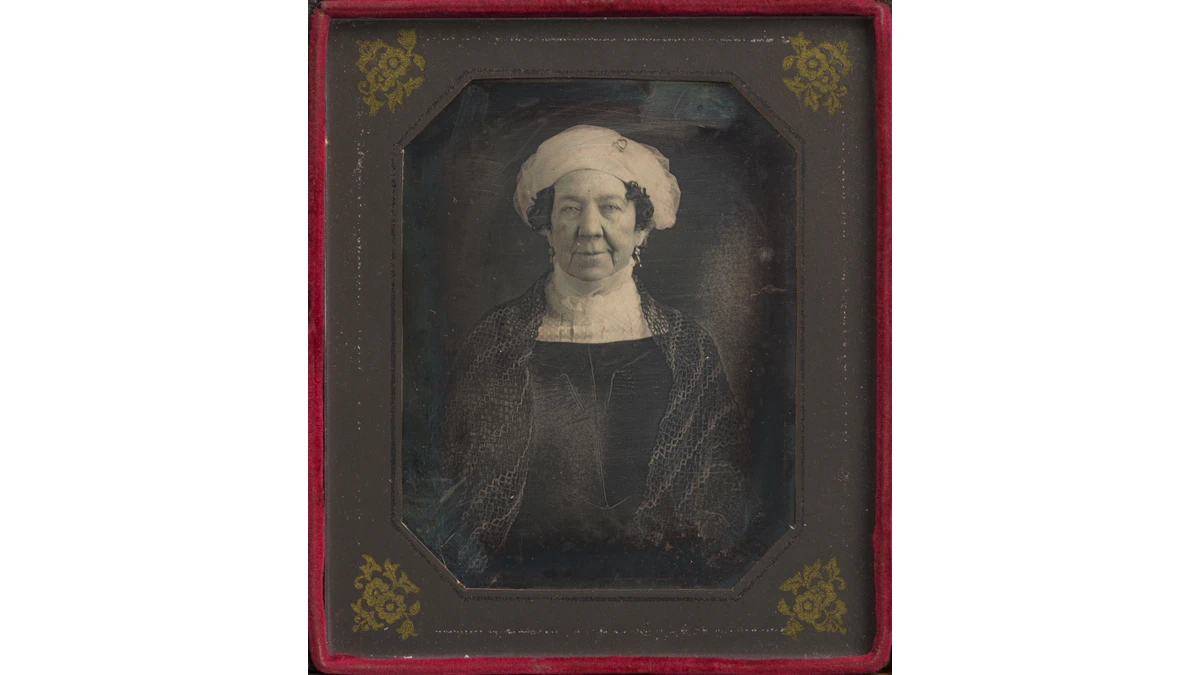
The museum will pair an 1846 quarter-plate daguerreotype of Dolley Madison by John Plumbe Jr. with an 1843 half-plate portrait of John Quincy Adams . The Madison photograph is the featured image here. Its Smithsonian collection record identifies its maker, date, medium, and CC0 status.
The record currently marks the object as not on view. The exhibition announcement describes its future presentation. That distinction matters for anyone planning a visit before the opening date.
A daguerreotype is a photographic image on a silvered surface. Viewing conditions affect its appearance. Its reflective character makes the encounter different from looking at a uniformly lit reproduction, while a protective case establishes a boundary around the image.
The formal balance of Madison’s headwear, shawl, and seated figure can be studied in a reproduction. The experience of a small cased portrait asks an additional question: how close must someone stand to read that face? Scale helps determine whether a likeness feels intimate, public, monumental, or held for private attention.
A large digital display can make the features easier to inspect while obscuring that original intimacy. Neither encounter cancels the other. They reveal different properties of the same work. Noticing the distinction is the first step toward looking at the exhibition as a collection of objects as well as images.
Separate sitter, maker, and presentation
Portrait captions often lead with the person depicted. That identity is essential, but it is only one part of the photograph. A useful reading can move through three questions: who is represented, what choices shaped the likeness, and how is the resulting image presented?
The first question concerns the sitter. Clothing, posture, expression, and the social role named in a label guide the encounter. The second concerns photographic authorship. Framing and the arrangement of light influence which features become prominent and how the sitter relates to the surrounding space.
The third question concerns the object that reached the viewer. A case, print, mount, crop, or reproduction can organize attention independently of the sitter’s expression. The photographer’s original frame and a later publication layout may ask the viewer to notice different things.
These questions are especially useful in a chronological exhibition. Instead of treating each decade as a simple technical improvement over the last, a viewer can examine which relationships changed. A new process might change exposure, reproducibility, surface, or circulation. Those changes need not all point toward the same artistic result.
Read the chronology through recurring choices
The museum says an introductory timeline will explain photographic processes and innovations. That provides technical orientation. The portraits themselves can then reveal continuity across those changes.
A pose can establish authority through stillness. A turn of the head can make the face seem momentarily available rather than formally presented. The amount of space around a figure can produce reserve, openness, or emphasis. These are choices a contemporary photographer still makes, even when the equipment and publication channel differ greatly from an early studio.
Comparing such decisions gives the chronology a practical purpose. The viewer can look for a recurring problem and observe how different makers solve it. Where does the frame end? How much of the sitter’s surroundings remains visible? Which part of the face receives the clearest light? How does a hand contribute to the pose?
The strongest comparison identifies an actual visual difference before attaching a historical explanation. Two portraits might share a frontal pose while using contrasting scale or light. Describing that contrast precisely creates a firmer basis for interpretation than assuming that every photograph simply expresses the character of its period.
Collecting also shapes the history on display
The anniversary refers to the museum’s photography collection, which began in 1976. It is not the age of photography itself. The institution’s decision to collect photographs expanded the kinds of likenesses available for telling American history.
A collection can preserve an image’s material record and make it available for future comparison. It also establishes which works enter an institutional account. The selection on a museum wall is therefore a curatorial argument, even when every individual object is an authentic photograph.
For photographers, that adds another layer to the act of looking. The subject, maker, object, and exhibition arrangement each contribute to the meaning encountered by a visitor. Reading them separately helps explain why the same picture can feel different in an archive, a book, and a gallery.
For continued close looking, John Szarkowski ’s Looking at Photographs I may earn a commission pairs 100 photographs from The Museum of Modern Art ’s collection with short interpretive essays. It offers another way to practice reading a single image closely.
Give one portrait a second look
A useful way to approach Photographic Memory is to choose one portrait early in the visit, then return to it after seeing later works. The second encounter can reveal a detail that the first pass treated as incidental: the edge of a case, the proportion of the head within the frame, or the distance between the figure and the background.
The goal is a more exact description of what the photograph does. Historical information then becomes something that sharpens the observation rather than replacing it. The exhibition’s long chronology offers many opportunities for that return. Its early cased portraits provide an especially clear starting point, because they make the photograph’s existence as a physical object difficult to overlook.