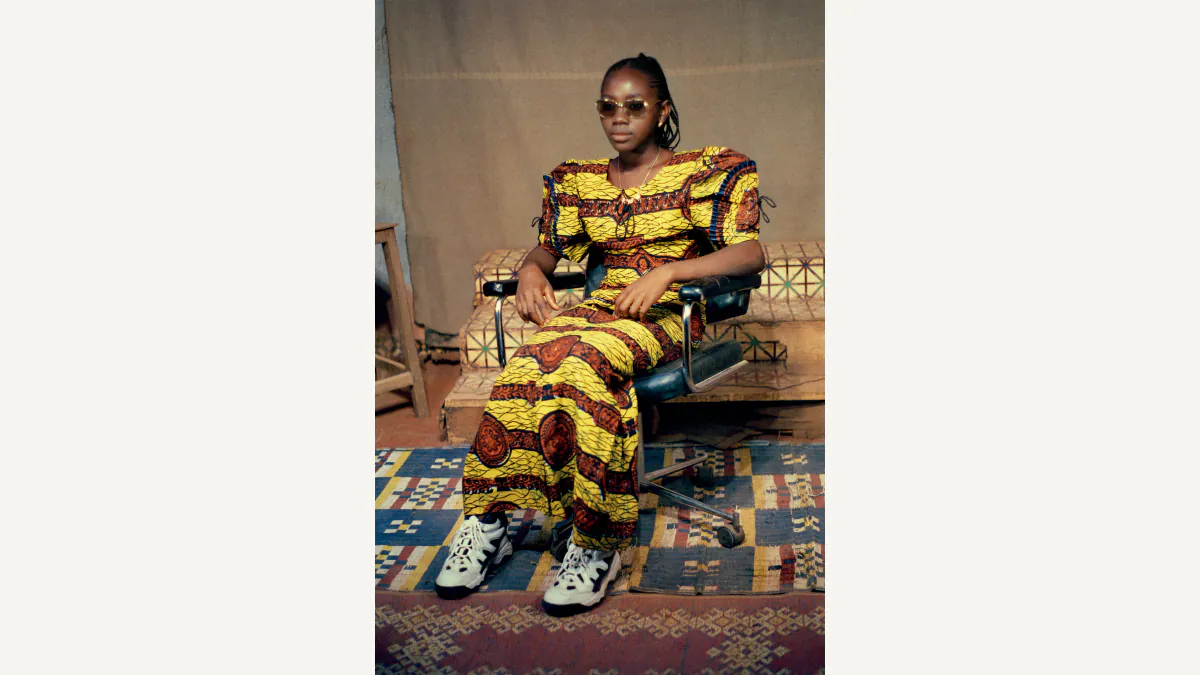
Sanlé Sory’s colour portraits bring a different rhythm to the studio photographs for which he is widely known. Fabric, painted backgrounds, furniture, and the small decisions of a sitter’s pose become separate, competing surfaces. Colour does more than brighten the scene. It changes how a portrait holds together.
The Photographers’ Gallery’s Colour Years exhibition , opening in London on October 14 and continuing through February 21, 2027, focuses on that later practice. The gallery describes prints restored from Sory’s archive negatives, alongside Volta Jazz record covers. Curator Taous Dahmani brings the studio and its surrounding cultural life into the same exhibition.
BJP’s October 5 coverage brings this forthcoming exhibition into current photography reporting. Its subject is a continuing archive, with colour adding a distinct set of relationships to read.
A sitter organizes the colour
The gallery’s published portrait of a seated sitter offers a particularly clear starting point. Yellow, orange, red, and black patterns run through a matching outfit. Behind the chair, quieter brown fabric covers the wall and a bench. A patterned rug occupies the lower frame, while white trainers introduce a bright interruption near the feet.
The pose holds these surfaces together. The sitter’s forearms follow the chair’s supports, and the hands settle near the center of the picture. Dark glasses make the face a compact visual shape. The chair supplies a structure around the body without becoming a neutral background object. Its metal and dark upholstery are as much part of the portrait’s arrangement as the textiles.
Look first at the largest colour relationships, then at the smaller repetitions. The yellow garment separates from the brown setting, while its dark pattern connects with the chair. White shoes pull attention down the frame. The photograph keeps the whole seated figure visible, so those connections can be read from face to floor. No single accessory needs to explain the sitter’s character.
This is a useful way to approach Sanlé Sory’s photographic practice : attend to how a person inhabits the available studio, rather than treating the surroundings as decorative evidence of an era. The photograph gives its subject room to participate in the image’s construction.
A studio remains a working relationship
Sory opened Volta Photo in Bobo-Dioulasso in 1960. The gallery traces his business from formal portraits and identity photographs to the city’s music and nightlife. Its account places his regular move into colour in the mid-1980s, extending a practice already associated with black-and-white pictures from earlier decades.
A working portrait studio brings different purposes through the same door. An identity photograph has a practical destination. A portrait made with a friend or partner can become a keepsake. A musician’s picture may circulate on a record cover. Those uses shape the encounter, even when the resulting photographs later share a museum wall.
The exhibition’s accompanying GOST announcement connects the restored colour prints to this continuing community record. It is helpful to keep that continuity in view. Colour Years presents another chapter of a sustained local practice, rather than a photographer appearing suddenly because his images have reached an international exhibition.
The studio also makes photographic authorship collaborative in a concrete sense. Sory determines framing and timing. A sitter brings clothes, a posture, and a reason for the visit. Their choices meet within the available light and setting. That relationship can be visible without turning the sitter into a symbol for an entire country.
The colour book widens the comparison
GOST’s Volta Colour , written and edited by Dahmani in collaboration with the gallery, is expected in October. The publisher lists 160 pages and 99 images. It describes clients choosing clothes, hair, and poses, and places the colour work across a changing Burkina Faso from the 1980s into later decades.
A book and an exhibition encourage different kinds of attention. A wall display lets a viewer compare prints at a distance, then move closer to one picture. A sequence of pages creates an order that can be revisited. Turning backward to compare two portraits makes repeated choices easier to notice: the relationship between a patterned garment and a plain ground, or the way a chair establishes a pose.
There is also a distinct Phaidon monograph titled Sanlé Sory . Phaidon describes more than 200 black-and-white studio and nightlife photographs, produced in close collaboration with the artist. These are separate books with different emphases. Comparing their stated selections clarifies why a colour-focused exhibition adds something substantial to an already familiar photographic identity.
Black-and-white images organize surfaces through tonal relationships. Colour introduces another way for fabrics and backgrounds to separate, echo, or compete. Neither approach needs to be presented as a more complete version of the other. The interest lies in following what Sory could do when those relationships changed.
Visit with the full frame in mind
The London exhibition offers a chance to look beyond a face or a striking outfit. In the published seated portrait, the rug, footwear, chair, hands, and glasses all contribute to the picture’s balance. Cropping mentally around the head removes much of what makes the arrangement specific.
The gallery’s dates and booking information are available on the exhibition page. Colour Years is an exhibition preview here, with attention to the photographs the organizers have published. Its strongest invitation is visual: begin with the sitter, then follow the connections that make the surrounding studio part of the portrait.