Hasselblad’s 2026 Masters winners show how an image can reveal its subject immediately while leaving its meaning open. A street market becomes an island of warmth, a twin portrait invites close comparison, and cattle form a landscape. Each approach rewards a second look.
This retrospective examines the Hasselblad Masters winners announced on June 30, 2026.
The official winners gallery brings together seven awarded series. Looking closely at the Street, Portrait, and Art selections reveals three distinct ways to organize attention: separate a subject from its surroundings, repeat a form with small differences, or make familiar shapes difficult to identify at first glance. Those choices are useful beyond competition photography.
Seven winners, seven photographic projects
Hasselblad’s announcement names one winner in each category:
- Art: Yudha Kusuma Putera, Indonesia, Waste Colonialism (Sapi-Sapi Piyungan).
- Architecture: Kevin Boyle, Canada, DaySleeper | Movieland.
- Landscape: Rohan Reilly, Ireland, Ephemeral Visions.
- Project//21: Panitbhand Paribatra Na Ayudhya, Thailand, Dwellers of the Night.
- Portrait: Svetlana Jovanovic, the Netherlands, Otherness.
- Street: Gosse Bouma, the Netherlands, Morning Ritual.
- Wildlife: Alfred Minnaar, South Africa, The Forest I Roam.
The Hasselblad Masters Award is distinct from the Hasselblad Foundation’s separate Hasselblad Award. The central subject here is the winning photographic work, rather than the camera equipment associated with the competition.
Morning Ritual makes warmth a measure of scale
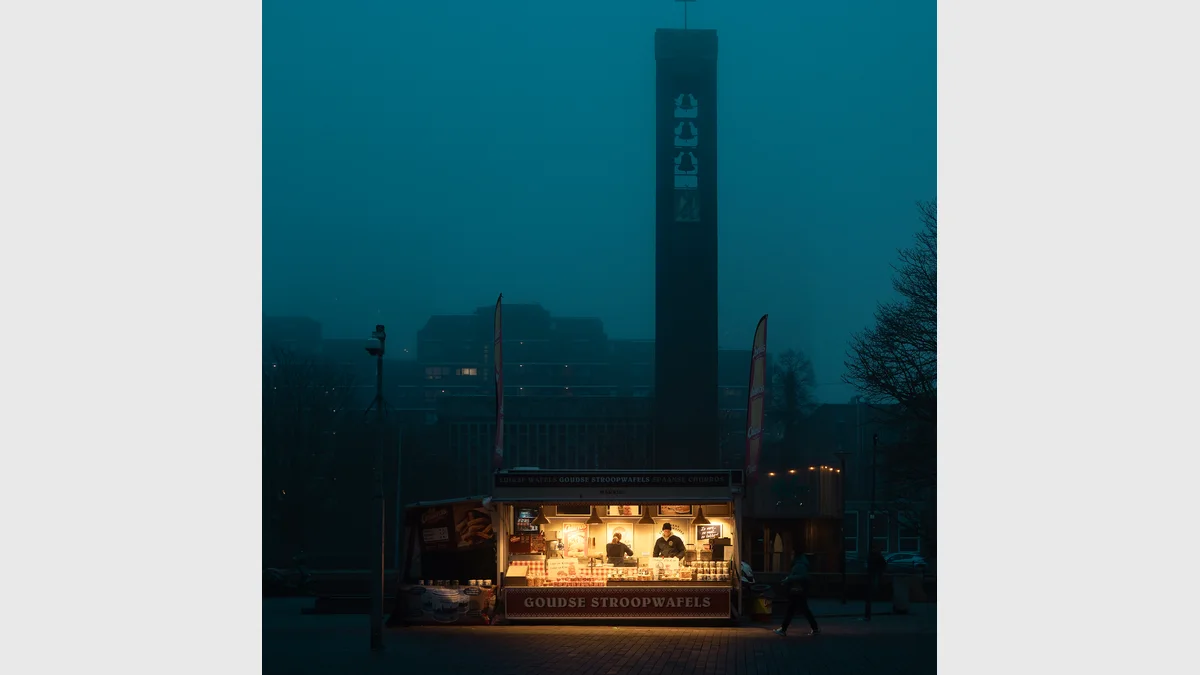
In the first photograph presented from Gosse Bouma’s Morning Ritual, a brightly lit food stall sits low in the frame beneath a tall bell tower. Blue atmosphere occupies much of the photograph. A person crosses the pavement beside the stall, while the illuminated interior makes the people working inside immediately legible.
The relationship between those elements is the picture’s engine. The stall takes up relatively little space, but its warm light gives it more visual weight than its size would suggest. The tower supplies a strong vertical. The surrounding darkness and haze allow both structures to remain readable without giving every background detail equal importance.
For street photographers, this is a useful distinction between a small subject and a weak subject. A person does not need to dominate the frame to anchor it. Contrast, placement, and the space around that person can do the work. Bouma’s photograph also allows the setting to retain its own character. Crop tightly around the stall and the transaction remains, but much of the relationship between a pocket of activity and the larger city disappears.
The effect depends on that balance. The viewer can move between the people, the stall, and the tower without the picture collapsing into three unrelated subjects.
Otherness turns resemblance into close observation
Jovanovic’s Otherness concerns identical twins. In one of the winning portraits, two red-haired subjects stand back to back in dark clothing against a pale background. Their bodies make a connected shape, while their faces turn toward opposite sides of the frame.
The photograph gives resemblance an unusually clear structure. Similar hair, clothes, and complexion make the pairing immediately apparent. Opposing head positions prevent the faces from becoming interchangeable. The viewer can compare expression, angle, and posture within a composition that keeps both people present.
That is a precise use of repetition. Repeating a visual element can establish a pattern, but small differences are what make the pattern worth examining. Here, the background carries little competing information. The attention stays with the two people and the tension between their shared appearance and separate presence.
A portrait photographer can apply that lesson without photographing twins. Consistent lighting or clothing can give a series a common language, while a change in gesture or distance supplies the individual distinction. Consistency creates the comparison. It does not have to erase the sitter.
Waste Colonialism changes what a landscape can look like
In Putera’s first winning photograph, overlapping cattle backs fill most of the frame. Brown and white surfaces form horizontal layers beneath a narrow area of sky. One black-and-white coat supplies a sharper graphic interruption.
Before the animals become fully identifiable, those surfaces can read as terrain. The photograph asks the viewer to revise an initial impression, which gives its simple arrangement more than one stage of recognition.
Hasselblad identifies the project’s setting as Yogyakarta’s Piyungan landfill. That context changes the stakes of the composition. The photograph’s visual ambiguity opens the encounter, while the project description connects it to waste and its surroundings. A single frame cannot establish the entire history or economics of waste disposal. Its contribution is to make the relationship available for sustained attention.
The practical lesson is to distinguish visual resemblance from explanatory evidence. A shape can invite a comparison. A caption or accompanying account must still make clear what was photographed and why that comparison matters.
A strong series gives each frame a job
These three approaches suggest useful questions when editing a body of work. Where does attention land first? What changes after the subject becomes recognizable? Which surrounding details make that second reading possible?
A frame earns its place in a series when it changes what the viewer can see, rather than simply repeating a successful look. Similar light, distance, or palette can hold a group together, but every photograph still needs a purpose. One might establish the environment, another clarify a relationship, and another interrupt the expected pattern.
That concern with authorship also runs through Newsroom’s analysis of Julia Fullerton-Batten’s transition from commercial assignments to fine-art projects. Different production methods can serve the same editorial question: which decisions belong to the photographer, and what do those decisions allow the viewer to discover?
The Masters selections offer three concrete answers. Bouma uses contrast and space. Jovanovic uses resemblance and difference. Putera uses overlapping form and contextual revelation. Each makes the photograph legible, then gives its first reading somewhere to go.
Further reading
For a book-length look at an earlier Masters edition, Hasselblad Masters: Evoke, Volume 3 I may earn a commission brings together work by eleven photographers responding to the theme “evoke.” Published in 2012, the multilingual hardcover includes English text and offers another way to explore how different photographers interpret a shared brief.