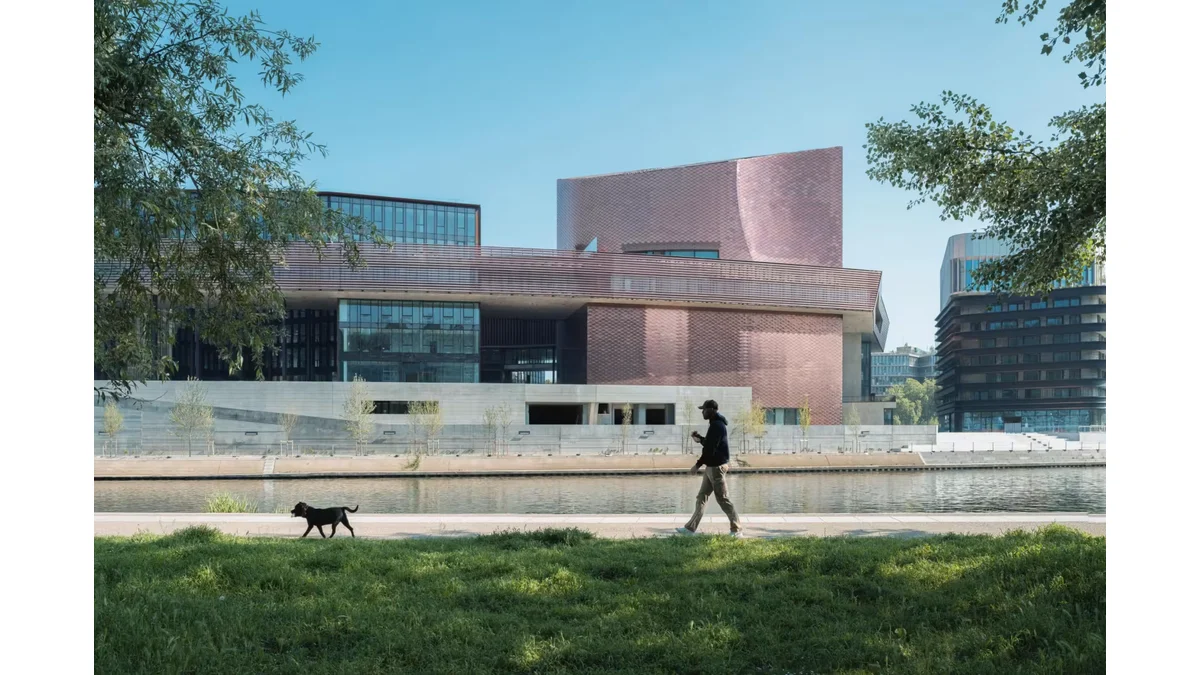
An island once associated with car making is about to welcome a different kind of traffic: visitors arriving for contemporary art. Large, the new art centre on Île Seguin in Boulogne-Billancourt, opens on October 17, 2026, with a free inaugural weekend that invites people to explore what happens when machines meet the imagination.
The opening announcement offers free admission on October 17 and 18 with advance registration. Its first exhibition, Imaginary Engine, turns the island's industrial history into a starting point for inventive objects, unexpected materials and playful changes of scale. The prospect is pleasantly concrete: a new place to wander, look closely and encounter something surprising together.
Cars become material for the imagination
The exhibition programme brings together more than one hundred works by 55 artists from 23 countries. Fifty works from the Renault art collection join contemporary pieces, with 17 artists invited to create new work for the opening.
The automobile provides a connecting thread. A car is a familiar object with a recognizable shape, an interior and a place in everyday memory. Artists can take that familiarity apart, rearrange it or let it become unexpectedly strange. A viewer arrives with useful knowledge before reading a label.
One chapter, Driving Forces, explicitly explores humor, chance and disorder within the usually orderly language of industrial production. Large identifies artists including Peter Fischli and David Weiss, Thomas Bayrle, Nina Beier and Bertrand Lavier within that part of the exhibition.
That is a cheerful invitation to look at ordinary machinery with fresh eyes. A component can become a pattern. A familiar outline can change when it meets an unexpected material. Something designed to perform a practical job can take on another life as an image or an object to puzzle over.
The island gives the visit its setting
Île Seguin sits in the Seine at Boulogne-Billancourt, outside central Paris. Its history as a Renault manufacturing site gives the exhibition's cars and machines a specific local connection. The new institution is part of the island's continuing development as a cultural destination.
In its October 15 preview , Smithsonian describes an opening that connects contemporary work with the site's industrial memory. The setting makes the exhibition more than a collection of automotive references assembled in an arbitrary room.
There is pleasure in recognizing how a place can acquire another use while retaining a conversation with what came before. Here, visitors can move through a new building and find the island's former activity returning in altered forms, from the materials artists choose to the machines their works evoke.
The exhibition also considers workers, collective experience and the relationship between bodies and machines. Its playful elements belong to a wider presentation with several registers. A visit can include both the immediate enjoyment of an unexpected object and a slower look at the stories around it.
The building joins the experience
According to Large's account of the art centre , the building was designed by RCR Arquitectes with the CALQ architecture agency. Its interior alternates narrower passages, long views and large volumes. The main exhibition space reaches fourteen metres in height.
That sequence gives artists room to work at a scale a visitor can feel physically. An artwork encountered after a narrow passage can appear very different from the same object seen in an open hall. The architecture helps organize those changes of pace.
Metal is an important part of the building's character. The centre describes a steel floor whose surface responds to light and use, connecting the exhibition setting with the exterior. It provides another reason to look around as well as at the artworks.
The building's position by the river adds a different kind of scale. A gallery visit can become part of an island outing, with the surrounding water and public space giving the experience room to continue outside.
A small way to make a visit more playful
An exhibition built around familiar machines offers an easy shared game: each visitor can choose one work that changes the meaning of something they recognize. Compare the choices after a first look, then return to the objects together.
One person may notice a repeated shape. Another may connect an object with a memory of a journey. A third may be drawn to an unlikely material. These are possible ways to begin a conversation, rather than tasks prescribed by the museum or a claim about the reactions visitors will have.
The exercise works because people bring different associations to the same object. A car can mean a family trip, a feat of engineering, a particular color or an image from a film. Art can bring those associations into view without requiring everyone to reach the same conclusion.
Readers interested in another playful return to automotive history can find a related idea in Newsroom's account of Citroën's electric 2CV concept. The projects are different, but both make a familiar vehicle a starting point for imagination.
Make plans for the opening weekend
Large is at 3 Parvis Amont on Île Seguin in Boulogne-Billancourt. The free inaugural weekend on October 17 and 18 requires advance registration, so check the official booking information before travelling. Imaginary Engine is scheduled to continue through March 7, 2027.
The centre's programme lists regular opening from Wednesday through Sunday, with a later Friday closing. Opening-weekend arrangements can differ from that routine. The official site is the source for current slots and access information.
The opening offers an appealing reason to put a museum visit on the calendar: a new building, an island setting and familiar machines transformed into things worth looking at again. For one weekend, the first step is simply choosing a time to come aboard.