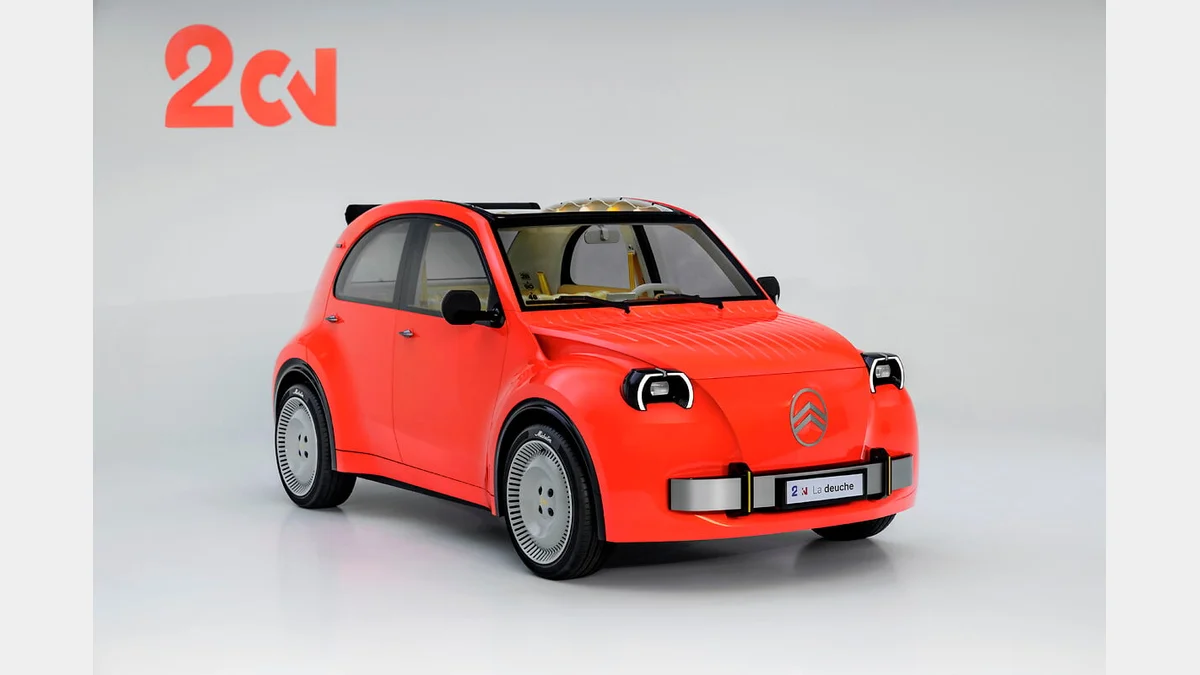
Citroën’s 2CV is coming back with an electric motor, a folding fabric roof, and room for a little mischief. The new 2 CV Concept brings one of France’s most familiar motoring shapes to the 2026 Paris Motor Show, previewing a European-built car planned for 2028 with a target starting price of about €15,000.
The delight is in how much everyday life fits into that small idea. Egg-shaped door storage, a portable radio, and yellow tartan seats turn a utilitarian brief into something cheerful. The original car made modest transport feel full of possibility. Its proposed successor has an unusually good starting point for doing that again.
A familiar face returns to Paris
Citroën’s official October 11 reveal describes a fully electric concept measuring 3.76 meters long, positioned between the Ami and C3. The company is aiming for roughly one tonne of weight and a production model joining the range by 2028. These are development goals, with the show car offering the first detailed look at the intended character.
The timing brings a pleasing symmetry. The original 2CV was presented in Paris in 1948. A 2028 return would fall on its eightieth anniversary, although the final launch date and production specification remain to come.
The new concept appeared at Stellantis’s “The Night Before” presentation on October 11, alongside five other brands’ concepts. Wallpaper’s account of the evening places it at Hangar Y in Meudon and describes the 2CV as the best-received concept there. That is the publication’s impression of the event, rather than a verdict from customers who have driven a finished car.
Hagerty’s October 5 preview followed the official teaser photographs before the reveal, identifying references to several generations of the original. The chronology matters: that earlier story anticipated a concept and included powertrain speculation. The October 11 announcement now supplies the actual show-car presentation.
For visitors, the official Paris Motor Show website is the useful place to follow the exhibition. For enthusiasts elsewhere, Citroën’s dedicated 2CV concept site offers the official design presentation and a community of owners’ stories.
Small enough to keep its sense of humor
The silhouette does much of the work. An upright windscreen, rounded wings, a sweeping roof, and separate-looking headlights make the family resemblance legible without needing a badge. Motor1’s passenger-car report highlights the relatively flat body surfaces and independently replaceable bumpers, details intended to simplify manufacturing and repairs.
Those choices matter to the character of a 2CV. A friendly shape is more convincing when its friendliness extends to living with the thing. A bumper that can be replaced separately gives the design a practical story as well as a visual one, though repair costs for the eventual production car have not been established.
Designboom’s close look at the concept follows the roll-up fabric roof, tartan upholstery, removable storage basket, and warm beige cabin details. Infra Red bodywork adds an orange-based burst of color with yellow and red highlights. The roof lets daylight become part of the interior, a simple pleasure that belongs naturally in this car.
Even the pedals join in: a hare marks the accelerator and a tortoise the brake. Numbers on the windscreen connect 1948, 1990, and 2026, marking the original reveal, the end of its production, and this new concept. The little door compartments shaped for eggs are the most affectionate callback of all.
There is one detail worth keeping in perspective. Citroën’s UK release and Motor1 describe 19-inch steel wheels, while the international release and Designboom say 18 inches. The final wheel specification remains unconfirmed. The important design idea is the familiar steel-wheel appearance, rather than treating either concept measurement as a purchase specification.
A cabin made for the stop as well as the journey
Inside, the usual dashboard gives way to a cylindrical structure carrying the single-spoke steering wheel, controls, and an eight-inch square touchscreen. Top Gear’s report credits Belgian comic artist Jean-Luc Delvaux with the screen graphics and describes a slim driver-information display recalling the rotating-drum instruments of classic Citroëns.
The Radioën is a detachable radio and speaker. Together with the removable basket, it imagines a car whose useful objects can accompany you when the driving stops. This is a lovely extension of the original’s adaptable spirit: the destination gets a share of the ingenuity.
PistonHeads’ introduction emphasizes the concept’s relaxed, colorful approach to a small-car cabin. Its enthusiastic reading is understandable. The storage, roof, seats, and controls suggest a place designed around people enjoying ordinary journeys.
A removable or extending seat arrangement is also part of the show-car presentation. How much of that furniture, lighting, and material palette survives development will be particularly interesting. The strongest idea is portable usefulness, and it can be carried forward in more than one form.
The original 2CV began with useful minimums
The Citroën 2CV’s history explains why a small electric successor is such an appealing proposition. Its name refers to the French fiscal horsepower classification, rather than an engine producing only two horsepower. It became famous for doing a great deal with modest mechanical resources.
Citroën’s official seventy-fifth-anniversary history dates the TPV, or Toute Petite Voiture, project to 1936. A running prototype followed in 1937. Its brief included transporting four people and 50 kilograms of luggage comfortably, with a maximum speed of 50 km/h.
The production car reached the public at the Paris show on October 7, 1948. Manufacturing began in July 1949 with a 375cc air-cooled flat-twin rated at nine horsepower. Citroën records 5,114,969 vehicles, including 1,246,335 vans, and the final 2CV leaving Mangualde, Portugal, on July 27, 1990. Distinguishing the 1948 unveiling from the 1949 production start helps make sense of the dates found in different accounts.
The famous egg-carrying story captures the wider brief beautifully. The BBC’s reporting by Theo Leggett connects the original’s soft suspension and rough-road ability to the idea of transporting eggs across a ploughed field. That same report follows its change from rural transport to a cult favorite, showing how utility and affection can grow together over decades.
The story still gives designers a useful question: which apparently small comforts make freedom feel real? In the old car, getting across a rough road was central. In the new concept, compact dimensions, a welcoming cabin, and affordability organize the answer. The technology changes, while the pleasure of making a modest vehicle useful remains recognizable.
The price is a promise to develop
The €15,000 ambition is central to the revival. InsideEVs’ October 11 account points out that the future car’s battery capacity, range, charging speeds, and power output have not been announced. It also identifies an unresolved question about incentives in the advertised price target.
That distinction is useful when reading British headlines suggesting approximately £12,700 or £13,000. Those figures translate the euro ambition. They do not establish a confirmed UK retail price, equipment level, or local launch schedule.
Top Gear offers 170 miles as its own suggested range, explicitly saying that Citroën has not supplied one. It should not become the new car’s specification by repetition. Matt Prior’s Autocar opinion raises the related question of whether keeping the battery small could restrict usefulness. The visible introduction supports that concern, without providing a tested range figure.
For a prospective owner, the sensible questions are concrete: will the finished car cover the regular journey with a comfortable margin, how will it charge at home or nearby, and what will the final price include? A countryside commute and a short city errand can ask different things of the same small vehicle. The concept gives both readers an appealing design to follow while those answers develop.
Reuters’ report from Meudon supplies the business context, placing the 2CV within Stellantis’s effort to restore its European competitiveness through distinctive brands and smaller, affordable EVs. That makes the price ambition consequential, but neither an attractive concept nor an announced target proves commercial success. France 24’s October 12 report adds a short on-site interview with Citroën chief executive Xavier Chardon, giving readers another route into the company’s thinking at the show.
The welcoming part is that accessible transport has become a design ambition worth showing off. There is room for delight in a car built around everyday limits.
The Fourgonnette brings back the working-car charm
On October 12, Citroën also revealed the 2 CV Fourgonnette Concept . Its tall, box-shaped rear recalls the original small delivery van, adding a working-vehicle expression of the same friendly front end.
Motor1’s Fourgonnette coverage traces the van lineage to 1951 and describes its connection to tradespeople, shopkeepers, and delivery drivers. The original’s practical identity explains why the new shape feels so immediately familiar.
Citroën calls this version a designers’ passion project and explicitly says it does not preview a production model in the short term. The passenger car’s 2028 ambition therefore cannot be transferred to the van. There is no confirmed Fourgonnette price, range, or launch window.
For a closer view, NetCarShow’s Fourgonnette gallery brings the exterior images together with the manufacturer’s description. It is useful visual reference, rather than a separate confirmation of the production plans.
That leaves it free to be enjoyed as a design idea. A small commercial vehicle can carry personality along with parcels. Its charm comes from imagining useful work with the same care usually reserved for leisure.
Two ways to revisit the original
Readers wanting more of the old car’s story can choose between two distinct kinds of book. Malcolm Bobbitt’s Citroen 2CV: Different is Everything , in the English paperback edition, introduces the model’s development and ingenious design. It is a compact historical companion to the new concept’s references.
R. M. Clarke’s Citroen 2CV Ultimate Portfolio collects contemporary road tests, comparisons, model introductions, and specifications. Its value is the chance to encounter the original through reporting from its own lifetime, complementing a retrospective history. These books concern the classic combustion-engine car, rather than the specifications of the proposed electric successor.
The new 2CV’s nicest achievement so far is giving a practical small car permission to be memorable. A roof that opens, a radio that comes with you, and a place for the eggs make daily transport feel like part of a life. If that warmth reaches the production car alongside the promised accessibility, the familiar face will have a fresh reason to be loved.