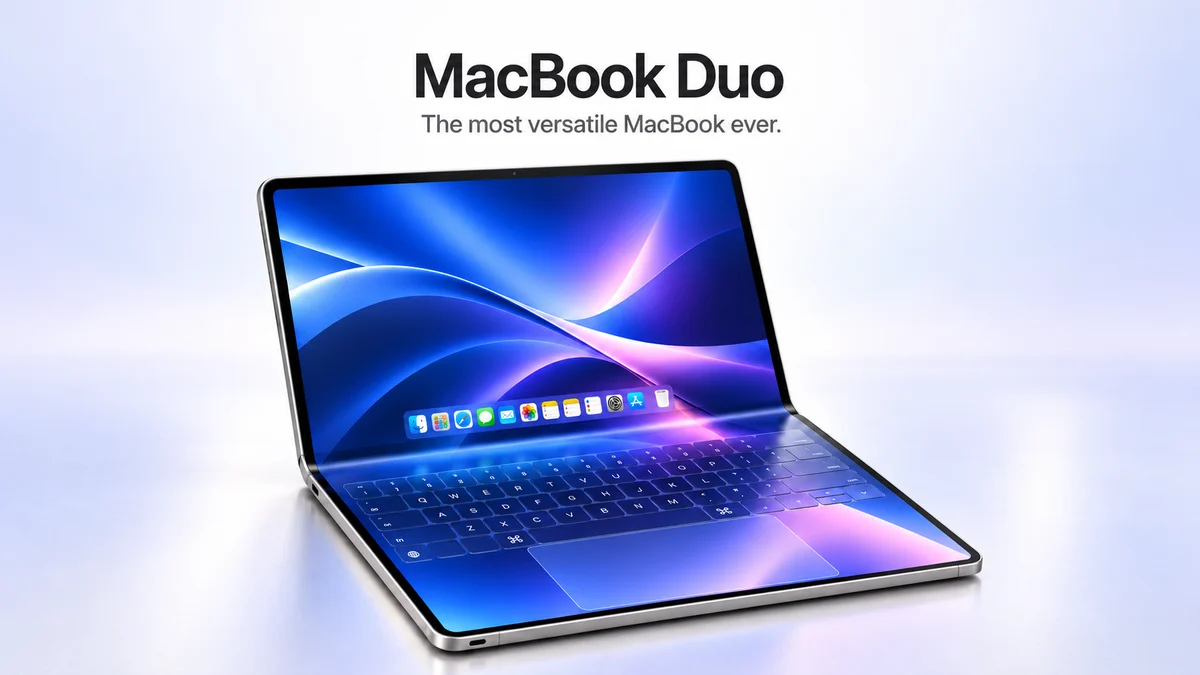
Apple called Wednesday’s event “Pro and tell.” Allow one small naming suggestion before the invitations become souvenir graphics: MacBook Duo.
The occasion is real. Apple has invited the press to Los Angeles on October 28 at 10 a.m. Pacific, as 9to5Mac reported from the invitation . The touch-Mac rumors have arrived right on cue. Bloomberg’s Mark Gurman expects touchscreen MacBook Pros this week, according to MacRumors’ October 25 account of his latest Power On report .
Here is the bolder bet for that stage: the interesting new MacBook won’t feel like another Pro. It will feel like a Duo, a computer whose lower half finally gets to join the fun. The concept illustration above gives that idea a wonderfully literal shape. Blue light runs from the upright display into a keyboard drawn across the base. The laptop looks as though someone told its wallpaper to stop respecting boundaries.
Key Takeaways
- Apple’s October 28 event gives the touch-Mac rumors a date to watch.
- Older keyboard patents give the Duo concept a real design lineage.
- The Duo bet combines reported display features with an adaptable lower touch surface.
The Steve Jobs-style pitch for MacBook Duo
Borrow the rhythm of Steve Jobs introducing the first iPhone and the pitch practically writes itself. Apple’s January 2007 announcement brought a phone, an iPod and internet communication together. For the Duo, try this:
A Mac. A creative canvas. A keyboard that changes its mind.
The Duo pitch practically writes itself: “The most versatile MacBook ever.” Two surfaces. One seamless experience. Your next big idea, with more room to play.
That is the promise this concept would have to earn. Versatility should mean useful choices, rather than a longer list of gestures to remember.
One computer, with a lot less agreement about where the keyboard ends. A conventional laptop gives its upper half almost all the visual freedom. The bottom half keeps the same arrangement, whether you are writing a letter, adjusting a photograph or playing a game. This concept turns the base into another working surface.
Picture finishing an email, then trading part of that keyboard for a generous set of editing controls. A musician could summon larger performance pads. Someone wrestling with a spreadsheet could give the numbers more room. These are imagined uses for the concept, and they explain the attraction better than a claim about how futuristic the glass looks.
There is a useful distinction here. A touchscreen lets you interact directly with displayed controls. A touch keyboard takes that flexibility into the place where your hands already spend their day. The second idea is what makes this particular MacBook daydream worth opening.
“Duo” earns its keep twice: two useful surfaces, and two ways of working. The name tells a little story before anyone has reached the specifications slide. Apple already uses it for the foldable iPhone Duo on its event page , so the word would have familiar company.
The family resemblance is the point. Bring the same design language to iPhone and MacBook: rounded glass, adaptable touch controls and a screen that takes on more of the interface. In this concept, the phone’s invitation to reach out and touch becomes a much larger working space. MacBook Duo makes that connection sound intentional. Your phone and your computer, finally speaking the same visual language without needing to do the same job.
Apple’s older patents make a touch keyboard plausible
The historical trail gives the glass keyboard more substance than a pretty picture. In February 2018, AppleInsider covered an Apple patent for a hinged second display . The underlying Apple patent, US9904502B2 , describes upper and lower displays connected by a hinge, permits touch sensing in either, and addresses reflections between them. Apple was considering practical details of putting illuminated surfaces opposite each other.
Then came a more directly relevant keyboard story. In March 2021, 9to5Mac examined Apple’s reconfigurable solid-state keyboard patent . The underlying Apple filing describes configurable input regions. Its attraction was a lower surface that could change its arrangement instead of staying committed to one permanent set of keys.
By August 2021, another 9to5Mac report described an Apple patent with a second display serving as a virtual keyboard, including alternative layouts and game controls. Put those older stories beside this week’s touch-Mac reporting and the Duo idea has a recognizable design ancestry. Apple has explored both halves of this proposition.
That history supports a real design possibility. It does not put a delivery date on the glass keyboard. Wednesday’s timing comes from the current event and reporting. The older work supplies a reason to take the more ambitious version seriously, rather than waving it away as a laptop-shaped screensaver.
What’s reported for Apple’s October 28 event
There is also a perfectly sensible, less extravagant reading of Wednesday. MacRumors describes Gurman’s expected machines as 14-inch and 16-inch models with OLED touch displays, lighter bodies and a Dynamic Island. Its account says touch would join the keyboard and trackpad as another input method. That sounds much closer to a familiar MacBook Pro gaining a new trick than to the illustrated machine’s all-screen lower deck.
Even the invitation gives “Pro” a conspicuous place. It is a solid reason to expect that name to survive. The case for Duo is an editorial wager on the bigger idea: once touch is invited into the Mac, a second adaptable surface becomes much easier to imagine as the next act.
That is the enjoyable tension going into the event. Apple can make the laptop screen respond to a finger, or eventually make the whole open computer feel like a more flexible instrument. One improves a familiar interaction. The other changes what you expect to find under your hands.
The predicted MacBook Duo specs
Give that idea a spec sheet. The first three entries follow the current reporting. The remaining targets carry today’s MacBook Pro hardware into the more adventurous Duo concept:
- Display: 14-inch and 16-inch OLED touchscreens.
- Chip: M5 Pro or M5 Max, rather than inventing another chip generation for the occasion.
- Camera cutout: Dynamic Island in place of the notch.
- Memory and storage: a 24GB and 1TB starting target, with higher configurations reaching 128GB and 8TB on the appropriate Max model. Those are expectations grounded in Apple’s current technical specifications , rather than a new configuration list from Apple.
- Keyboard deck: the big Duo prediction, a touch surface with an adaptable keyboard, trackpad region and app controls. That is where the older patents and this illustration meet.
- Connections: keep the current Pro’s useful mix of Thunderbolt, HDMI, SDXC and MagSafe. A second screen should not require a ceremonial sacrifice of the card reader.
The exact lower-screen size, battery endurance and price need an actual machine to settle them. The more persuasive promise is a familiar level of Mac capability with a second surface worth touching.
Readers comparing Apple’s current hardware can browse the Apple Store on Amazon (paid link).
The real test for a touch keyboard
A beautiful glass deck has one demanding audience: people who type without looking down. The illustrated keys are easy to admire. Finding them by feel during a long afternoon would be the harder audition. Feedback, accidental touches and the ability to rest your hands would all need convincing answers before a virtual keyboard could take over that job.
Those questions make the idea more interesting. The best demonstration would be gloriously ordinary: write a paragraph comfortably, switch to a useful control layout, then return to typing without making a production of it. Give the lower screen a reason to exist beyond looking excellent in the opening film.
Newsroom’s earlier look at Apple’s macOS 27 upgrade pitch raised a related point about software: a new capability has to fit the work people already do. The same standard belongs on this much shinier desk.
For Wednesday, then, put the MacBook Duo bet on the table. Keep the useful Mac, let the keyboard loosen its tie, and give that second surface something delightful to do. “Pro and tell” has the invitation. Duo has the punchline.
FAQ
When is Apple’s October event?
Apple’s “Pro and tell” press experience is Wednesday, October 28, 2026, at 10 a.m. Pacific in Los Angeles.
What is MacBook Duo?
MacBook Duo is this article’s bet on a more versatile touch Mac, connecting two adaptable surfaces with the iPhone’s design language.
What specifications are expected?
Current reporting points to 14-inch and 16-inch OLED touchscreens, M5 Pro or M5 Max chips, and a Dynamic Island. The Duo spec bet extends that foundation.
Could a MacBook have a touch keyboard?
Apple’s older patents establish that it has explored configurable keyboards and lower displays. This week’s reported machines retain a keyboard and trackpad. The adaptable touch deck is the bigger Duo prediction.