Paris Fashion Week is still unfolding, with the Spring/Summer 2027 womenswear calendar running from September 28 to October 6, 2026. Through October 5, five major houses offer a particularly useful way to read the season: Dior, Saint Laurent, Loewe, Givenchy and Chanel are all working with recognizable signatures, but changing how those signatures occupy the body.
The connecting idea is freedom through construction. Chiffon can soften an archival silhouette. Tailoring can create room without losing definition. An everyday garment can become a vehicle for exceptional craft. These collections pursue those possibilities in different ways, with Saint Laurent supplying a gleaming, theatrical counterpoint to the quieter ease elsewhere.
Dior: heritage made weightless
At Dior , Jonathan Anderson has made lightness a technical proposition. Claudia Croft’s collection report for 10 Magazine describes familiar Dior constructions rebuilt in chiffon, including a softer interpretation of the angular hips of the 1952 Cigale dress. Some garments use ten layers of chiffon. Micropleats give printed surfaces a blurred, watercolor effect.
That combination changes the relationship between silhouette and substance. A garment can retain the outline that makes it legible as Dior while shedding the visual weight associated with a formal archive reference. The interesting move is the translation of structure into layers: recognizable volume becomes something that appears more porous and mobile.
Anderson’s approach also makes heritage a material resource. A historical shape supplies the starting geometry, then contemporary fabrication changes its character. The archive remains active because it can be worked on.
Saint Laurent: gold, contrast and evening drama
Anthony Vaccarello’s Saint Laurent takes a more emphatic route. In Nicole Phelps’s Vogue review , gold fabric transforms safari jackets and trenches, while brocade jackets and black chiffon establish a contrast between richness and transparency.
The metallic safari jacket makes a practical form read as eveningwear. Black chiffon shifts brilliance into shadow. This is a useful counterpoint in the comparison: Paris’s interest in lightness still leaves room for spectacle.
Loewe: everyday clothes become a craft language
Loewe co-creative directors Jack McCollough and Lazaro Hernandez are finding expressive possibilities in familiar wardrobe pieces. Croft’s 10 Magazine account identifies twisted polos, windbreakers and trench coats with holographic resin collars. Chiffon dresses take basketball jerseys as their starting point, with beaded hems changing the weight and movement of the sportswear reference.
Adrienne Faurote’s October 5 Haute Living review adds the detail of leather shaved to summer weight and sheer glass-bead dresses wrapped and tucked like a beach towel. Her reading emphasizes a wardrobe gaining confidence through familiar clothes rather than ever-larger demonstrations of technique.
The jersey dress captures that balance particularly well. Its recognizable sports shape gives the viewer an immediate point of entry. Chiffon and beads then complicate that familiarity. Craft supplies texture, light and motion while the everyday reference keeps the idea approachable.
Givenchy: precision creates room to move
Sarah Burton’s Givenchy develops ease through cut. Croft’s October 4 report describes asymmetrical jacket fronts, trousers cut on trapeze lines, and jersey gowns suspended from slender brass supports.
These details make precision productive. An angled front establishes a waist and redirects the eye. A wider trouser line allows shape and drape. The suspended jersey makes support part of the garment’s visual idea, with the fabric hanging from a defined framework.
Burton’s contribution to the week is especially useful beside Dior and Loewe. All three make construction central, but their points of entry differ: archival volume at Dior, a familiar wardrobe at Loewe, and the relationship between a clean line and a moving body at Givenchy. Newsroom’s closer look at Burton’s Spring 2027 collection explores that relationship in more detail.
Chanel: a house vocabulary with multiple selves
Matthieu Blazy’s Chanel Spring/Summer 2027 presentation extends the conversation about freedom into the house’s own history. The official collection notes published through FHCM on October 5 describe a progression from jersey underwear to reworked menswear and suits, followed by light evening dresses and layered silk transparencies.
The notes identify raw-edged gilets, pencil-skirt suits and a concluding smocked tweed designed for stretch and mobility. These are the house’s descriptions of its materials and construction. They make the collection’s central proposal clear: familiar Chanel forms can accommodate several versions of a wardrobe and several kinds of movement.
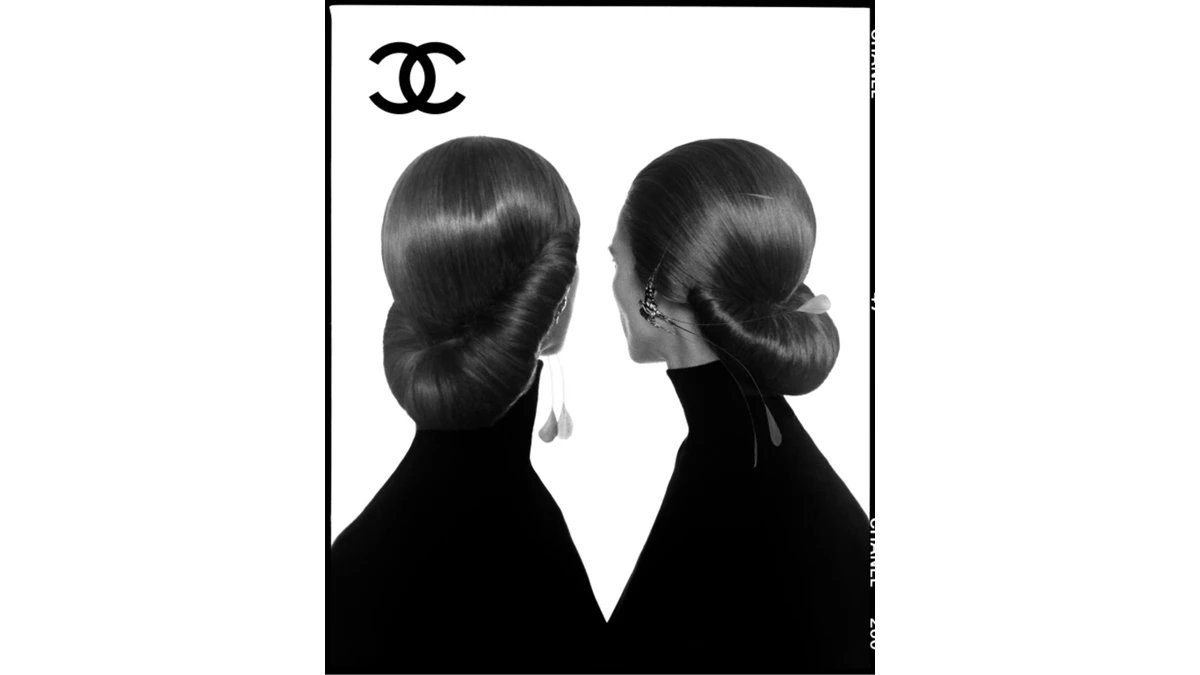
The official David Bailey teaser photograph accompanying the show offers a graphic introduction to that world, with two dark profiles against a white ground. It is promotional photography rather than a runway frame. The collection itself carries the more detailed argument, taking the house vocabulary from intimate layers to tailoring and eveningwear.
Three themes to carry into the final day
Across these five collections, lightness has several meanings. At Dior it comes through fabric and layered volume. At Loewe it brings elaborate craft into recognizable clothes. Givenchy uses defined cut to organize drape, while Chanel’s announced stretch tweed connects a familiar suit to greater mobility. Saint Laurent keeps visual drama firmly in the picture.
A second theme is the usefulness of a familiar starting point. A jacket, polo, jersey or suit lets a designer make a complex idea immediately readable. The transformation becomes more interesting because the viewer can recognize what has changed.
The third is heritage treated as working material. This is ready-to-wear , with house references being translated into present-day wardrobes. The strongest comparison is between the methods of translation, rather than a single look declared to represent the whole season.
The week continues through October 6 on the official calendar . These highlights describe collections and reporting available through October 5, with the final day still to complete the picture.
Books for reading the archives behind the clothes
Five verified English hardcover editions offer historical context for the featured houses and their founding designers. Yale University Press provides the edition records for Dior , Yves Saint Laurent , Chanel and Givenchy . Hachette’s Little Book of Loewe adds a compact house history. The books predate Spring/Summer 2027 and serve as archive companions.
- Dior: The Collections 1947–2017 I may earn a commission, by Alexander Fury and Adélia Sabatini, provides a long view of the house vocabulary Anderson is reworking.
- Yves Saint Laurent: The Complete Haute Couture Collections 1962–2002 I may earn a commission, with an introduction by Suzy Menkes and texts by Olivier Flaviano, supplies background on the founder’s couture language.
- Chanel: The Complete Collections I may earn a commission, the 2020 revised and expanded edition by Patrick Mauriès and Adélia Sabatini, offers an archival companion to Blazy’s current conversation with the house.
- Givenchy: The Complete Collections I may earn a commission, by Alexandre Samson with contributions by Anders Christian Madsen, traces the house through the designers preceding Burton.
- Little Book of Loewe I may earn a commission, by Jessica Bumpus, offers a compact history published during Anderson’s tenure, before the current creative directors’ Spring 2027 collection.
Read together, the books make the distinction between an enduring signature and its latest interpretation easier to follow. The current shows then reveal what each creative director chooses to preserve, lighten or reshape.