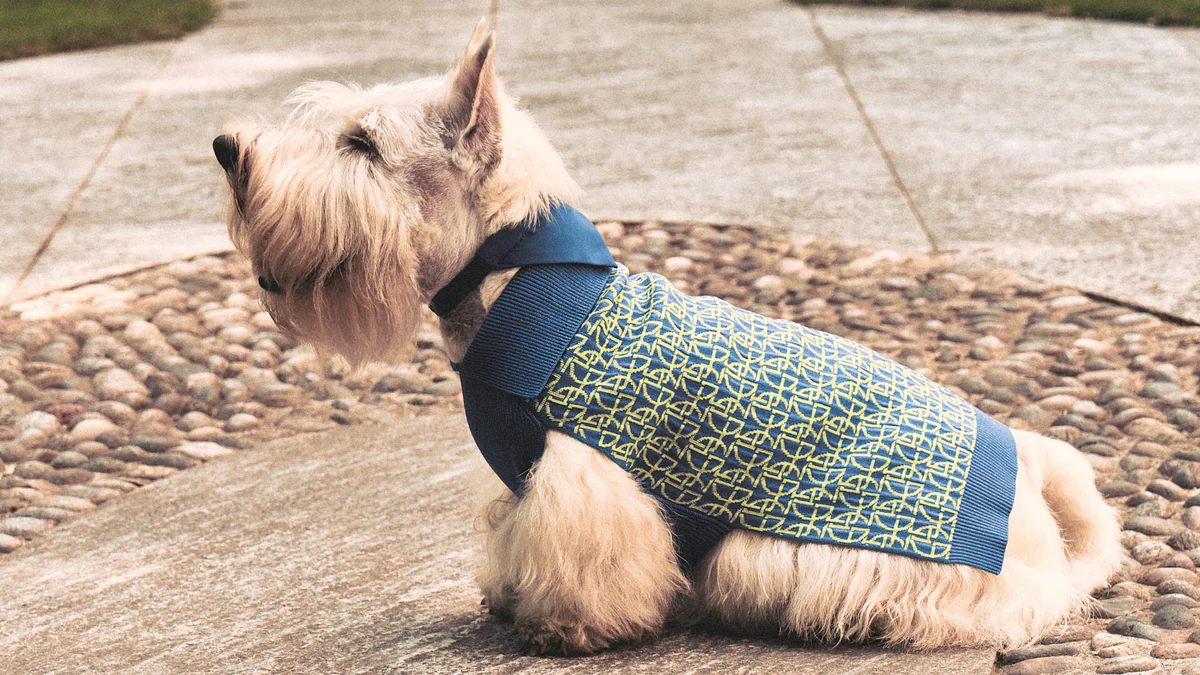
This publisher-commissioned analysis begins with the Giorgio Armani and Poldo Dog Couture collection announced September 15 and independently reported September 17, then compares it with current Louis Vuitton and Gucci pet ranges.
Armani Designs a Complete Daily System
Giorgio Armani and Poldo Dog Couture have made the Fall 2026 dog collection feel less like a novelty capsule and more like a small, coordinated wardrobe. The monogram viscose-blend jumper, nylon coat, raincoat, harness, collar, leash, portable bowl, travel mat, and waste-bag holder cover dressing, walking, and travel rather than one photogenic moment.
Fashion Times identifies Avio, lime, and navy as the defining colors and notes the collection's September 15 announcement. The palette does useful design work. Avio and navy retain Armani's calm, architectural character, while lime introduces the flash of visibility that technical outdoor equipment often needs. A jacquard monogram gives the knitwear a recognizable house code without turning every surface into a logo field.
The latest pieces also sit inside a much larger official assortment. Armani's collection page currently presents 51 pet accessories, including earlier beds, carriers, leather walking pieces, pinstriped coats, and velvet mats. That depth changes the proposition. A buyer can add one weather layer or assemble a matching environment across home, walk, and journey.
The collection's most persuasive detail is therefore not simply the monogram. It is coordination. A blue coat can meet a matching harness, leash, bowl, and mat. The system promises visual continuity, but each item still has to perform an ordinary task. FashionUnited's release coverage records sizing from XS to XL and frames the line around city life, changing weather, and travel.
Louis Vuitton Builds From Travel Heritage
Louis Vuitton reaches the same category from a different direction. Its strength is not the seasonal wardrobe first, but the idea that a dog belongs inside the house's travel universe. PAUSE's 2026 collection report connects the assortment to the 1913 Monogram dog kennel and describes collars, leashes, harnesses, a crossbody leash, water bowls, the Speedy Pet Trunk, the Kennel Trunk, and the LV Lovers Dog Beret.
The official Louis Vuitton pet-accessories collection now extends across dog and cat pieces, ready-to-wear, bowls, collars, leashes, carriers, and the Travel Dog Carpet. Here, the house code is logistical. Monogram canvas, trunks, and travel bags already communicate movement, packing, protection, and personal belongings. The pet range miniaturizes and adapts that language rather than inventing a separate identity.
The Neverwoof makes the strategy especially clear. Louis Vuitton's official product page describes a Monogram coated-canvas carrier based on the Neverfull, with a side opening, an inside leash, and a removable, washable mat. The pun is playful, but the product architecture is serious. It translates a familiar bag into a pet carrier by changing access, restraint, lining, and cleaning rather than by adding a dog motif to an unchanged tote.
Gucci Treats Petwear as a Miniature Wardrobe
Gucci's current approach is the most explicitly styled as a miniature wardrobe. The official Gucci Pet clothes category lists nine pet garments across raincoats, reversible coats, jumpers, a sweatshirt, and a T-shirt. The range moves house motifs onto familiar clothing forms instead of building the collection around trunks or a single seasonal kit.
The reversible GG pet coat places GG Supreme canvas on one side and blue polyester on the other, with an Interlocking G charm and branded snap buttons. Reversibility is more than a merchandising flourish. It allows one item to move between an emphatic house signature and a quieter technical surface.
The forest-green wool pet jumper belongs to Cruise 2026 and uses gradient GG wool with rib trim. Gucci describes these pieces as “mini-me” looks. That phrase captures the range's central idea: the animal's garment becomes an extension of the owner's wardrobe and the house's visual identity.
Three Houses, Three Ways to Extend a Brand
Together, the collections reveal three distinct design systems. Armani organizes a full day through coordinated color, discreet monogram, outerwear, walking equipment, and travel pieces. Louis Vuitton begins with luggage and reconstructs travel objects for a pet's body and movement. Gucci emphasizes personality through recognizable motifs and familiar ready-to-wear categories.
This is a verified comparison, not proof that every luxury house or pet owner is moving in the same direction. Dog clothing has long combined practical and decorative roles, as the broader history of dog fashion makes clear. The current significance lies in the completeness of the assortments. These brands are not offering only a collar or novelty jumper. They are treating pet goods as coherent extensions of apparel, leather goods, travel, and lifestyle design.
The comparison also exposes the limits of reading petwear only through brand codes. The wearer cannot choose a logo, explain discomfort, or value a matching set. PDSA's guidance on dog coats says useful clothing should keep a dog warm or dry, fit properly, and let the animal move freely. Breed, age, health, coat, climate, and the individual dog's response matter more than a coordinated palette.
That does not make design irrelevant. Good closures, washable linings, weather-appropriate materials, correct harness access, and a shape that permits walking, toileting, and play are design questions. Luxury earns its place when the finish and house identity sit on top of those answers, not when they replace them.
Armani's Fall 2026 collection makes the category newly visible because it is unusually complete and visually disciplined. Louis Vuitton and Gucci show that the larger idea is already established: a pet collection can carry the same codes as a human wardrobe while solving a different set of physical needs. The strongest pieces are the ones in which those two ambitions meet cleanly.