This retrospective revisits the exhibition through Gothamist’s September 30, 2026 reporting and the museum’s exhibition records.
On view from September 16, 2026, through January 3, 2027, Doll Dressing at The Museum at FIT presents more than 170 objects under curator Colleen Hill, the museum’s senior curator of costume. Its dolls sit within a larger conversation involving full-size garments, accessories, art, and moving images. The productive relationship runs in both directions: designers dress dolls, then borrow the dolls’ shapes, surfaces, and possibilities for clothes worn by people.
The exhibition gives that exchange a useful structure. A miniature can communicate an existing style. It can become a surface on which to develop a designer’s signature. Enlarged or imitated, it can also expose the conventions of clothing that adult fashion usually makes seem natural. Those are distinct creative jobs, and recognizing them makes the familiar doll a much more interesting fashion object.
A fashion model that could travel
Long before a look could arrive instantly on a screen, dressed dolls offered a way to circulate fashion in three dimensions. FIT traces their use as miniature style models to European courts as early as the 14th century. A loan from Colonial Williamsburg, an 18th-century doll with a pale blue silk gown, makes the principle tangible in the exhibition’s historical section. Gothamist’s account describes the surviving doll and its clothing as a particularly detailed example of that exchange.
The advantage was physical information. A painted likeness could show a fashionable outline, while a dressed figure offered a garment with volume and a relationship between its parts. For a dressmaker translating the look into human scale, that difference mattered. The miniature was a communication device as well as an object to admire.
Hill’s exhibition brochure makes another important distinction: a fashion doll has clothing designed to be removed and changed. That changeability connects the historical model to the modern fashion doll . A fixed costume presents a character. A wardrobe offers successive choices, allowing a single figure to carry different silhouettes, occasions, and identities.
Small clothes, recognizable designers
For designers, the miniature can be an early place to practice construction and later a concentrated expression of an established label. In her interview with Gothamist, Anna Sui recalled making doll clothes from the scraps left by her mother’s sewing. The exhibition pairs Sui’s adult fashion with miniature versions, including a floral-and-lace Blythe look and a velvet ensemble for Madame Alexander’s Cissy.
At reduced scale, a designer’s identity has to remain legible. Print, trim, color, and the relationship between coat and dress must do much of the work. A doll-sized version offers a particularly clear test of which details make a collection recognizable. Sui’s involvement also goes beyond dressing a figure: Mattel’s 2025 Inspiring Women doll represents the designer herself. Its official design account connects the outfit to her collections and personal signature pieces.
Tim Blanks’s The World of Anna Sui supplies a broader book-length context for that visual language. It is a companion route into Sui’s work rather than a substitute for the exhibition’s specific examples.
Other houses have used the doll to stage a complete world. The show includes a 1939 Louis Vuitton baby doll with a branded leather trunk and wardrobe, described in Smithsonian’s exhibition coverage . Clothing, luggage, and the figure form a miniature ensemble. The relationship makes the doll an object through which a house’s design can extend beyond an individual garment.
When doll proportions become human clothes
The exchange becomes especially revealing when the direction reverses. For his fall 1994 collection, Martin Margiela enlarged doll clothes and accessories to 5.2 times their original size. FIT’s press release explains how that operation magnified disproportionate stitching, construction, and fit.
Simply scaling an object does not make it behave like conventional human clothing. A small fastening becomes conspicuous. A seam takes on a different visual weight. An awkward fit becomes the organizing idea rather than a problem to correct. Margiela made the translation itself visible, showing how much ordinary fashion depends on agreed proportions.
Alexandre Samson’s Martin Margiela: The Women’s Collections 1989–2009 offers a wider reference for the collections around that experiment. The doll wardrobe matters here as a design method: change the scale while retaining the original relationships, and a familiar garment becomes unfamiliar.
Jeremy Scott approached the question differently at Moschino. His spring 2017 jacket and skirt retained the protruding tabs of a paper doll outfit, with printed effects suggesting clothing in two dimensions. The museum’s object photograph and description identify the ensemble. Tabs that ordinarily attach a paper costume to its figure became part of the full-size look.
Where Margiela makes miniature construction unusually prominent, Scott turns the boundary between image and garment into a design feature. The comparison shows why doll dressing cannot be reduced to pink or nostalgia. The doll supplies a different set of rules for how clothes meet a body.
A wardrobe can also carry a cultural argument
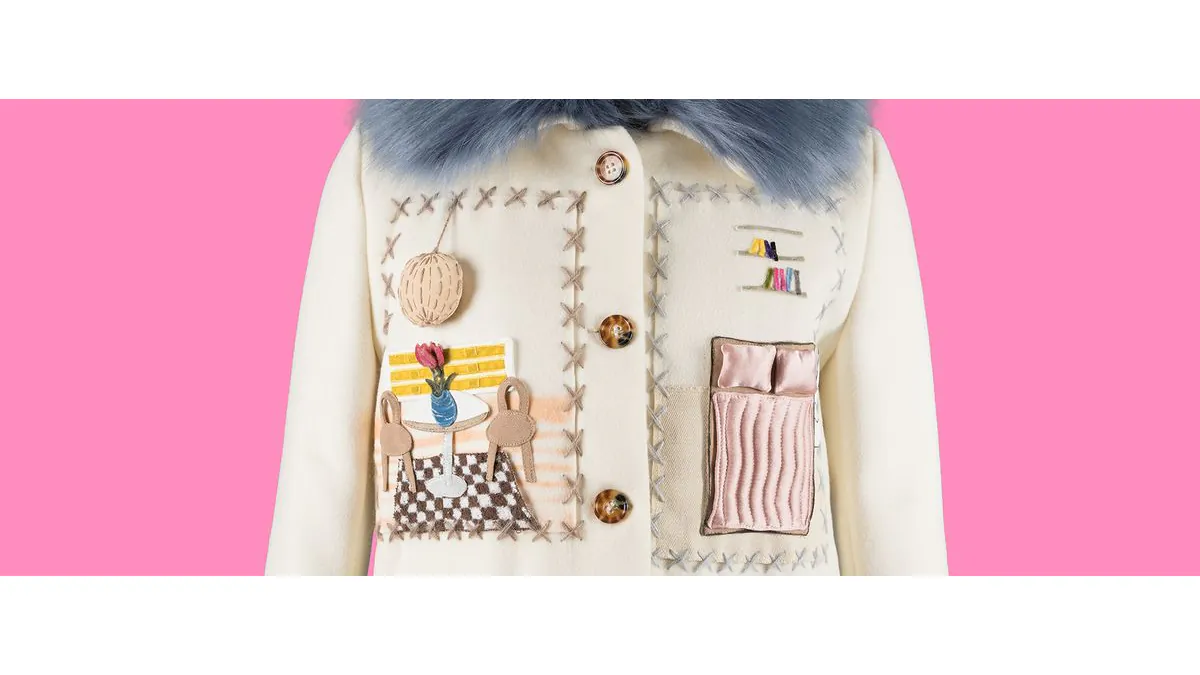
Lirika Matoshi’s 2024 “Apartment Coat” gives the dollhouse a wearable form. Its appliquéd rooms bring a table, chairs, books, and a bed onto the surface of a full-size coat. In FIT’s official photograph, visible stitches connect the scenes to the cream fabric. The miniature world becomes a way to construct and decorate clothing, extending play from the figure to its imagined surroundings.
The exhibition’s quieter achievement is to connect technical play with the choices people make about appearance. In Fashionista’s interview with Hill , the curator discusses the “living doll” as a way to consider agency. Its reporting also describes the fashion beginnings of designers working with dolls and the adult boudoir dolls carried as accessories during the 1920s.
That history complicates the assumption that doll dressing ends when childhood does. A doll can be a model, a companion object, a collector’s piece, or a source of style. Its smallness does not determine the seriousness of the design around it.
Representation makes the wardrobe’s meaning more consequential. In Elle’s interview with Hill , the curator describes Harlem dressmaker Ruby Bailey’s handmade dolls wearing miniature versions of her clothes. The exhibition brings a matching adult ensemble and doll together. That pairing places Bailey’s authorship in both scales, giving her miniature fashion the same attention as the garment made for a person.
FIT also includes the original 1980 Black Barbie, designed by Kitty Black Perkins, and a Monster High doll wearing a miniature version of a 2017 runway look by Virgil Abloh’s Off-White. These examples put character, clothing, and recognizable fashion authorship in the same object. The clothes are part of what the figure communicates.
Hill also acknowledges in the brochure that dolls and fashion have been criticized for consumption, restrictive beauty ideals, and gender stereotypes. The exhibition’s argument gains force by keeping that tension visible. Wearing a doll-inspired silhouette can be an act of self-definition, while the image of the doll can still carry expectations about how a person should look.
For the visitor, a useful question is what each example lets the designer do. Does the doll transmit information, preserve a signature, change proportions, or make an identity visible? That question turns a tour of appealing miniatures into a close reading of fashion’s methods. Play is part of the work, and the work can be exacting.
Seeing Doll Dressing
Doll Dressing occupies the Special Exhibitions Gallery at The Museum at FIT through January 3, 2027. WWD’s August 5 exhibition preview outlined its six thematic sections, while the ongoing.in listing also records the closing date. The museum remains the authoritative source for visiting details.
Admission is free . The museum is at Seventh Avenue and 27th Street in New York City, with regular hours of noon to 8 p.m. Wednesday through Friday and 10 a.m. to 5 p.m. Saturday and Sunday, New York local time. It closes on Mondays, Tuesdays, and specified holidays. Check its visitor page before traveling.
The accompanying Doll Dressing: Fashion from Barbie to Bratz and Beyond , edited by Colleen Hill and published by Rizzoli Electa, extends the subject into a book. For another example of the movement between doll imagery and adult garments, Newsroom’s Megan Hess and LEO LIN article follows Barbie-inspired bows from illustration into clothing.
The exhibition’s most useful proposition is that fashion does real thinking through dolls. A wardrobe in miniature can circulate an idea, sharpen a signature, or unsettle a proportion. The small figure is a place where the larger fashion system becomes easier to see.