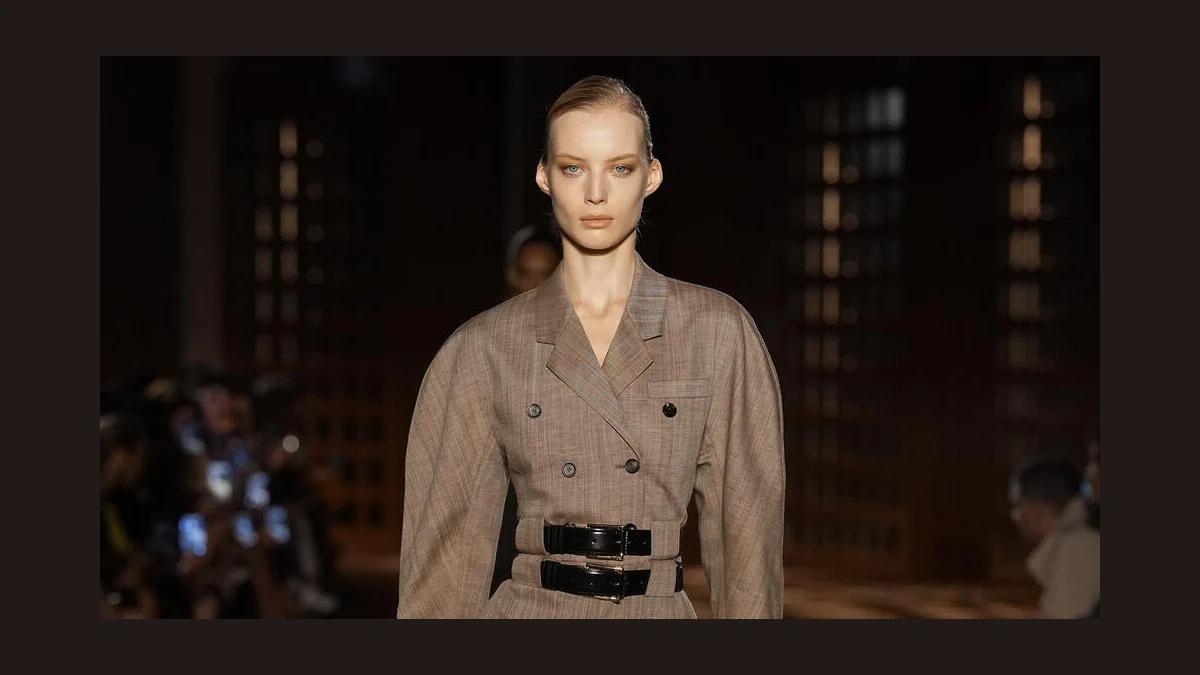
Ferragamo's Spring/Summer 2027 show brought Maximilian Davis's interest in the house's history into sharper focus. The official Milan Fashion Week gallery records a September 26 runway where doubled belts, close-cut tailoring, sheer layers, and light-catching finishes repeatedly change how a garment defines the body. The collection's most useful story is in those construction choices, not a forecast about what shoppers will buy next year.
The belt becomes part of the garment
The opening looks place belts at the waist of tailored dresses, jackets, and skirts. In the show gallery , a gray double-breasted dress is held by two black bands. The belt is no longer only a finishing accessory. It pulls an otherwise formal silhouette into a more controlled shape and becomes a repeated line the eye can follow across womenswear and menswear.
Vogue's September 26 runway report says Davis cited the defined waist of 1940s dress while preparing the collection. Its reporter observed belts placed at bustlines as well as waists, with some skirts suspended beneath structured bodices. The placement matters more than the period reference: a familiar hardware detail takes on a structural job. That idea connects the restrained early looks with the collection's later draping and eveningwear.
Davis's use of a waistline is precise without turning every look into the same outline. The gallery shows jackets kept broad enough to move, narrow skirts balanced by shirt volume, and trousers with more space through the leg. A slim belt can emphasize the body's center while the rest of the garment stays relaxed. That push and pull is part of the collection's appeal, and it is visible in the clothes themselves.
A house shoe becomes a visual reference
Vogue also reports that Ferragamo's 1947 Invisible Sandal was an important starting point for Davis. Its transparent upper made the heel appear suspended. In the new collection, the idea appears to be less about copying an archive shoe than about deciding which part of a garment looks present and which part nearly disappears. Sheer silk-wool exposes internal construction, while translucent layers soften the outline of a coat or dress.
The official Ferragamo site provides the house context for readers who want to explore its current work. The runway photographs are the evidence for this collection's shapes. Vogue's conversation with Davis supplies his stated inspiration. Neither source establishes how the garments will fit in stores, how they will be priced, or whether a runway idea will become a broad market direction.
That distinction helps the reader look closely. A clear panel may seem visually light, yet it can require a careful seam or supporting layer. A belt may seem ordinary, yet doubling it changes the balance of a dress. Ferragamo's design problem here is how to make construction noticeable without making the garment feel overburdened. The most convincing looks answer with one strong intervention at a time.
The footwear connection also keeps the clothes from becoming a costume exercise. A historical reference can produce a literal revival, but Davis uses the archival sandal as a question about visual weight. The answer may appear in a transparent layer, an exposed interior, or a narrow strap that seems to carry more than it should. Those are observations about the displayed designs, not a claim that every item uses the same construction method as the 1947 shoe.
Photography enters through fabric and light
Vogue says Davis looked to the work of photographers Lee Miller and Man Ray, including their experiments with solarization. The report attributes that reference to the designer. Some reflective and translucent finishes in the gallery can be read through that idea, but a runway photograph cannot establish every intention behind a material. It can show how light changes a surface as a model moves.
Our profile of Lee Miller's photographic identity gives readers a fuller account of the artist whose work Davis invoked. Her career extends far beyond one darkroom technique. Keeping that broader history in view avoids reducing a photographer to an aesthetic cue while still acknowledging the collection's documented source of inspiration.
The later looks move from muted neutrals into shine and stronger color, according to the Vogue gallery and account . That movement gives the show a sequence: controlled tailoring first, fabric experiments through the middle, and a brighter evening register at the close. It is a coherent runway progression. Whether it becomes a coherent wardrobe for buyers is a separate question, one that requires retail evidence later.
What follows the Milan preview
Our earlier Milan Fashion Week schedule guide told readers when Ferragamo was due on the calendar. The September 26 gallery now shows what Davis sent down the runway. Looking at the actual clothes changes the question from who was scheduled to what design language emerged.
The immediate answer is a study in controlled visibility. Belts hold and divide, sheer fabric reveals construction, and footwear history informs the idea of apparent lightness. A Milan Fashion Week overview supplies background on the event, while the official gallery remains the direct record of this show. The collection deserves attention for the decisions visible on the runway. Claims about sales, trend leadership, or lasting influence can wait.