A Career Seen Across Its Full Range
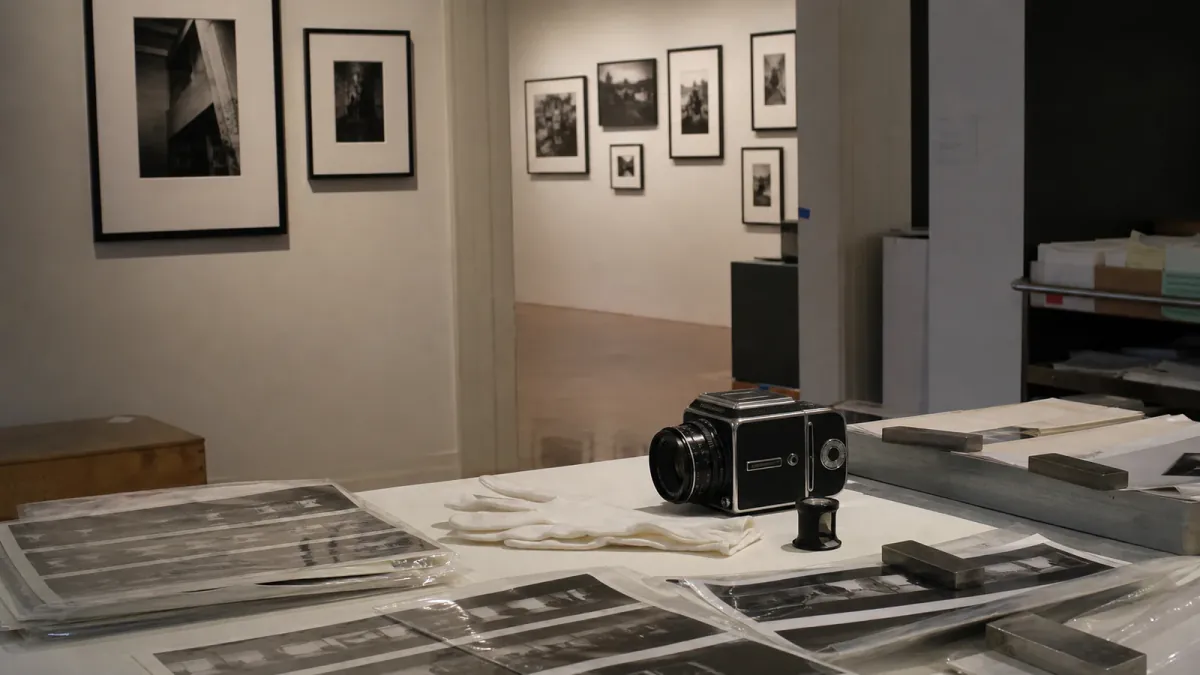
Lee Miller: Fearless brings approximately 150 photographs to the Art Institute of Chicago, spanning fashion, portraiture, Surrealist experiment, travel, and wartime reporting. On view from August 29 through December 7, 2026, the museum describes it as the first comprehensive survey of Miller’s photographs in more than 25 years.
The exhibition’s breadth gives a fuller account of Lee Miller as a photographer. Her work moved between commercial studios, magazines, landscapes, and the conditions of war. Seen together, those fields invite attention to the decisions that connect a practice: where to stand, what to include, when to release the shutter, and how to give an image its place in a larger story.
Chicago organized the exhibition with Tate Britain and the Musée d’Art Moderne de Paris. The museum’s account follows work from the 1920s through the 1950s, including portraits, Egyptian photographs, magazine assignments, and the war’s final battles and aftermath. That span gives the exhibition an expansive subject while keeping Miller’s photographic work at its center.
Fashion as a Field of Authorship
Miller’s career in front of the camera brought her into fashion’s image-making world. Her move behind it established an independent practice within that world. The distinction matters: modeling is part of her history, while the photographs ask to be understood through the choices of their maker.
Fashion photography brings bodies, clothes, gesture, space, and publication into a single frame. A photographer decides how a pose holds a garment, how a setting changes its meaning, and what the picture communicates when it reaches a magazine page. These are questions of authorship as well as technique.
Miller carried her practice through Paris, New York, and Cairo during the interwar years. Apollo’s preview points to the pace of that development and singles out her imaginative treatment of landscape and architecture in Egypt. The movement between settings makes the career especially valuable to consider as a whole. Commercial work, artistic experiment, and travel each offered different conditions for looking.
For photographers, the connection is productive. An interest in a person’s relationship to space can inform a fashion assignment and a portrait. Attention to shape can connect a garment to an architectural detail. A body of work gains coherence through those recurring concerns, even when its subjects and commissions change.
Surrealism as a Way of Looking
Surrealism runs through Miller’s work as an approach to perception. It opens familiar objects and settings to unexpected associations, making framing itself a means of transformation. Scale, cropping, juxtaposition, and the organization of space can all unsettle a straightforward reading.
Her experiments with Man Ray made the darkroom part of that inquiry. The Lee Miller Archives traces their use of solarisation to an accidental exposure to light during development, followed by work to reproduce the effect. The process creates unusual tonal relationships and outlines, bringing an image’s photographic construction into view.
The significance extends beyond an identifiable visual effect. An accident became something to examine, understand, and use deliberately. That movement from surprise to control remains relevant across photographic tools. The strongest experiment gives a picture a new relationship to its subject, rather than simply announcing a technique.
The Tate exhibition book , by Hilary Floe and Saskia Flower, places Miller’s Surrealist practice within work that also includes still life, advertising, fashion, landscape, and reportage. Its research and essays offer a route into the range of her output and the artistic judgment that connects it.
Vogue and the Demands of Wartime Reporting
During the Second World War, Miller reported for Vogue and photographed the liberation of Paris and the concentration camps at Buchenwald and Dachau. The Art Institute gives two rooms to the war and its aftermath.
Here, the purpose of the photograph changes profoundly. Camp photographs bear witness to historical violence. Their importance rests in what they record, the people and events they represent, and the responsibility carried by their publication.
Miller’s magazine experience belongs to that history. Vogue became a channel through which her wartime reporting reached readers, widening the subjects a fashion publication could bring before its audience. The relationship between photographer, editor, page, and reader takes on particular force when the image is evidence of what has happened.
Placing this reporting alongside the earlier work makes the career more complex. The photographer’s command of framing and visual communication continues, while the circumstances demand a different relationship with the subject. The museum also records the lasting psychological effects of what Miller witnessed. The exhibition’s chronology contains both the work and the human cost of making it.
A Photographic Identity Beyond One Genre
Miller’s range offers a useful way to think about a contemporary portfolio. A recognizable practice can rest on sustained attention to gesture, space, atmosphere, or human relationships. Those interests can remain visible across very different assignments.
For a fashion photographer, this shifts the editing question from “Do these pictures look alike?” to “What way of seeing connects them?” A consistent palette or lighting treatment may help a sequence cohere. So may a repeated sensitivity to how people occupy a room, how clothing changes a silhouette, or how an image holds a moment of uncertainty.
The Newsroom’s Kisau Photography studio case study approaches that question at the scale of one editorial, following a recurring prop through changing gestures and wardrobe. Miller’s career offers the larger perspective: photographic identity can develop through new subjects, places, and purposes.
Lee Miller: Fearless brings that breadth into a single survey. Fashion, experiment, portraiture, and reporting emerge as substantial parts of a career whose coherence lies in active, searching photographic judgment.