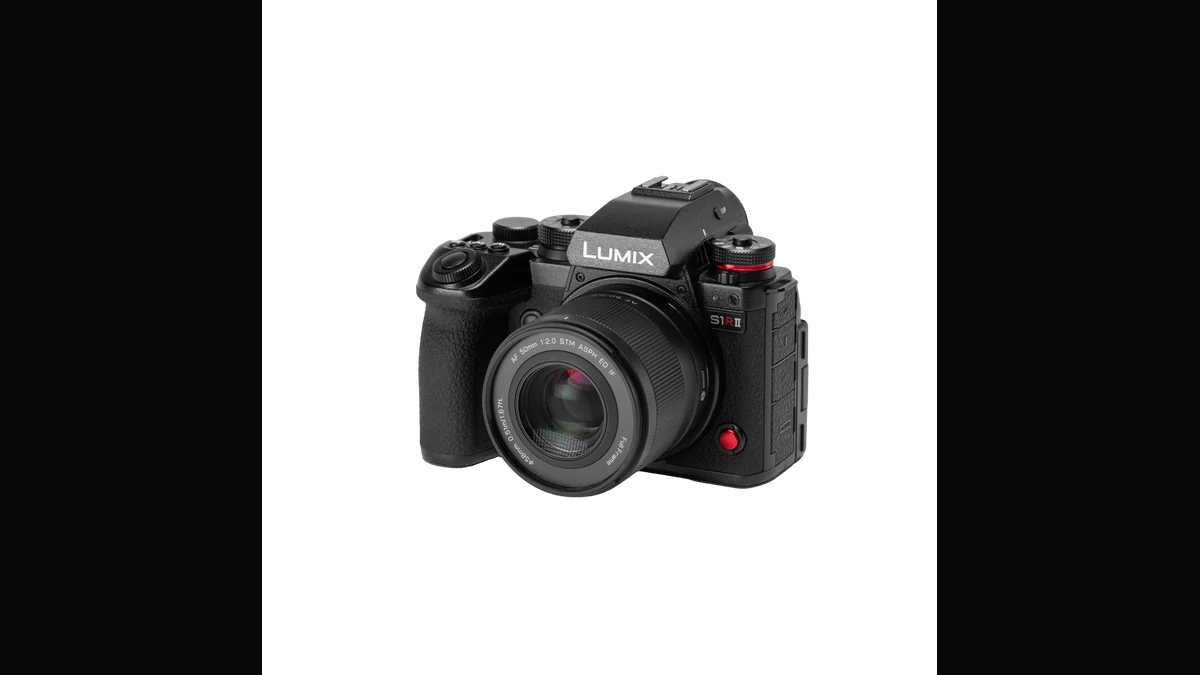
Four small lenses, four different decisions
Viltrox has brought its complete Air-series prime set to L-mount, giving Panasonic, Leica, Sigma, and other compatible full-frame bodies four compact autofocus options in a single release. The line now covers 14mm F4, 20mm F2.8, 40mm F2.5, and 50mm F2. Independent launch reports from PetaPixel , DIYPhotography , and Fstoppers agree on the central proposition: full-frame autofocus primes, each under 210 grams, priced between $168 and $199.
The meaningful story is not simply that another manufacturer supports L-mount. It is that the four lenses form a compact decision tree. The official Viltrox L-mount collection lists the 14mm at $199, the 20mm at $176, the 40mm at $168, and the 50mm at $199. That narrow price spread lets photographers choose primarily by framing and aperture rather than by a steep jump in cost.
The 14mm is the specialized option
At 14mm, the F4 lens is the outlier. Its ultra-wide field of view is suited to interiors, architecture, night-sky foregrounds, and exaggerated near-to-far compositions. It is also the focal length most likely to expose weak technique. Small changes in camera height and tilt can alter converging lines, stretch edge subjects, and make a foreground either purposeful or empty.
An ultra-wide prime can be easier to carry than a large zoom, but compactness does not remove the need to inspect edge behavior, flare, distortion correction, and corner performance. Viltrox says the lenses support in-camera corrections. Photographers should still check how their specific body applies those profiles to raw and JPEG files, especially when a composition places straight lines near the frame boundary.
The 20mm balances drama with portability
The 20mm F2.8 is less extreme and one stop faster than the 14mm. It can cover environmental portraits, street scenes, travel interiors, and handheld evening work while keeping a strong sense of place. For photographers who find 24mm useful but not expansive enough, 20mm can provide a clear visual difference without the pronounced spatial exaggeration of 14mm.
The practical tradeoff is subject placement. Faces close to the edge can stretch, and a close camera position can enlarge whatever sits nearest the lens. Used deliberately, that perspective can give street and fashion photographs energy. Used casually, it can make proportions look accidental. The lens choice should follow the desired camera position, not the temptation to fit more into the frame.
The 40mm may be the everyday center
The 40mm F2.5 sits between the familiar 35mm and 50mm views. It is wide enough for environmental context and tight enough to avoid the restless edge space that some photographers see at 35mm. For a one-lens walk, it may be the most versatile member of the set.
Its $168 launch price makes it the least expensive of the four. That does not automatically make it the best value. The important checks are autofocus consistency, close-focus behavior, manual-focus feel, flare, and rendering at the apertures a photographer actually uses. Fstoppers reports STM autofocus, eye and face detection, metal mounts, and native correction support across the line. Those specifications describe the operating envelope, not the finished image quality.
The 50mm offers the brightest aperture
The 50mm F2 is the fastest lens in the group. It gives a more conventional normal perspective and one more stop of light than an F2.8 lens. That can matter for indoor portraits, detail photographs, and evening street work, where shutter speed and ISO often compete.
F2 is not an extreme portrait aperture, but it can separate a subject at close working distances while keeping the package small. Photographers who want stronger compression or thinner depth of field should compare it with longer, faster options, including Newsroom's first look at the Sigma 85mm F1.2 DG Art. The Viltrox is built around portability and price. The Sigma serves a different ambition.
L-mount compatibility still deserves a check
The L-Mount Alliance defines a shared mount across multiple manufacturers, and Wikipedia's L-Mount overview provides useful historical background. A shared physical and electronic standard does not guarantee identical behavior on every body and firmware combination.
Before buying, confirm that the exact camera is supported, update both camera and lens firmware where appropriate, and check whether distortion, vignetting, and chromatic-aberration corrections are available in the preferred raw processor. Video users should also examine focus breathing, autofocus transitions, and aperture changes. Still-image users should pay particular attention to edge sharpness and flare at the apertures they expect to use.
What this launch does and does not establish
The availability and specifications are clear. PetaPixel reports that the four lenses are available immediately, while the official Viltrox collection presents the current prices and product pages. The line gives L-mount owners an unusually inexpensive route to a light four-prime kit.
What remains open is performance. This first look does not establish that the lenses match more expensive alternatives in resolution, autofocus reliability, weather resistance, sample consistency, or long-term service. Those questions require controlled testing and real assignments.
The strongest buying logic is therefore specific. Choose 14mm for deliberate ultra-wide structure, 20mm for expansive environmental work, 40mm for an everyday walkaround view, or 50mm for a brighter normal lens. The coherent advantage is not that one of them replaces every lens. It is that each makes a different photographic role available without making the camera bag heavy or the purchase unusually costly.