This explainer revisits GoPro's September 1, 2026 merger announcement to examine Starman Optical's business and the technology behind it.
The company behind the unfamiliar name
Starman Optical entered the camera world's conversation through its proposed combination with GoPro. Its principal contribution is a business that moves information through light: optical transceivers and related photonics technology for computing infrastructure. That gives the familiar action-camera brand a prospective partner with a different product, customer, and engineering task.
GoPro's merger announcement describes Starman Optical as a privately held US company within Starman Holding, operating its photonics business through Starman New Photonics. Those names identify related parts of the organization. Starman Optical is the named merger counterparty, Starman Holding is the holding company, and Starman New Photonics is the optical business described in the announcement.
Our earlier article, GoPro and Starman Optical: The Proposed Merger Explained, covers the transaction's financial structure and significance for camera owners. This companion focuses on what the photonics operation makes and how to read its product and manufacturing claims.
A transceiver gives data an optical path
An optical module connects electronic equipment to an optical communications link. The transmitting side converts an electrical signal into light. At the receiving end, a detector converts the arriving light back into an electrical signal that the equipment can process. A transceiver combines both directions in one module.
Inside a computing installation, these modules help link switches, servers, and other equipment through fiber. The light carries encoded information rather than a picture of the scene in front of a lens. This is a useful distinction for photographers: optical engineering can serve communication as well as image formation.
A camera lens gathers light from a subject and forms an image on a sensor. An optical transceiver sends a deliberately controlled signal along a connection. The two devices share a dependence on optics, electronics, and careful physical design, but their performance is judged against different outcomes. One records a viewpoint. The other carries data between endpoints.
Liberty is the product family to understand
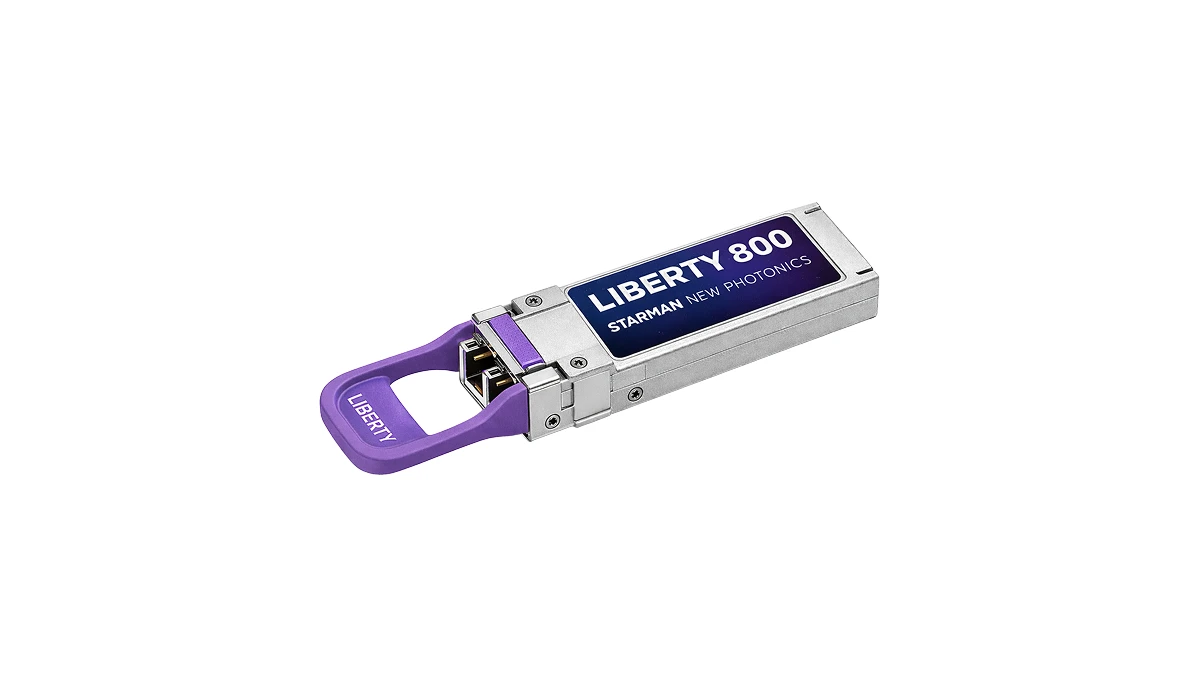
Starman New Photonics introduced its Liberty Series in an exhibitor announcement dated March 17, 2026 at OFC . The announcement identifies 800G and 1.6T transceivers aimed at large data-center deployments. It describes the company's role as supplying connectivity for AI and high-performance computing systems.
Those speed labels describe communications capacity. They are not camera resolutions, image-quality ratings, or measures of how intelligently a system behaves. An 800G link belongs to an 800-gigabit-per-second class, while 1.6T denotes a 1.6-terabit-per-second class. The useful comparison is with the requirements of a network connection, including the equipment at both ends.
Starman New Photonics' product page currently labels Liberty 800 as shipping and Liberty 1600 as qualifying. It lists OSFP and QSFP112 formats for the 800 product and OSFP224 for the 1600 product. These names describe module interfaces and packaging. They matter to the people integrating hardware into compatible systems.
The distinction between shipping and qualification is consequential. A qualification process evaluates whether a component works within a customer's particular system and requirements. It does not automatically establish deployment at scale. Starman's labels provide a first-party account of product status, with customer validation and production milestones determining what follows.
Domestic manufacturing is a staged plan
The company places US manufacturing at the center of its positioning. Its public site describes a transition from global supply toward domestic production, including pilot manufacturing during 2026. That wording makes the production sequence part of the story.
The linked OFC 2026 specification and availability sheet sets out separate ramps for 800G and 1.6T hardware. It puts the 800G US production ramp in 2026 and the 1.6T ramp in the second quarter of 2027. These are the company's published plans, rather than measured current output.
For a prospective hardware customer, the practical questions concern which product is available, where the relevant production steps occur, and when a validated component can be supplied consistently. Domestic oversight, a product's origin designation, and manufacturing capacity describe different attributes. A precise account keeps each attached to the evidence that establishes it.
What the connection means for GoPro users
The proposed combination would put consumer imaging and optical communications inside a broader company. A transceiver roadmap does not itself specify the next camera's sensor, stabilization, battery life, or accessory compatibility. Those remain camera-product decisions.
In his September 3 letter to GoPro customers , founder Nick Woodman describes continued camera development alongside accessories, software, and services. His argument is that diversification would give the company a stronger financial foundation for that work. It is a statement of intention, with future products and support providing the practical evidence.
Readers exploring that consumer-camera family can browse the GoPro Store on Amazon I may earn a commission. The cameras and accessories there belong to the image-making side of the business. Their availability does not establish progress on Starman's optical manufacturing plans.
Starman Optical's importance is therefore specific. It would add a communications-hardware operation and a domestic manufacturing strategy to the company surrounding GoPro. Understanding that business helps camera users follow the proposed combination while judging their own equipment by the qualities that matter when a real scene needs to be recorded.