The human gesture inside the machine picture
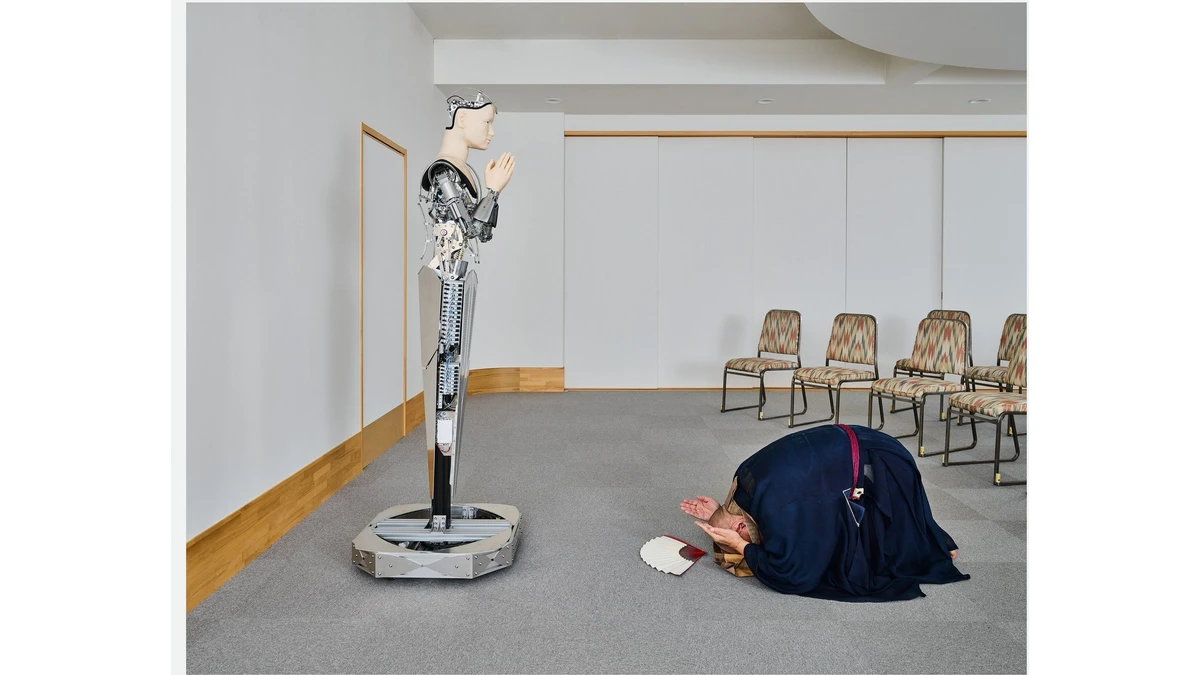
Start with the photograph the publisher identifies as Mindar (Robotic Priest), Kyoto, Japan, 2019. A mechanical figure stands at the left of a plain room. A person kneels opposite it, bending toward the floor. Behind that encounter, a row of patterned chairs waits against an otherwise restrained interior. Kris Graves Projects ’ publisher’s preview places the image among the prints offered with the book.
The exposed apparatus and the human posture create the picture’s tension. The machine stands upright, its internal components visible beneath a face and joined hands. The kneeling figure makes a low, dark shape. One form reveals its construction, while the other is almost entirely gathered into clothing and movement. Their unequal heights give the frame a clear visual structure before a viewer knows anything about the robot.
The chairs matter too. They keep this from becoming an isolated confrontation between a person and a futuristic object. They suggest a room arranged for other people, with ordinary furniture and a familiar capacity to gather an audience. The photograph contains an extraordinary subject inside an everyday space. That combination rewards a slower look than the label “robotic priest” alone would invite.
Spencer Lowell ’s own portfolio identifies this encounter within his robotics work. The image offers a useful entry into the book because it makes a relationship visible without resolving it into a verdict about technological progress. We can examine posture, distance, materials, and surroundings. The photograph gives those observations room to coexist.
Scale gives infrastructure a face
The October 2 account presents subjects including a fire-tornado laboratory, automated cow milking, and a doorway at Fukushima. Those captions establish specific places and moments. Together, the examples suggest a photographic practice that moves between scientific investigation, industrial operation, and the situations in which people meet machines.
For a photographer, the challenge is scale. A laboratory device can be small enough to hold yet belong to a research system too large to show in one frame. A room can reveal its working surfaces without explaining everything that happens there. A person can make the dimensions of a machine immediately legible. Each choice produces a different kind of understanding.
That is why an infrastructure photograph benefits from details that give the eye something concrete to measure. A chair, doorway, workbench, or human figure can turn an unfamiliar arrangement into a space a reader can navigate. Such elements do more than provide scale references. They establish the relationship between an apparatus and the world that accommodates it.
There is also a useful distinction between photographing an object and photographing an encounter. An isolated machine may invite admiration for its engineering or design. An encounter introduces behavior, expectation, and distance. In the Mindar photograph, the space between the two figures becomes as important as either figure by itself. The picture’s meaning depends on how those parts share the room.
A book offers another pace of looking
The trade catalogue describes photographs made from 2007 to 2024, edited by Alyssa Coppelman, with text by Daniel Sherrell. It lists an English-language hardcover with 96 pages. This is announcement and preview coverage rather than a judgment based on reading the finished volume.
A photobook can make connections through sequence, repetition, and the interval between images. Turning a page creates a pause that a stream of individual pictures often compresses. An industrial interior and a small laboratory experiment can share a spread or follow one another, allowing their shapes and working arrangements to become part of the conversation.
The announced range of subjects makes that possibility particularly interesting here. A reader can look for repeated gestures, recurring enclosures, or changes in the distance between a person and an apparatus. Those are ways of reading the available images, rather than claims about an unseen sequence. They keep attention on the photographs’ construction instead of asking every frame to illustrate a single slogan about the future.
The title adds another useful perspective. “Past” asks a viewer to imagine that today’s equipment will eventually look dated. A photograph can preserve the physical appearance of something that once seemed almost impossible to comprehend. Its surface, surrounding furniture, and human context may later become the details that make a particular technological moment recognizable.
Two ordering routes, two dates
The publisher’s direct listing says preorders are shipping in October 2026. The distributor’s entry gives a December 8 trade publication date for ISBN 9781954877290. The verified Amazon hardcover listing for Spencer Lowell: Futures Past I may earn a commission matches that ISBN, publisher, language, and 96-page format, and also lists December 8. Readers comparing the two routes should use the date and edition information attached to their chosen seller.
The distinction is practical. A publisher preorder and a trade listing can describe different distribution schedules for the same title. Neither date establishes that a copy has already reached a particular reader. The official preview remains the clearest place to explore the photographs and the publisher’s announced options.
What makes this book worth following is the specificity of the pictures. Lowell directs attention toward rooms, structures, and encounters that make technology tangible. The visible work invites readers to consider how a machine occupies space, how a person responds to it, and how photography can hold both within one frame.