The practical answer
Revisit an old photo project by changing its question before changing its pictures. Preserve the first edit, make a fresh contact sheet, and assign every selected frame a role. Search the archive and reorder the sequence before deciding that missing context requires another shoot.
Return With a New Question
An old photographic project holds more than the pictures selected the first time. It also contains overlooked transitions, repeated gestures, and details whose meaning becomes clearer with distance. Returning to that work can reveal a more precise subject and a stronger way to present it.
In Alex Cooke's Fstoppers lesson , Ted Forbes discusses handmade photographic publications and the value of revisiting a subject. One example follows Martin Kirchhofer's vintage-racing project from an earlier zine into a larger book after another period of photographing.
That return suggests a productive starting point: change the question before changing the pictures. A new question gives selection a direction. It helps distinguish the frame you remember fondly from the frame that makes the project more complete.
Choose a finished, stalled, or abandoned body of work. Gather the original files or prints, a notebook, and a way to view a small group of photographs together. Keep the original edit intact while making a separate working version.
Find the Question Inside the Archive
Write one sentence describing what you want to understand now. A project once organized around a place might become a study of its daily rhythms. A portrait series might reveal a recurring gesture or a changing relationship between the subject and the camera.
Try a question with a visible answer:
- What does repetition reveal about this place?
- Which gestures connect photographs made months apart?
- Where does the subject challenge my first impression?
- What changes between the opening image and the ending?
Look through the archive once with that question in mind. If another relationship keeps drawing your attention, adjust the question. The strongest organizing idea often emerges through looking closely at the pictures already there.
Define the project's boundary as well. Choose the dates, locations, people, or sessions that belong in this version. This keeps the edit manageable and helps preserve the circumstances in which the photographs were made.
Make a Fresh Contact Sheet
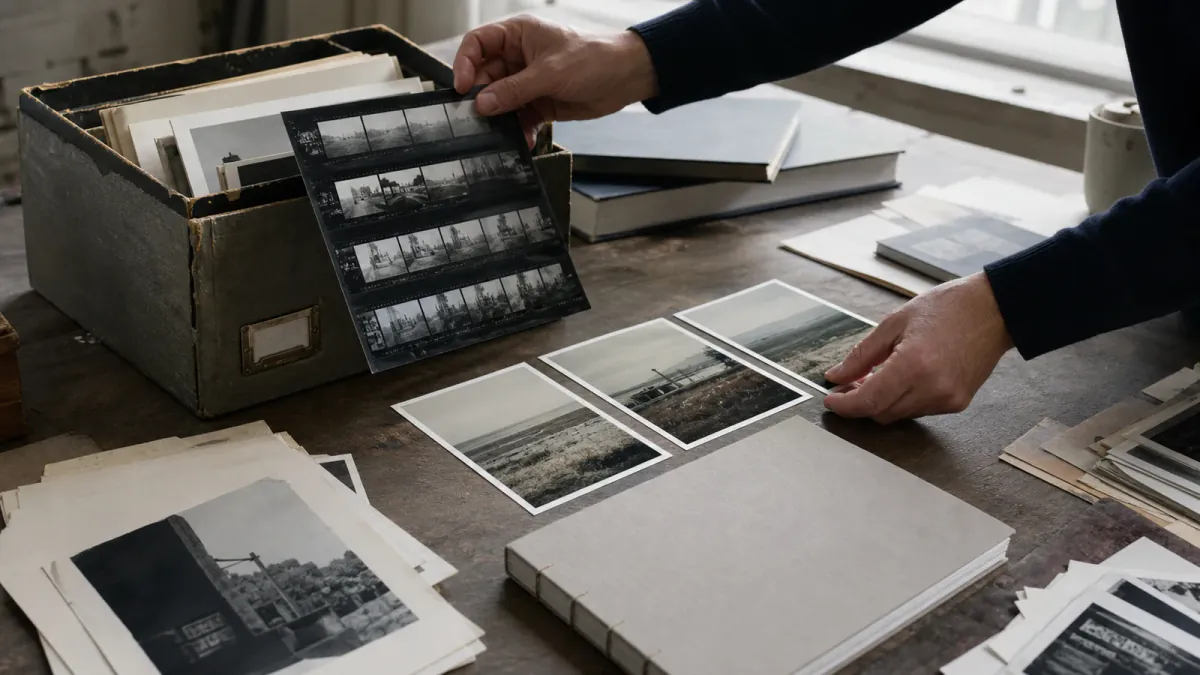
Create a contact sheet or thumbnail grid with the old ratings and sequence labels hidden. Keep a separate filename reference so every selection can be traced back to its original file.
Start with 12 to 20 photographs visible at once. Look for pictures that address the new question, then make another pass for transitions and context. A quieter frame may establish scale, introduce a person, or give the reader a pause between more insistent images.
The one-word photo-selection exercise can help identify your immediate response. Follow it with a more specific question: what does this photograph contribute to the sequence?
Give each selected frame a working role. It might open the story, orient the reader, introduce a visual motif, complicate an earlier image, or bring the project to a close. These labels are editing aids. Let them change as the relationships become clearer.
Bring the first selection down to around 20 frames. At that scale, repeated pictures and missing connections become easier to see. Keep an alternative folder for images you want to reconsider without crowding the main edit.
Build a Sequence You Can Read in One Sitting
Reduce the selection to eight or twelve images and arrange them on a wall, table, or simple digital spread. Begin with the order that best serves the subject. Chronology is useful when time is central, while shape, gesture, distance, or atmosphere may suggest another route.
A photobook makes neighboring images work together. Test a pair in both directions. Notice whether the second photograph expands the first, changes its emotional tone, or shifts the reader's attention from a person to a place.
My Hong Kong archive at Kisau Photography brings separate shoots together through location while retaining their individual identities. For a smaller project, that distinction is useful: a shared place can organize a collection, while a sequence needs its own rhythm and point of view.
Read the edit quickly for pace, then slowly for detail. Leave it overnight and return without your notes. Mark any point where context arrives late, two images repeat the same information, or the ending feels less resolved than the pictures before it.
Let the Edit Tell You What to Photograph Next
Use the small sequence to identify what is missing. Group those needs into a few practical categories:
- An overlooked image may already exist in the archive.
- A weak transition may improve when two pictures change places.
- Missing context may call for a caption, document, map, or photograph.
- A changed subject or unavailable location may suggest a narrower scope.
- An unanswered question may need another period of looking and photographing.
Search and reorder before planning a return shoot. Then give each proposed new photograph a clear purpose. A useful reshoot brief might ask for the setting around a portrait, a recurring activity at another time of day, or a detail that connects two parts of the story.
Before publishing, revisit captions, dates, permissions, and the expectations of identifiable subjects. Preserve the first edit and its context as a dated version, alongside the new sequence.
The reward of returning is a clearer relationship with the work. Familiar photographs can reveal an unexpected structure, and a well-defined gap can make the next session purposeful. The project moves forward through what you now notice, select, and place beside another image.
Worked example: a place study becomes a rhythm study
Suppose the first edit of a neighborhood project contains twelve strong buildings but says little about how the street changes through a day. The new question is how opening, activity, and closing alter the place. Search the archive for an unopened shop, a delivery, a midday gathering, and an evening shutter before returning with a camera.
Build two eight-picture sequences. One follows time, while the other alternates wide views and close details. Write the role of each frame, such as orientation, activity, transition, or ending. Compare whether the sequence communicates the new question without a long introductory caption.
If evening context is missing, a focused return visit now has a specific purpose. The career-habits guide can give that visit a place in the calendar. Preserve original dates and captions so the new sequence does not imply that separate visits were one continuous event.