The practical answer
Give each photograph one word for its immediate effect, then one visible reason for that word. Compare neighboring frames and repeat the edit after some distance. The word starts the conversation, while the reason identifies a framing, timing, or sequencing decision you can change.
Name What Holds Your Attention
A photograph often makes its first impression before you start explaining the exposure or the composition. Naming that response gives you a useful place to begin an edit: what is the picture doing, and which visible choices make it happen?
Landscape photographer Simon Booth uses a one-word question while composing in the field. In Alex Cooke's account for Fstoppers , Booth looks for a positive response such as peaceful or elegant, notices when a scene feels cluttered, and gives particular attention to the quieter verdict of ordinary. Technical competence can make that last response easy to overlook.
Bring the prompt into photo selection by pairing each word with a visual reason. Then return to the pictures after a little distance. The exercise turns an instinctive response into something you can use when choosing a frame, adjusting a crop, or planning another shoot.
Make a First Pass Through the Pictures
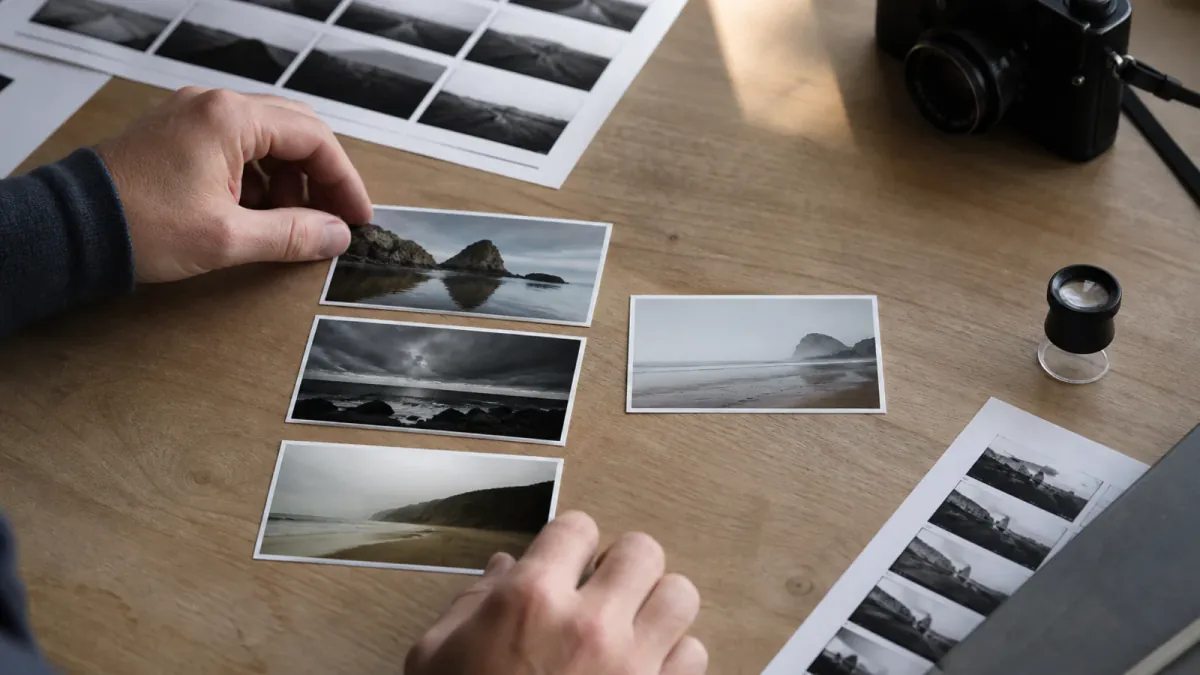
Choose 12 to 20 photographs from one session. Show them at a consistent size and hide ratings, camera settings, and filenames where practical. You want the first pass to begin with the image rather than a reminder of the lens, the journey, or the effort behind it.
Give each photograph about five seconds and write one descriptive word. Calm, compressed, awkward, spacious, and tense all offer more direction than a simple like or dislike. Let the word describe your response, including uncertainty when that is what you feel.
Move through the group before revisiting a frame. Keeping this first pass brief helps you notice which photographs establish a mood immediately and which take longer to resolve. It also gives you a record to compare with your slower examination.
This is the beginning of an edit, so keep the original files and selections intact. Use a separate collection, contact sheet, or notebook for the exercise. You should be free to reconsider a photograph without having to recover something you deleted in haste.
Add One Visible Reason
Return to each picture and explain the word in one sentence. Point to something another viewer can find inside the frame:
- Calm: open space gives the figure room between the surrounding buildings.
- Crowded: three bright edges compete with the face.
- Tense: a diagonal shadow draws attention toward a hand cut by the frame.
- Distant: the small subject sits behind several layers of foreground detail.
A clear reason connects feeling with light, color, gesture, timing, scale, or spatial relationships. It also makes the discussion more useful when someone else reads the same image differently. You can compare where each of you looked rather than argue over whose adjective is correct.
Photographic composition gives you a vocabulary for that discussion. Look at the balance of bright and dark areas, the direction of lines, the space around a subject, and the activity at the borders. Describe the arrangement before deciding how to change it.
Return With Some Distance
Repeat the exercise after 48 hours, keeping your earlier words out of view. That interval is a practical editing rhythm: enough time to approach the sequence again with a different level of attachment to the shoot.
Compare the two sets of notes. A picture that remains quiet may have a consistent relationship between subject and space. One that shifts from exciting to ordinary may have carried more of the outing's energy than its own visual interest. A frame that moves from confusing to tense may reward the longer look.
Give the changed responses your attention. Ask what you noticed the second time, whether your eye followed a different route, and how the neighboring photographs affected the reading. A pair of strong images can compete with each other, while a quieter frame can give a sequence room to breathe.
Turn a Reaction Into a Photographic Decision
Choose a few near misses and write one specific action for each. A crowded frame might benefit from a lower viewpoint, a later gesture, or a crop that removes an unrelated bright corner. A flat portrait might need more separation between subject and background. An ordinary scene might become distinctive through a more precise moment.
Try the changes that remain available in editing, then compare versions at the same size. Keep documentary context intact when cropping. For decisions that belong at capture, write a short prompt for your next session rather than trying to manufacture a missed gesture afterward.
In my Cropping With Intention study at Kisau Photography , the borders and negative space change the emphasis of portraits of Jing Su. A hand, a rose, or the distance around a figure can become the center of attention as the frame tightens. That is a useful question for your own edit: which element carries the response you want to preserve?
Choose for the Photograph and the Sequence
Finish by placing six candidates together. Read each individually, then look at the rhythm of the group. Check captions and subject context alongside the visual edit. A documentary frame may communicate through its testimony, and a connecting image may earn its place through the transition it creates.
The exercise pairs well with Pattern Recognition Turns Familiar Streets Into Better Photography Practice. Repeated walks sharpen what you notice. Repeated edits clarify what those observations become inside a photograph.
Take one word into the next shoot as a starting intention, then see which pictures express it in their own way. The lasting value is a more precise account of your choices: why this frame holds your attention, what the next one adds, and where the sequence is ready to end.
Worked example: turn crowded into a specific edit
Imagine two portraits from one session. Frame A places a face between a bright doorway and a cut-off hand. Frame B preserves the hand but leaves more empty wall. Your first words might be crowded for A and spacious for B. Write the reason before choosing either: two bright edges compete with the face, versus the hand and face have room to connect.
Try a crop of A that removes the doorway without cutting the gesture. Compare it with B at the same size. If the crop loses the place that explains the portrait, B may be the stronger choice even when A has the more animated expression.
In a sequence, a quieter B might also provide breathing room after a dense frame. The archive-project exercise helps distinguish an image's individual strength from the role it plays beside another photograph.