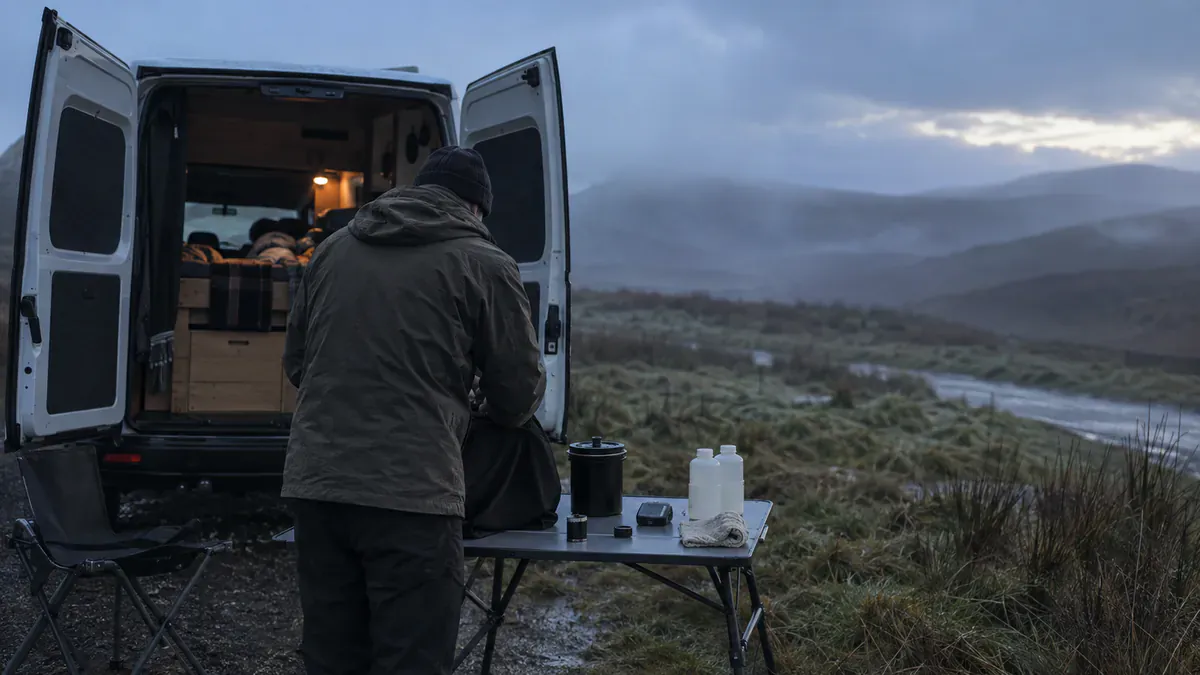
The exposure is made, but the photograph still has a physical journey ahead. A strip of film has to find its way onto a reel in darkness. Later, that same strip will hang wet in a space chosen before it was needed. Off-grid development makes those small arrangements part of the picture.
A landscape can be carefully composed and still acquire a scratch or drying mark afterward. That gives a mobile darkroom a useful priority: protect the negative through each handoff, from loading to processing to storage. Rehearsing those transitions gives the photographs a better chance of keeping what the exposure recorded.
In Alex Cooke's Fstoppers account of Thomas Heaton's Scottish field experiment , Heaton photographs Assynt on medium-format black-and-white film and processes the rolls in a camper van. Loading the reel proves particularly demanding in the heat. Drying takes close to eight hours, and a favorite lighthouse reflection suffers physical damage. These details make a useful starting point for building a mobile workflow around preparation, consistent handling, and unhurried finishing.
Begin the first rehearsal near home with a subject you can revisit and a familiar film. Give processing its own uninterrupted afternoon. As you work, notice where a tool has to be reached for, where a full vessel will sit and where the film can hang without being brushed. Those observations are useful preparation for a smaller workspace.
Let a practice roll teach your hands the route
A changing bag replaces the darkroom for loading a conventional daylight tank. It does not replace familiarity with the reel. Ilford's loading guidance recommends practicing with unwanted film in daylight, then with eyes closed, and keeping the spiral completely dry. Its grooves separate the film so chemistry can reach the emulsion evenly.
Use a practice roll of the format you intend to shoot. With 120 film, rehearse separating the backing paper and feeding the film without losing control of the loose length. Repeat the complete sequence inside the bag, including fitting the tank's light-tight components according to its manual. Keep the tank, reel, and necessary tools in the same positions each time.
Give both arms room and choose a position you can keep comfortably. If the feed starts to resist during a practice run, stop and identify where it catches. The aim is to recognize the feel of film entering cleanly, so a snag does not turn into harder pulling on an exposed roll.
Exposed film needs complete darkness during this loading stage. A red safelight is not a substitute. Open the bag only after the film is securely enclosed in the correctly assembled light-tight tank.
Save the exposure correction before leaving coverage
A long exposure can soften water and stretch passing clouds while a rock keeps its outline. Film adds a stock-specific timing question. Reciprocity failure means that sufficiently long exposures need more time than the meter indicates. The correction belongs in the plan before the phone loses coverage.
Ilford's Delta 100 technical information specifies additional exposure beyond one second. Save the instructions for your chosen stock before leaving coverage, alongside filter factors and a notebook for the actual settings. Use the manufacturer's correction method rather than borrowing a value from another film.
Include an ordinary shutter-speed frame of a repeatable scene on the test roll, alongside the longer filtered exposures. Develop the roll as a whole, then compare the negatives. The reference gives you something less complicated to judge beside an ambitious exposure. A normally loaded roll-film tank processes the connected frames together.
The Newsroom waterfall tutorial develops a complementary exercise: compare shutter speed and reflections while keeping the composition steady. That habit makes experiments easier to read, whether the final image begins on film or a sensor.
Give every full container somewhere to go
Pack a compatible tank and reel, measuring vessels, a thermometer, timer, clean water, labeled chemical containers, suitable protection, and film clips. Check water and storage capacity against the complete sequence, including washing.
Ilford's processing guide sets out the main stages of photographic processing : development, stopping, fixing, washing, and drying. Use the film-and-developer combination's specified dilution, temperature, time, and agitation. Record those choices before mixing, then record what actually happened.
In a compact vehicle, give the wet work a defined area. Keep it separate from food preparation, provide ventilation, and use stable surfaces with spill containment. Follow the product label and safety data sheet for protective equipment and handling. Ilford's health and safety guidance also calls for different waste chemicals to remain separate and labeled. Arrange an appropriate disposal route before traveling, and carry waste to that route rather than releasing it onto the ground or into waterways.
Arrange the workspace as a sequence of movements. Keep the instructions dry and the timer visible. Leave a clear place for the full container you are about to pick up, rather than finding one while holding it. In a compact vehicle, that simple rehearsal can expose a missing surface before chemistry is mixed.
The drying space is part of the photograph
Choose the hanging space before pouring the first chemical. Wet film needs clearance from clothing, upholstery and passing hands, with a tray below for drips. The drying stage determines when the negative is ready to scan or sleeve. A planned departure time does not make it dry sooner.
Once dry, handle the film by its edges and inspect it before cutting. Put the ordinary exposures beside the longer ones and look for density, tone and physical marks. Keep notes about any loading or processing interruption with the negatives. That record gives the next roll a specific problem to solve.
If the van has nowhere suitable to hang the film, a better-equipped location can finish the job later. The exposure is already made. Giving its negative enough space and time is another photographic decision, as deliberate as the one that chose the reflection in the first place.