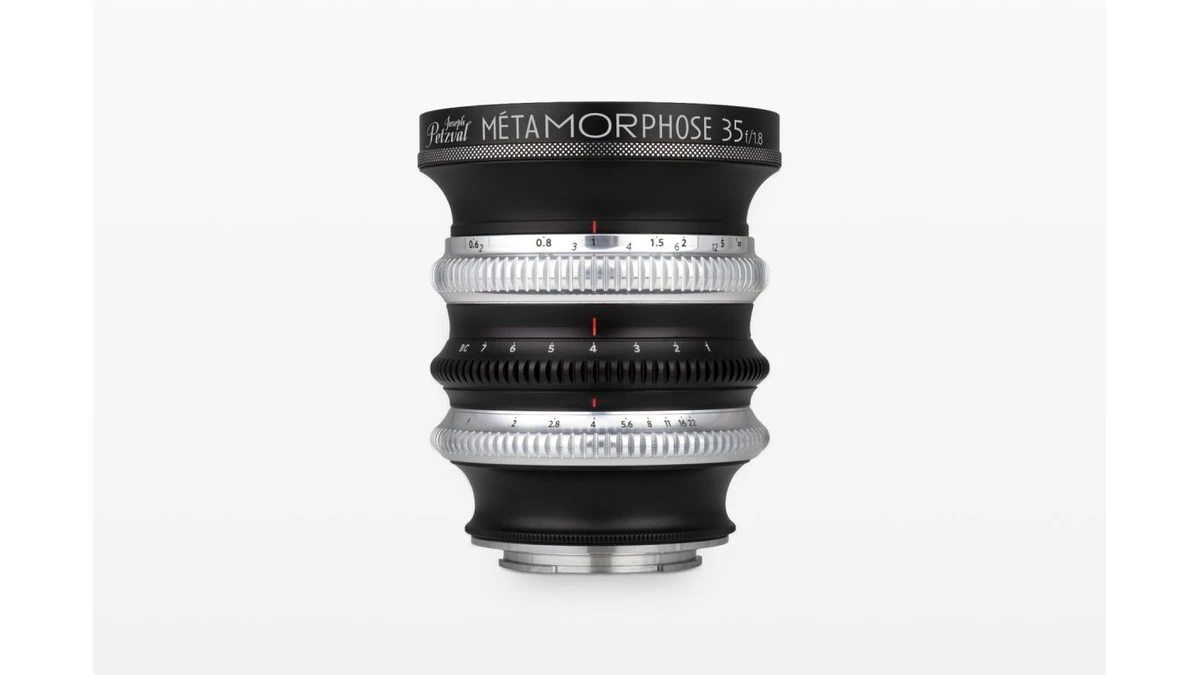
Lomography has announced the Joseph Petzval Métamorphose 35mm f/1.8, a manual-focus lens that makes background character an adjustable part of the composition. The official product page lists seven bokeh levels and versions for Sony E, Nikon Z, and Canon RF full-frame mirrorless cameras.
The design’s interest is broader than a strong blur effect. A photographer usually changes the look of a background through aperture, framing, and the distance between subject and surroundings. A dedicated bokeh control adds another decision: how the out-of-focus parts of the frame behave around the subject that stays in focus.
The center and the edges have different jobs
Lomography describes the highest setting as an optical warp around a sharp center. At the lowest setting, it describes softer edges and soap-bubble-like background highlights. The visual idea is a transition between relatively calm surroundings and a much more energetic perimeter.
For a portrait, this places unusual importance on the relation between the subject and the center of the frame. A face may be the point of attention, but the surrounding pattern can pull the eye toward it or compete with it. A busy background that looks lively by itself can become distracting when it contains bright points close to the subject’s outline.
Bokeh describes the character of out-of-focus areas, rather than simply how much of a picture is blurred. Two backgrounds can be similarly soft while their highlights and transitions look very different. That distinction explains why the new control is a creative variable rather than another name for the aperture ring.
Focus coupling has a specific purpose
The company says its focus-coupled mechanism prevents focus shift when the bokeh setting changes. This addresses a concrete filming problem: changing the background’s character could otherwise disturb the subject’s focus and require another adjustment at the same moment.
The promise belongs to that interaction between the rings. It does not turn a manual-focus lens into an autofocus lens or make subject movement disappear. If the subject walks toward the camera, its distance changes. The person focusing still has to follow that change, regardless of what happens to the background texture.
PetaPixel’s September 30 account reports a 180-degree focus throw and stepless controls. That combination gives the design an obvious filmmaking use: the photographer can plan a visible transition rather than treating the selected bokeh level as a setting that must stay fixed for the whole shot.
A wide frame gives the surroundings more influence
A 35mm lens on a full-frame camera leaves room for context around a subject. In an environmental portrait, the setting can help explain where the person is and what they are doing. The more of that setting the frame includes, the more consequential its visual behavior becomes.
That makes background choice central to this lens’s use. Small highlights, foliage, textured walls, and open sky each supply different material for an optical effect. A largely featureless background may offer little visible change. A background full of contrasting detail can make the perimeter more expressive, while also asking more of the composition.
A useful creative comparison would keep the subject, camera position, and aperture fixed while varying the bokeh control. That isolates what the ring contributes. A second comparison could change subject distance to see how the relationship evolves. These are ways to evaluate a look once the lens is available, rather than claims that one setting is inherently better.
Close focus adds another compositional option
The official specification lists a minimum focusing distance of 0.35 meters. Working close can make the foreground subject a stronger presence in the frame while allowing its surroundings to recede. It also makes small shifts in camera position more visible in the relation between near and distant elements.
For a still-life composition, that can encourage careful placement of a clear central form with texture around it. For a portrait, working distance also affects the perspective a viewer sees. A dramatic background effect cannot compensate for a camera position that gives the face a proportion the photographer did not intend.
The practical question is therefore where the lens’s character belongs in the picture. It may support an expressive portrait, an atmospheric detail, or a moving shot with a deliberate change in mood. The same character could make a less useful match for a subject that requires consistent edge detail. The scene and the reader’s attention should lead the equipment choice.
Availability is still a preorder decision
Lomography’s US listing shows a starting price of $649 and estimated shipping in December 2026. PetaPixel reports the same launch price and timing. Those are announcement and preorder details, with the current retailer page supplying the relevant purchasing status.
The new lens is a first look at an optical design, rather than a firsthand evaluation of production samples. A later test can examine center and edge behavior, focus repeatability, and the visual transitions under controlled conditions. Those observations will be especially useful because a distinctive rendering can be desirable without being appropriate for every kind of assignment.
Métamorphose’s strongest photographic proposition is that the background can become an active, adjustable element. The subject still needs a purposeful position, the highlights still need room to work, and focus still needs attention. When those decisions agree, changing the bokeh becomes part of directing the picture’s movement and mood.