In August 1945, photographic film at Eastman Kodak developed dark spots while still in its packaging. The defect led physicist J. H. Webb to radioactive material in the cardboard, and from there to fallout from the first atomic bomb test. A supply-chain failure had become a record of an event far beyond the factory.
Alex Cooke’s September 28 account in Fstoppers brings this episode back into view. Its strongest photographic lesson is that an emulsion records more than the light a photographer intends to admit. The historical lesson concerns how evidence travels: through air, water, manufactured materials, and eventually public institutions.
The experiment that reached a box of film
The Department of Energy’s history of Trinity places the first nuclear explosion in New Mexico on July 16, 1945. The device used plutonium and stood on a tower in the desert. Its detonation preceded the atomic bombings in Japan that August.
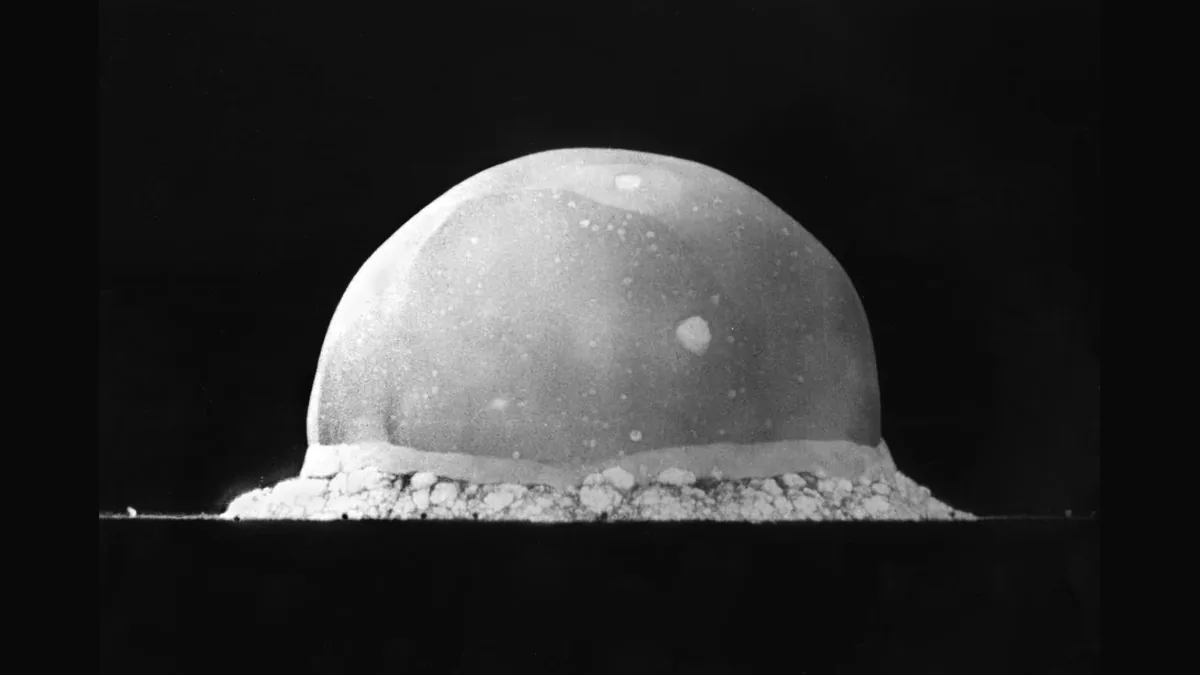
The Trinity test also left a deliberate photographic record. The familiar Trinity photograph , reproduced above, shows the fireball 0.016 seconds after detonation. Berlyn Brixner made it for Los Alamos. That image deliberately records an explosion. Kodak’s damaged film recorded another part of the same event through an entirely different chain of contact.
Those two photographic records have different meanings. One describes the shape of an extraordinary instant. The other makes an invisible material connection visible after exposure and development. Reading them together expands the story beyond the dramatic image at ground zero.
What Webb could measure
The authoritative starting point is Webb’s 1949 paper in Physical Review , whose published abstract identifies strawboard manufactured in Vincennes, Indiana, beside the Wabash River. A production run dated August 6, 1945 contained an unusual radioactive contaminant. X-ray film touching the board developed fogged spots after about two weeks.
Webb found beta activity without detectable alpha activity. The measured beta energy was about 0.6 MeV, with a half-life of approximately 30 days. The chemical results placed the contaminant among the rare-earth elements. These findings were compatible with cerium-141, rather than a definitive identification of that isotope.
His explanation connected contaminated river water with wind-carried fission products from Trinity. That distinction matters: the industrial process could incorporate fallout into packaging even when the material appeared ordinary. The board became the exposure source sitting directly beside the film.
The paper’s reasoning moves from observation to measurement to explanation. A visible spot established a defect. Radiation and chemical measurements narrowed its cause. The timing and material route connected it to a specific historical event. Each step answers a different question, and the isotope qualification belongs in the account because it preserves the precision of Webb’s result.
Kodak had a baseline, not a lucky guess
The Museum of Radiation and Radioactivity at ORAU explains why Kodak was already examining packaging. Earlier recycled paper could carry contamination from the radium industry. The company therefore arranged for carefully selected raw materials at an Indiana mill.
That prior experience gave the new defect a meaningful baseline. A clean-looking box was insufficient protection for a sensitive product. Kodak’s investigation extended beyond the emulsion to the materials around it, precisely because an earlier problem had established that those materials could matter.
ORAU retains a spotted-film specimen and a declassified 1947 letter requesting further information from Webb. It also records Kodak’s installation of air samplers in ventilation intakes. These surviving objects connect the investigation with subsequent monitoring, rather than leaving it as an anecdote about a ruined shipment.
This is the part of the story most useful to photographers: the finished negative contains the consequences of its entire handling history. The intended exposure is one part of that history. Materials, storage, and transport can also become part of the image.
Detection did not mean advance knowledge of the bomb
The chronology limits the popular claim that Kodak discovered a secret weapon. The packaging incident followed Trinity, and Cooke points out that the atomic bomb had become public by the time the problem emerged. Kodak’s distinctive finding concerned where radioactive debris had traveled.
That is a substantial discovery on its own. It connects a weapons test with a distant commercial material, using measurements from the damaged product. The story becomes more informative when “detected the bomb” is understood as tracing fallout from the test, rather than learning about the weapon before everyone else.
Who received the warnings?
Later testing raised a different question. In the October 1, 1997 Senate hearing on Nevada fallout , Senator Tom Harkin described Kodak’s complaint following elevated radiation readings in Rochester after snow in 1951. He said the Atomic Energy Commission agreed to advance information about tests and expected contamination, extending forecasts to the photographic industry.
Harkin challenged the absence of comparable warnings for dairy farmers and parents. The hearing records that challenge and testimony about the disparity. It does not establish a single documented decision in which officials explicitly ranked film above children. The question of institutional priorities is serious enough to retain that distinction.
The National Cancer Institute’s fallout explanation describes a separate exposure pathway: iodine-131 deposited on pasture, consumed by cows and goats, and transferred through milk. Its account identifies childhood exposure as particularly consequential and explains that incomplete historical records complicate reconstruction.
Film damage and human exposure are different measurements. A damaged sheet cannot establish someone’s absorbed dose or eventual health outcome. The connection lies in the movement of fallout and the distribution of information about it. Kodak’s case shows an industrial customer responding to contamination, while the later hearing asks how protective information reached the wider public.
Read further into Kodak’s history
For a wider view of the company, Douglas Collins’s The Story of Kodak on Amazon I may earn a commission is a 1990 illustrated history published by Harry N. Abrams. It offers company and photographic-history context beyond this episode. The book is a further-reading option, while Webb’s paper and the historical records above support this article’s central account.
Kodak’s own history pages place its work across consumer photography, motion pictures, and health imaging. The Trinity episode belongs within that broader history of making sensitive materials reliable. Here, the failure of that reliability produced evidence: the film registered an exposure that no photographer had planned.