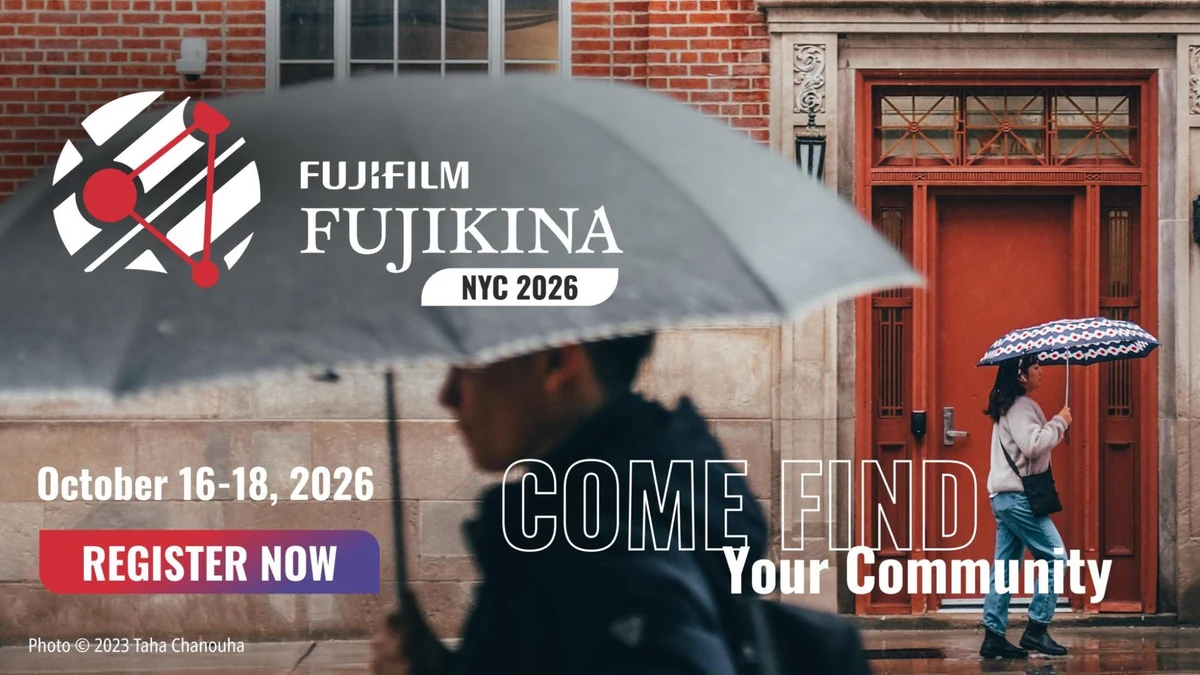
FUJIKINA NYC 2026 brings three days of photography to New York’s Lower East Side from Friday, October 16, through Sunday, October 18. Hosted by Fujifilm and anchored at the International Center of Photography , the festival combines exhibitions, talks, workshops, photowalks and portfolio feedback across eight neighborhood venues. Marking photography’s 200th anniversary, the $10 Experience Pass is open to photographers using any camera brand, including people just starting to make pictures.
The most useful way to approach the weekend is to choose a photographic purpose before filling a schedule. You might want to see how an accomplished photographer edits a body of work, practise working with movement on the street, or put a finished project in front of an editor. Those choices lead to different sessions, and the festival offers room for each. Its galleries also make a substantial visit possible without a tightly booked workshop itinerary.
Fujifilm announced the festival on August 17, 2026, as documented in Digital Camera World’s announcement coverage . The organizers’ current program supplies the attendance details for the October weekend.
The Pass, Reservations and Official Program
Start with the official festival website and its downloadable full schedule and venue map . The PDF shows the parallel programs by day and location. It is particularly useful for spotting overlaps before reserving activities.
The $10 general admission Experience Pass covers the festival’s exhibition program and a selection of talks, panels, meetups and community spaces. It does not mean every workshop or special activity is included, or that every seat is guaranteed. Fujifilm offers both free and paid add-ons, booked through the festival area of a FUJIFILM Shop USA account after buying a pass. Add the chosen activities to the cart and complete checkout, including free reservations.
In the downloadable program, a red triangle marks an activity requiring a pre-booked add-on. A walk-up waiting list may be available. Other sessions are general admission but can reach venue capacity. Keep the badge and activity tickets accessible throughout the day, and check the account’s personal schedule before travelling between rooms.
ICP members can obtain free festival access by requesting the discount code through the contact route on ICP’s festival listing . Membership access still needs to be reconciled with any separate session booking. All times below are local New York time, Eastern Daylight Time, and represent published plans rather than a promise of remaining places.
Eight Venues Within a Neighborhood Route
The organizer’s map identifies eight festival locations. ICP describes the cluster as walkable, with venues generally a five- to eight-minute walk apart. The exact journey depends on the chosen pair of addresses, the entrance and personal mobility. Use the map’s access symbols and venue information when planning a route.
| Festival venue | Address | Main role |
|---|---|---|
| International Center of Photography | 84 Ludlow Street | Exhibitions, library talks, school tours, studios and badge check-in |
| FUJIKINA Theater, Seward Park campus | 68 Ludlow Street | Talks, screenings and weekend badge check-in |
| FUJIKINA Community Gallery, Hashimoto Contemporary | 54 Ludlow Street | Community exhibition, conversations and photowalk meeting point |
| femmefoto*, Somwhere | 48 Ludlow Street | Gallery, community conversations and photowalks |
| Magnum Photos | 301 Grand Street | Exhibitions, tours, artist talks and photowalks |
| FUJIFILM Brand House | 294 Grand Street | Equipment experiences, exhibition, talks, workshops and badge check-in |
| World Press Photo | 105 Eldridge Street | Exhibition, guided tours and photowalk meeting point |
| FotoFest and Professional Photographers of America, Manny Cantor Center rooftop | 197 East Broadway | Saturday portfolio reviews and professional discussions |
The theater is closed Friday in the published map. The Manny Cantor Center program runs Saturday only. Those distinctions matter when deciding which day to attend. Badge pickup is listed at ICP and the Brand House, with the theater also providing check-in Saturday and Sunday.
For a gallery circuit, Ludlow Street connects ICP, the theater, the Community Gallery and femmefoto*. Grand Street then links the Magnum space and Brand House, with World Press Photo nearby on Eldridge. The Manny Cantor Center is a separate southeast leg toward East Broadway. Leave enough time to enter a building, find the correct room and settle in before a reserved session.
The map marks World Press Photo’s main exhibition space as stairs-only, with an accessible viewing annex at the Brand House. It describes theater wheelchair access as available by request. Confirm arrangements with the organizers before relying on a particular venue. The map also identifies the Delancey Street–Essex Street, Grand Street and East Broadway subway stations. ICP’s visitor information supplies an additional starting point for the central venue.
The Exhibitions Deserve Time of Their Own
Fujifilm’s gallery guide describes six exhibition strands within the festival, all covered by the Experience Pass. They range from established documentary archives to the work of local photographers. Give at least one gallery an unhurried visit, even if workshops are the main reason for attending.
At Magnum Photos , A World in Color connects the cooperative’s color archive with contemporary photographic responses. Alec Soth: Three Teens follows three teenagers through a coming-of-age project. Seeing the photographs before hearing an artist speak gives the discussion a concrete foundation: the relationship between individual frames, the sequence and the people represented.
The World Press Photo Exhibition 2026 brings the annual contest’s awarded photojournalism and documentary projects to 105 Eldridge Street. Its captioned stories reward attention to the relationship between a photograph and its reporting context. The accompanying tours provide another way into that relationship, through questions about the circumstances and decisions behind the images.
ICP’s program connects the festival to I’m So Happy You Are Here: Japanese Women Photographers from the 1950s to Now and Laia Abril: On Rape and Institutional Failure. The Friday Abril tour includes discussion of sexual violence, as ICP states in its event information. That context is useful when choosing a session, particularly for visitors attending with others.
The Community Gallery’s Inheritance explores what images leave behind, while femmefoto supplies a community-led exhibition and conversations. The Brand House’s 15 Years of X Series* brings the camera system’s history into a gallery setting. Together, these spaces let visitors compare several uses of photography: recording public events, describing private lives, preserving a local memory and experimenting with visual form.
Friday Highlights: Color, Books and an Opening Circuit
Friday is a useful entry point for visitors who want to orient themselves before Saturday’s dense program. The Brand House’s Opening Basecamp Meetup is scheduled from 11 a.m. to 1 p.m. The downloadable schedule places Ritchie Roesch’s Fuji X Weekly film-simulation discussion immediately afterward, from 1 to 2 p.m.
Roesch’s subject suits photographers interested in making a deliberate color decision before pressing the shutter. Film-simulation recipes can establish a consistent rendering approach across a sequence. The useful question to bring is how a particular look supports the subject and the intended output, rather than how many recipes can be collected.
At ICP, the current event listing schedules a 2:15–4 p.m. conversation with Yuki Tawada, Yurie Nagashima and Tomoko Sawada, followed by a 4 p.m. discussion of the making of I’m So Happy You Are Here, with Lesley Martin, Pauline Vermare and Carrie Cushman. These sessions make the relationship between photographic practice, exhibition and book especially tangible. They are distinct from simply walking through a display.
The PDF also lists a guided Magnum tour from 2 to 3 p.m. and a World Press Photo tour beginning at 4 p.m. Gallery opening activities run into the early evening. A workable Friday approach is to choose either the ICP book-and-exhibition conversations or an initial gallery circuit, then use the opening period to meet other visitors. Trying to combine simultaneous talks at different addresses would sacrifice the attention each deserves.
Saturday Highlights: Street Practice and Major Conversations
Saturday has the widest spread of parallel activity. The downloadable program lists FUJIFILM Touch & Try at the Brand House from 10 a.m. to 7:30 p.m., with photowalks, studio experiences and talks distributed across the neighborhood.
David Campany and Alec Soth are scheduled in conversation at the FUJIKINA Theater from 2:30 to 3:30 p.m. ICP identifies Soth’s Three Teens as the subject. This is an especially useful anchor for visitors interested in how a photographic project develops, and how a small group of subjects becomes a coherent exhibition.
Later, World Press Photo’s festival program places Kira Pollack in conversation with Carol Guzy at the theater from 4 to 4:45 p.m. Their discussion concerns photojournalism on the U.S. front lines, including reporting on immigration and the care of photographic archives. It offers a different working perspective from a session about camera settings or visual style.
For street practice, the PDF lists repeated photowalks with Derek Fahsbender, Jasmine Quiñones and Hayden Goldsworthy about movement in the city, and with Alison Conklin and Melissa Breyer about everyday geometry. Jonas Rask leads black-and-white street sessions from the Magnum Gallery meeting point. Tom Baumgaertel’s multiple-exposure walks meet at the Brand House. These are reservable activities in the program, so choose a slot before arranging the rest of the day.
The distinction between them is photographic. Movement asks how shutter speed and timing describe a changing scene. Geometry asks which lines, shadows and spaces hold a composition together. Black and white places more attention on tonal separation and light. Multiple exposure builds a frame from layers. A single focused walk can provide a clearer experiment than moving hurriedly among several techniques.
ICP also offers tintype portrait sessions with Larson Harley during the afternoon and evening. Its festival listing includes a separate reservation route. The wider program includes Janette Beckman’s documentary and portrait talk, Melinda Sue Gordon on movie stills, and professional discussions organized by the Professional Photographers of America . Check the account schedule for the chosen session’s location and admission conditions.
FotoFest Portfolio Reviews Are a Separate Commitment
The Meeting Place by FotoFest is scheduled for Saturday, October 17. FotoFest describes a half-day program for 50 photographers and 25 reviewers, with each participant receiving three individual 20-minute appointments. Its published review hours are 9 a.m. to 12:30 p.m., with check-in before the reviews begin.
FotoFest lists a $250 review fee, in addition to the $10 festival pass. Registration is required for this half-day program. FotoFest’s page currently carries a sold-out notice. Use its official page and contact route for any waitlist or availability question, and do not plan on obtaining a review by arriving with prints. The program’s reviewer-preference deadline was September 30, and individual schedules are due to be released October 12.
FotoFest encourages physical prints but does not require them. Its guidance recommends prints between 8×10 and 11×14 inches to fit the review tables comfortably. Participants should bring a complete or nearly complete body of work that is ready for exhibition or publication. The practical preparation is to edit that work into a legible sequence and identify the question the reviewer can help answer: selection, pacing, presentation or the next destination for the project.
Reviewers’ interests vary, so read the biographies and genre preferences on FotoFest’s page. A review’s value depends partly on the fit between the work and the professional seeing it. Returning participants should check their appointment schedule at check-in, since FotoFest notes that travel or other circumstances can prompt changes.
Sunday Highlights: A Project, a Critique and a Final Walk
Sunday offers a shorter gallery day and another chance to connect looking with practice. Alec Soth’s About the Work talk is listed at Magnum from noon to 12:45 p.m. World Press Photo’s guided exhibition tour follows from 12:30 to 1:30 p.m. These sessions overlap, so they are alternatives for a visitor planning to attend in full.
Earlier, Saba Askary’s Why Your Work Belongs in World Press Photo is scheduled from 10:45 a.m. to 12:15 p.m. at the ICP Library. World Press Photo describes it as guidance on preparing an entry for the 2027 contest, including what makes a strong submission and how judging works. Bring questions about the reporting and sequence of a real project, so the advice has a specific application.
Michael Ackerman’s group critique at ICP provides a different kind of feedback. ICP asks participants to bring physical prints, or a hard drive and a device for viewing images. ICP and the downloadable festival program disagree on the timing: ICP’s event page gives 10:30 a.m.–noon, while the downloadable festival program gives 10:45 a.m.–12:15 p.m. Confirm the reserved time in the festival account before attending. The same habit is useful for every session, since partner pages and static schedules can change at different speeds.
The program also includes Coco Tolentino’s short-film screening at the theater from noon to 2 p.m., and Meryl Meisler’s afternoon photowalk. Visitors drawn to street photography can connect a gallery morning to a session about seeing the neighborhood, then leave room to make a few photographs independently. The streets between venues are part of the experience, provided a walk does not make a reserved session late.
Equipment Without a Brand Requirement
The Brand House provides an opportunity to handle Fujifilm equipment, alongside the festival’s talks and exhibitions. FUJIFILM’s X Series and GFX information is the official starting point for understanding the camera families. If a hands-on session raises a concrete equipment question, the Fujifilm Store on Amazon provides a separate commerce destination for cameras, lenses and related products.
Bring the camera you already enjoy using. Fujifilm explicitly welcomes people working with other image-making tools, and attendance does not require changing systems. For a photowalk, practical preparation includes charged batteries, available memory, comfortable shoes and clothing appropriate to outdoor conditions. For a critique, the essential equipment is a reliable way to show the selected work. Keep the bag manageable enough to move between venues and pay attention to the pictures.
A Weekend Built Around Looking and Making
FUJIKINA’s most useful combination is the proximity of finished work and working practice. A gallery can reveal the choices that hold a sequence together. A talk can explain those choices. A workshop or walk can then give a photographer a specific idea to test. Choosing one gallery, one major conversation and one practical session creates a coherent day without requiring every hour to be reserved.
For wider context, Newsroom’s October 2026 New York photography calendar places the festival alongside other exhibitions and events. The background on ICP helps explain why a museum and photography school can serve as the festival’s central meeting point. For this weekend’s actual attendance decisions, return to the official program and the personal account schedule.
FAQ
Does the $10 pass cover the whole weekend?
The Experience Pass is the festival’s general admission access for October 16–18. Some activities require a separate free reservation or paid add-on, and rooms have capacity limits. Check the chosen session before assuming it is included.
Do I need a Fujifilm camera?
No. The organizer welcomes all experience levels and camera brands. Bring the image-making tool suited to the activity you have booked.
Can I get a FotoFest review with general admission?
No. FotoFest portfolio reviews require separate registration in addition to the Experience Pass. Its page currently displays a sold-out notice, so consult FotoFest directly for any change in availability.
Where can I find the complete official program?
Use the full schedule and map linked above, then check the festival area of your FUJIFILM Shop USA account for booked activities and their current details. Partner listings from ICP, World Press Photo and FotoFest provide additional session information.