Davide Tranchina makes photographs that invite a second look at what an image appears to show. His exhibition Light-years Away at CAMERA opens in Turin on October 17, 2026, bringing more than two decades of work into a presentation that ends with a new piece made for the institution's Project Room.
The exhibition offers a useful way to approach experimental photography: begin with what the picture makes visible, then ask how that visibility was constructed. A photograph can record light with great precision while leaving the identity, scale or distance of its subject open to interpretation.
A hand makes an apparent universe personal
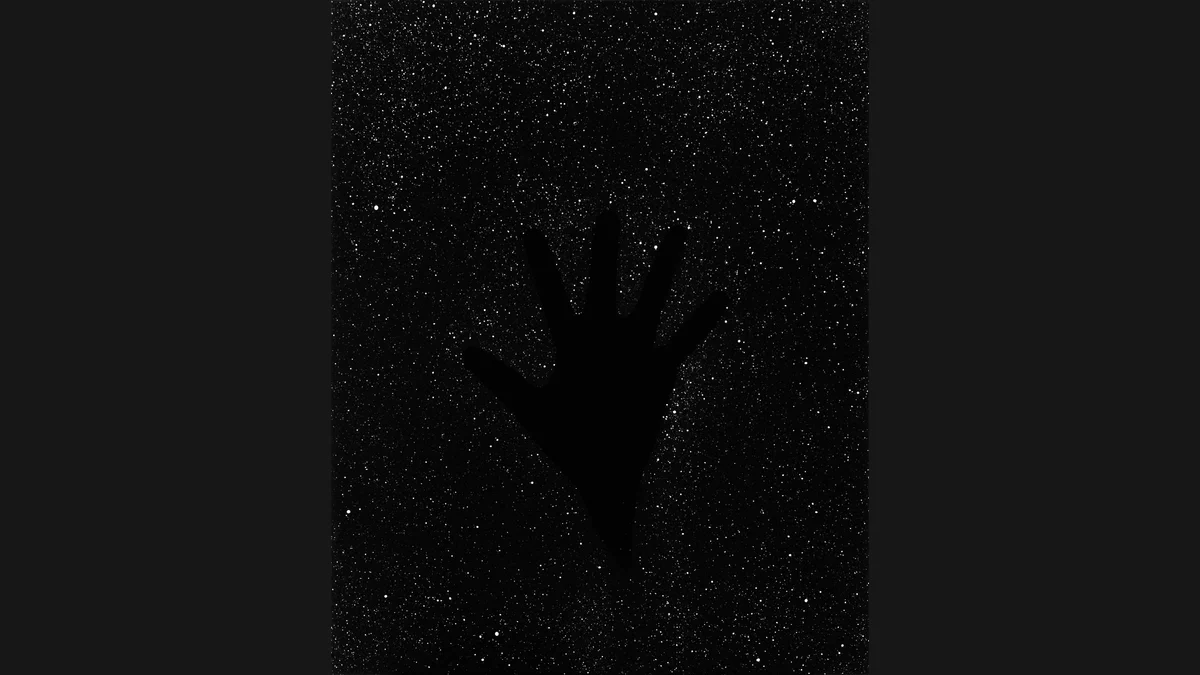
The image CAMERA uses to introduce the exhibition, Big Bang Self Portrait from 2009, presents a dark hand against a dense field of white points. The spread fingers interrupt that luminous field, establishing a familiar bodily shape within something that initially resembles a night sky.
The effect depends on two kinds of recognition arriving together. The hand feels close and human. The speckled expanse suggests a scale that is much harder to measure. Neither a horizon nor an ordinary room supplies a stable distance between them.
Read through its title, the work draws a connection between a self-portrait and an imagined origin. The visible hand supplies a personal presence without the face, expression and surrounding room that usually organize a portrait. The white marks carry the eye outward, while the silhouette keeps returning it to the body.
The image's ambiguity is available to examine in its arrangement of light and dark. The relationship between the visible hand and the luminous field invites a viewer to move between bodily and imagined scales.
Photography can construct the thing it reveals
In his own account of his practice , Tranchina describes an interest in intangible subjects such as infinity, distance and energy, often using techniques that work without a camera. Photography, installation and video form part of that exploration.
The photogram provides useful background for understanding this broader field. In a photogram, light and material interact directly with a sensitive surface. Objects can leave traces without being described through a camera's conventional viewpoint. That general principle helps explain why a photograph's relationship to reality can extend beyond the familiar act of pointing a lens at a scene.
It also changes the questions a viewer can ask. What blocked the light? What reached the surface? Which marks resemble something familiar, and which resist identification? A work can be materially precise while encouraging several imaginative associations.
CAMERA describes the exhibition in terms of the construction of images and the relationship between perception and representation. Those ideas become easier to grasp when attached to a particular visual decision, such as placing a recognizable hand inside a field whose apparent scale remains uncertain.
A survey with a new work at its endpoint
The exhibition is curated by Walter Guadagnini and made in collaboration with Galleria Studio G7 . Its span of more than twenty years allows the visitor to look for recurring questions across different bodies of work, rather than expecting one technique to explain an entire career.
The Eye of Photography's October 16 preview identifies works including 40 notti a Montecristo, Apparent Horizons, Spectrum and The Kármán Line. Their titles introduce ideas of duration, boundaries and distance, giving a viewer several possible routes through the broader photographic inquiry.
The new work conceived for CAMERA adds a forward-facing element to that survey. Earlier projects establish the vocabulary, while the commission brings the inquiry into the particular space where the exhibition takes place. The institution has not made the whole presentation interchangeable with its online preview.
For the reader, that distinction creates a useful expectation. The published images can introduce the visual questions. The exhibition offers the opportunity to encounter their physical scale, sequence and relationship to the room.
Look at the picture before solving it
A productive first pass through work like this can be very simple. Notice the brightest area, the darkest interruption and the point where the eye changes direction. Look for a visual cue that suggests distance, then see whether another cue unsettles that impression.
With Big Bang Self Portrait, the hand gives the white field a bodily reference. Covering that silhouette mentally changes the picture. It becomes easier to imagine an unbounded expanse. Restoring the hand brings touch, proximity and a particular person's presence back into the composition.
Those observations make the title more interesting because the image has already established a tension of its own. The label can expand a reading that begins in the photograph, rather than supply the only reason to look at it.
Newsroom's earlier account of Julia Fullerton-Batten's photographic practice offers a related question about constructed images. Different artists use construction for different purposes. The connection is the attention a viewer gives to the decisions that make a photograph persuasive.
Plan a visit to Turin
Light-years Away runs in CAMERA's Project Room from October 17, 2026, through January 6, 2027. The institution is at Via delle Rosine 18 in Turin. Its visitor information is the appropriate place to check current opening hours, tickets and access arrangements before travelling.
The exhibition is accompanied by a catalogue from Dario Cimorelli Editore. It offers another way for readers to follow the work beyond the visit.
The strongest invitation is visual: take a familiar thing, such as a hand, and watch how its meaning changes inside an unfamiliar field. Tranchina's exhibition gives that act of looking a history, a sequence and a new work through which to continue it.