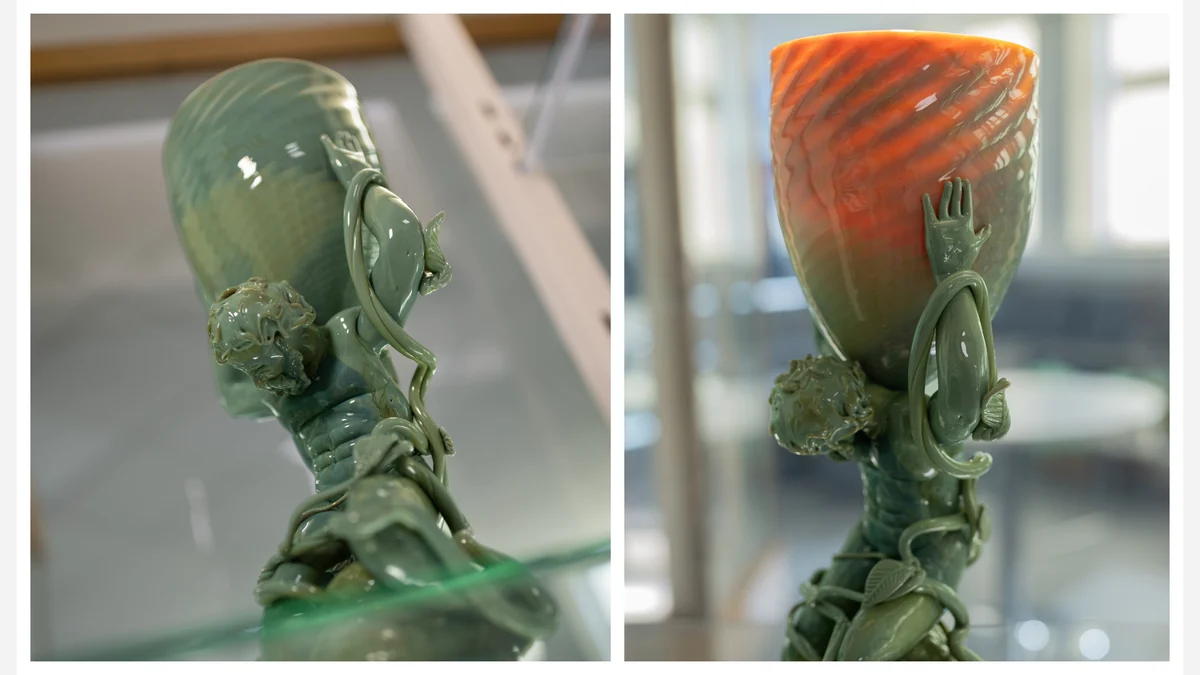
Same glass, two appearances
There is a particularly satisfying kind of surprise in an object that changes while staying right in front of you. No replacement is needed. Move the light, and the thing you thought you had finished looking at offers another version of itself.
The University of Sheffield's October 26 account describes glass that appears green in reflected light and red when light passes through it. Smithsonian's October 28 feature brings fresh attention to the work and its ancient inspiration, the Lycurgus Cup.
Hollands worked with Roman-glass specialist Caroline Jackson and experimented with materials and furnace conditions. The university describes small amounts of gold and silver playing a part in the effect. The process required more than adding a colorful ingredient to an otherwise finished object.
An old material gives an artist a new problem
The university then commissioned Walker to make a sculpture with the glass. His design connects the Lycurgus story with the figure of Atlas, replacing the globe with a cup. The material becomes part of the idea rather than simply a decorative finish applied at the end.
That is an enjoyable way to look at craft. Ask what the material makes possible before asking whether you like the finished shape. Here, lighting becomes part of the encounter with the object. A photograph showing one appearance cannot offer quite the same experience as seeing the change happen.
The wider category of dichroic glass provides background, but the historical claim needs care. Modern makers have produced color-changing glass before. Sheffield's account emphasizes a repeatable recreation connected to the ancient material, not the invention of every form of glass that changes color.
Give the reveal a little time
Newsroom's earlier Wakasa chopsticks story follows a different kind of reveal. A maker builds decoration into lacquer, then polishing brings the pattern into view. The processes are distinct, but both reward looking beyond the first surface.
That connection makes a pleasing prompt for the next museum visit. Choose an object and notice how its appearance depends on where you stand or where the light falls. A surface may look settled from one position and unexpectedly busy from another. Sometimes the second look is the best part.
Sheffield says Walker's sculpture will be unveiled at the Millennium Gallery during Festival of the Mind, November 6–15, 2026, before moving to the university's Turner Museum of Glass. Check the event's current visitor arrangements before making plans.
FAQ
Does the glass change color because it is painted differently on each side?
The reported effect comes from how the glass interacts with reflected and transmitted light. The same material can present the two appearances.
Where will the new sculpture be shown?
The university announces a November 6–15 unveiling at the Millennium Gallery, followed by permanent display at its Turner Museum of Glass.
Was the original Roman cup made for this project?
No. The ancient Lycurgus Cup is the inspiration. The university's announcement concerns recreated glass and a contemporary sculpture made with it.