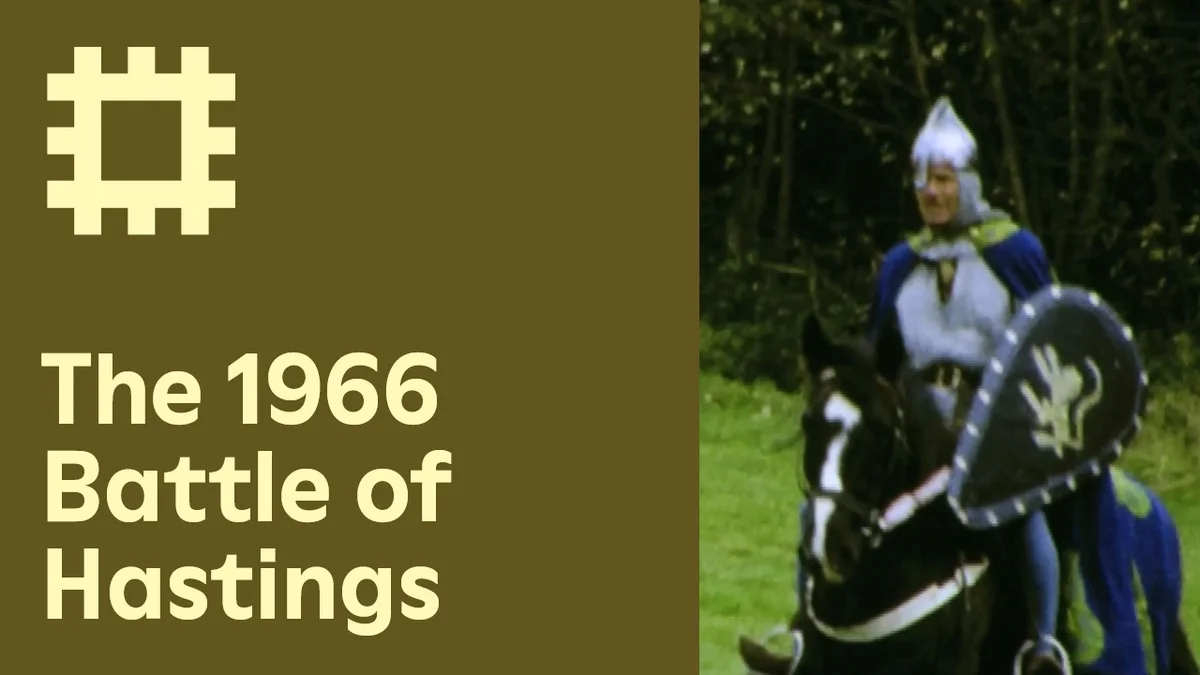
A family film archive has brought the 1966 Battle of Hastings reenactment back into view. Restored footage made by Alan Wootton and his team will return to Battle Abbey this weekend, with an invitation for the people on screen to help fill in its missing names.
English Heritage's October 6 announcement introduces the recovered color film ahead of the October 10 and 11 event in East Sussex. The pleasure is in the reunion it makes possible: a community can revisit an early version of its annual gathering, and former participants may find themselves in a moving family album.
Smithsonian's October 8 coverage brings renewed attention to the released film and the search for its participants.
A father’s film, a son’s return
The film belongs to a larger collection of 300 reels passed to Alan's son Cliff. ITV's account of the restoration describes Cliff gradually reviewing and restoring that material. He had also helped make the original recording, working with his brother Den as a sound recordist when he was twelve.
That gives the project a particularly lovely continuity. The person returning to the footage knows it as an inherited collection and as an occasion he helped record. A child's contribution to a family undertaking has become part of the work he can share decades later.
There are two kinds of recognition available here. One is personal: a familiar face, a remembered role, or the realization that someone in the family took part. The other belongs to the event itself. A gathering that has acquired its own traditions can encounter an earlier version of its public life.
Neither requires the viewer to be an expert in medieval history. The film offers an invitation to look at people making something together, then to consider what those people might remember that the camera could not record.
A town puts on a show
The 1966 festivities marked the battle's 900th anniversary. English Heritage describes the reenactment as the first regular edition of the event that became an annual tradition. The footage includes a procession along Battle High Street, putting the town's familiar public space inside the film.
Battle, East Sussex has an unusually close relationship between its main street and abbey. The abbey gateway anchors the street's southern end. That geography makes the old procession more than an interchangeable parade: it records an event moving through a place whose identity remains closely connected to the gathering.
When opening the official restored-film video , try looking for two layers. Follow the reenactors and the roles they are performing, then notice the setting that holds the performance. A costume belongs to the imagined earlier period. A street, crowd, and way of organizing the occasion belong to the year in which the camera was running.
This is a useful way to enjoy an archive film without turning every detail into a historical verdict. The record preserves a particular performance and the community occasion around it. Its charm can come from that double view, with an older story being retold by people who have themselves become part of the local past.
The sound connection
Alan and Mary Wootton's interests extended beyond filming. The Supersound history , linked by English Heritage, describes the electronics company they established in 1952. Its products included amplifiers, tape decks, and projector accessories.
The connection gives the recording project a practical dimension. Making a local film could draw on the same curiosity about equipment and sound that shaped the family business. Cliff's role behind the recording equipment is part of that shared creative activity.
For today's viewer, sound also provides a helpful question to keep alongside the images: which elements belong to the original recording, and which belong to the restored presentation? English Heritage credits a soundtrack by musician Jonny Dyer for the released film. The present soundtrack therefore belongs to the film's return to an audience.
Music gives the shared presentation another creative contribution. It can help a recovered reel become something people gather around, while the original images retain their connection to the earlier event.
An archive can keep gaining names
English Heritage is asking former participants, or people who recognize relatives and friends, to come forward. ITV reports that many foot soldiers were recruited from Sussex and Kent universities, while the organizers lack a record of their names. Surviving participants may be invited back as special guests.
That request turns watching into a possible contribution. A viewer might recognize someone, connect the recording with a family photograph, or remember a detail that helps identify a scene. The reel stays the same, but the account attached to it can become richer.
The wider pleasure of film preservation is this return to an audience. The BFI National Archive describes preservation and public access as connected parts of its work, and offers free archive films to explore. The Wootton project gives that broad idea an intimate scale: one family collection can reopen a local conversation.
Where the old film meets the new gathering
The 2026 Battle Abbey event page lists October 10 and 11, from 10 a.m. to 5 p.m., with living-history camps, music, and other activities alongside the reenactment. English Heritage says the recovered film will be shown in the school library during the weekend.
The online video offers a way into the story for readers elsewhere. At Battle Abbey, the screening puts the recording beside the event it helped document. An inherited reel has become an invitation to return, recognize a face, and add a name to a shared memory.