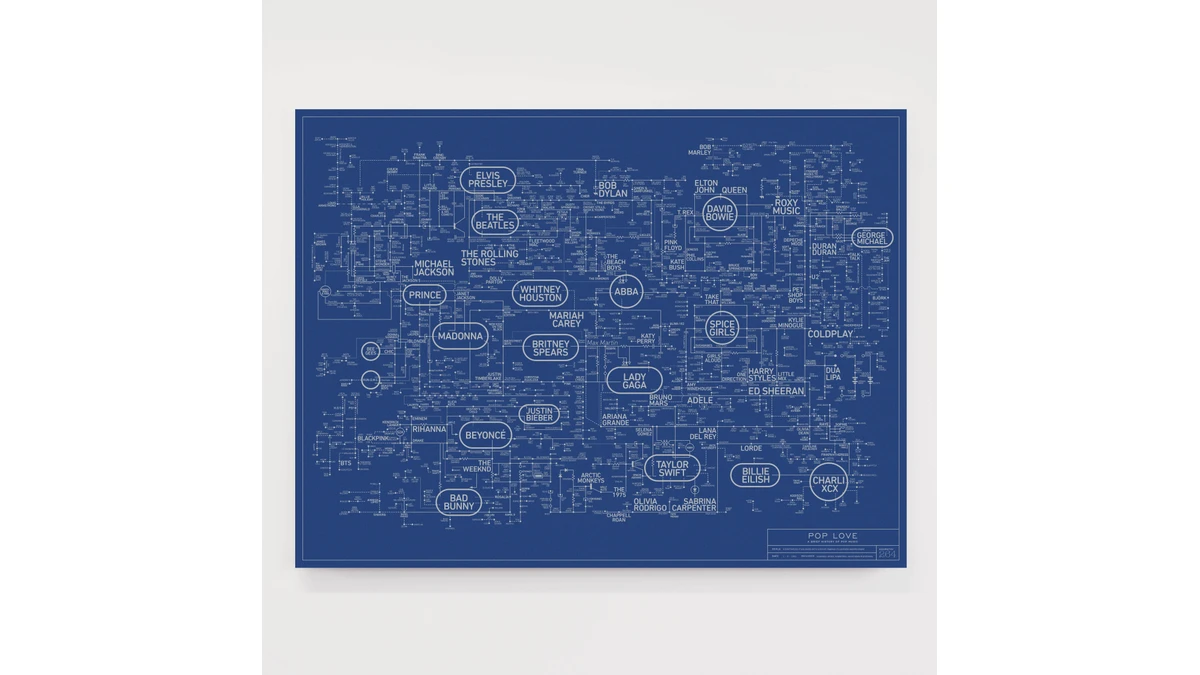
A music collection usually begins with a song. Dorothy’s Pop Love Blueprint offers another entrance: a name printed on a branching circuit, with another name nearby and a line leading somewhere else. A familiar favorite becomes a starting point for wandering.
My Modern Met’s October 2 feature introduces the design, while Dorothy’s original product page explains its construction. The studio maps more than 1,200 musicians, bands, songwriters, and producers onto the circuit diagram of a 1980s portable cassette player. Metallic silver printing sits against deep blue paper, turning an everyday piece of listening equipment into a busy map of musical connections.
One familiar name opens another route
The artwork’s large names give the eye somewhere to begin. Smaller names and branching lines then invite a slower search. It is an effective arrangement for a subject that can feel overwhelming when presented as a long list of essential records.
Start at David Bowie and the print offers nearby routes into other performers and styles. Begin with Madonna, Prince, or Whitney Houston and a different part of the page comes into focus. Someone drawn first to recent pop can enter through Billie Eilish or Charli xcx and explore outward from there.
The delight is partly recognition. A name recalls the first place a song was heard, the person who played it, or a particular journey with headphones. The next name can produce a different response: recognition without a remembered song, or complete unfamiliarity. That small gap makes a natural invitation to listen.
A map cannot settle every influence or explain every collaboration. Its lines organize a designed reading experience. The most enjoyable way to use it is to let a visual connection prompt a question, then allow the music itself to supply a fuller answer.
The cassette player gives the idea its shape
The portable audio player made listening something that could move through daily life. The cassette player is an especially apt container for this artwork because it combines a recognizable object with hidden internal complexity.
From outside, a player offers a few controls and a place for the tape. Inside, its circuitry distributes activity across many small components. Dorothy uses that contrast to hold a large musical history within a familiar outline. Big names provide landmarks, while the fine print supplies the feeling of a system extending beyond any one star.
The blueprint treatment also changes the mood of the history lesson. It suggests discovery and construction. Instead of receiving a fixed sequence from first to last, a viewer can enter at several points and make a personal route through the page.
That freedom suits music. People rarely encounter recordings in historical order. A parent’s favorite, a film soundtrack, a friend’s recommendation, and a new release can sit next to one another in memory. The circuit format makes room for that uneven, affectionate way of knowing a subject.
Pop becomes more interesting at its edges
Dorothy’s description ranges from early jazz and big-band figures to contemporary electronic pop. It also identifies soul, funk, disco, hip-hop, K-pop, and Spanish-language stars as parts of the design’s account. Songwriters and producers appear alongside performers.
Including those behind the recording broadens the game. A familiar singer can lead to the person who wrote or produced several apparently unrelated favorites. The resulting connection is less obvious than a shared genre label, and often more rewarding to explore through listening.
The mix of eras helps too. Older music need not become a separate homework assignment, and recent music need not occupy a sealed present. A listener can move between them, comparing a rhythm, a vocal arrangement, or the way a chorus arrives. Each comparison becomes a small act of attention.
The print’s selection is necessarily finite. Its density should invite additions in the viewer’s imagination, rather than establish that every important artist has been included or that one visual position measures another musician’s value. A personal discovery remains worthwhile even when someone else would draw the map differently.
A poster can become a shared listening game
The easiest way to enjoy the idea does not require a complete tour. Choose a name everyone recognizes, then let each person pick a nearby unfamiliar one. Listen to a track from each and compare what caught the ear. The page supplies the invitation, while the participants create the route.
Another approach is to follow the quieter credits. Pick a songwriter or producer, find a recording associated with them, and listen for the work underneath the headline artist. An arrangement, a recurring sound, or an unexpected change in tempo can become the focus of the conversation.
For a family or a group of friends, the artwork also gives different generations equal ways in. One person recognizes a name from a teenage bedroom wall. Another knows the recent singer whose music fills their current playlist. Both can begin with what they love and offer it to someone else.
This is the social appeal of a dense music map. There is no need to finish it, win a quiz, or agree on a greatest artist. The useful outcome is one new conversation or one song that makes the next listen more interesting.
Readers who enjoy following those connections can pair the exercise with Robert Dimery’s 1001 Songs on Amazon I may earn a commission, a separate collection of stories behind recordings. It offers another route from a recognized name to a specific track, rather than reproducing Dorothy’s map.
The details keep the curiosity alive
Dorothy specifies a 60-by-80-centimeter screen print on blue uncoated paper. In the studio’s photograph, large lettering remains prominent across the composition, while small labels reward a closer look. The metallic treatment turns the circuit into a visible graphic structure instead of a background decoration.
On a small screen, much of that fine lettering becomes difficult to read. The original page provides a better view of the artwork and its current product details. The idea, however, is immediately understandable: music has many routes, and an old listening machine can become a cheerful place to draw them.
Pop Love Blueprint’s best invitation is modest and open-ended. Find a name, follow a line, remember a song, and try another. A large history becomes approachable through a small moment of curiosity.