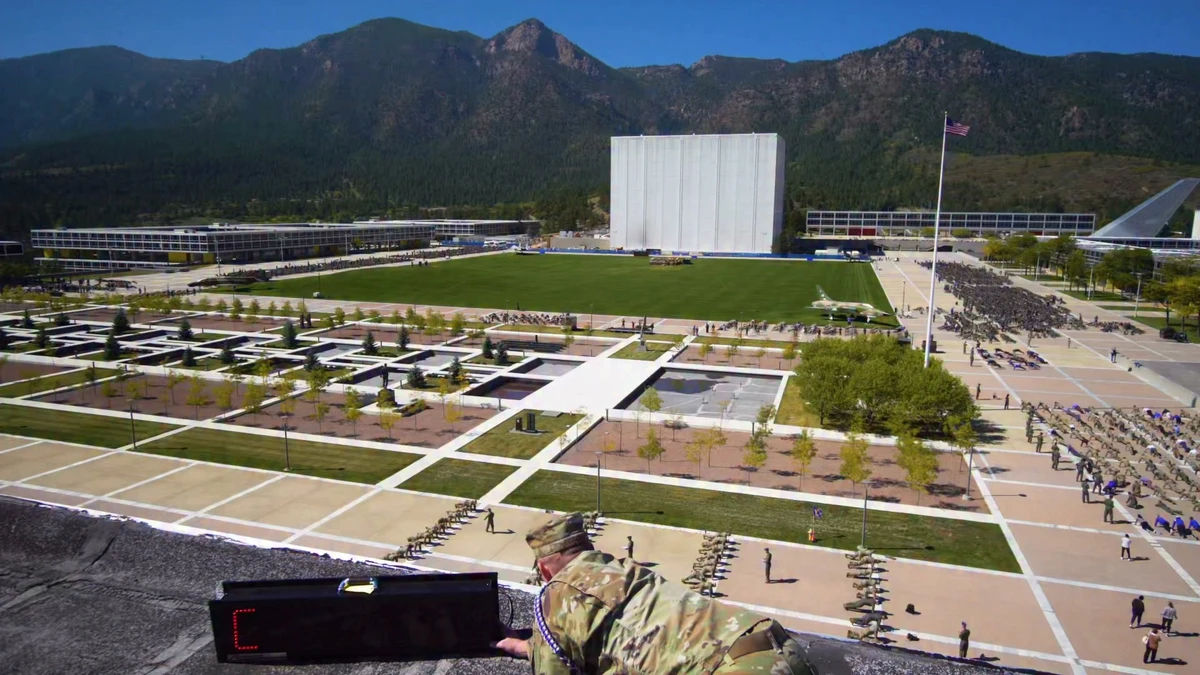
The Academy ’s October 2 announcement says the challenge began at 11:57 a.m. and broke the Guinness World Record for the most people simultaneously performing push-ups for one full minute. Its modest attraction is immediately understandable: thousands of people agreed to do the same demanding little thing at the same time.
The Academy’s official event view captures long rows arranged across its campus. Its announcement includes cadets, squadron commanders, Academy Military Trainers, and Academy leaders in the participating group. The shared effort reaches across those everyday roles.
The extra 635 participants matter
The difference between 3,703 and the previous 3,068 is 635 people. Calculated against the earlier benchmark, that is an increase of about 20.7 percent. The comparison describes the size of the participating group, giving this particular challenge an easily grasped measure.
That distinction helps preserve the fun of the achievement. A world-record challenge measures one defined thing. Here it is the number of people participating simultaneously for a specified duration. A larger group makes the organizing task more impressive without turning the result into a claim about every individual’s ability.
The count is also a reminder that a crowd is made of separate participants. Each person has a position, a start, and a minute to complete. The headline number becomes possible because those many small contributions remain part of the same event.
One minute gives everyone a shared clock
A minute is short enough to understand without a complicated explanation. It has a clear beginning and end. For a group challenge, that simplicity gives thousands of people a common frame for what they are trying to accomplish.
The Academy says participants had to move through a full range, lowering until the elbows reached 90 degrees and returning to a locked-out position. Those rules distinguish the measured exercise from a crowd merely making similar movements.
They also make the event legible to someone watching. A shared start and a repeated action create a pattern that can be recognized across a large group. The delight comes partly from the scale of that pattern: an ordinary exercise becomes an organized spectacle when enough people perform it together.
A group record therefore combines two achievements. People complete the specified action, and the event maintains a common definition of that action. The second achievement is less visible in a headline, but it is what allows the first to become a comparable result.
Rivalry supplies a friendly frame
The challenge took place the day before the Air Force Falcons were scheduled to host the Navy Midshipmen on October 3. The Academy’s announcement explicitly places the record in that rivalry-week setting.
An extra contest can give a sporting weekend another shared story. The football game has its own rules, score, and result. The push-up challenge contributes a separate number that participants can celebrate before the game begins.
The charm is in how direct the comparison is. The earlier benchmark came from the other academy, so the new group had a concrete number to exceed. That makes the event easy to recount afterward: one school held a participation record, and the other gathered enough people to pass it.
Nothing in that account needs to diminish the earlier achievement. The previous total supplied the target and remains an accomplishment of its own. A record changes hands because the measured result changes, rather than because the earlier participants somehow did less than they originally achieved.
A crowd can make an ordinary action memorable
Many people know what a push-up looks like even if they have no interest in record keeping. That familiarity makes this kind of group feat approachable. The audience does not need specialist knowledge to grasp the basic action or appreciate the size of the coordinated effort.
The event then adds two things to the familiar exercise: a very large number of participants and a shared minute. Neither element changes the movement’s identity. They change the social experience around it.
This is why a simple record can be more enjoyable than an elaborate claim about greatness. It gives the reader something concrete to picture. Thousands of people begin together, repeat the same movement, and finish inside the same clock. The organizer’s reported total gives that picture its scale.
The precision of 3,703 also helps. It is a count, rather than a vague description of a huge crowd. The arithmetic can be checked, and the difference from the prior benchmark can be stated without an exaggerated adjective.
Readers interested in other feats can explore Guinness World Records 2027 I may earn a commission, the annual collection with chapters on the natural world, humans, science and sports. It offers a wider view of the varied achievements that record keeping brings together.
The result belongs to the group
The Academy’s announcement names cadets and personnel together. That is part of the story’s appeal. The record depends on participation across the assembled group, rather than on one exceptional performer completing the exercise alone.
A minute of effort becomes a shared memory because everyone’s contribution is tied to the same attempt. Participants can point to the final number and know that their own place in the crowd is part of it.
The new benchmark may eventually be surpassed. That possibility is built into record keeping and adds to the light competition. It does not change what happened on October 2: according to the Academy, 3,703 people turned a familiar exercise into a synchronized achievement, with a rivalry weekend still ahead of them.