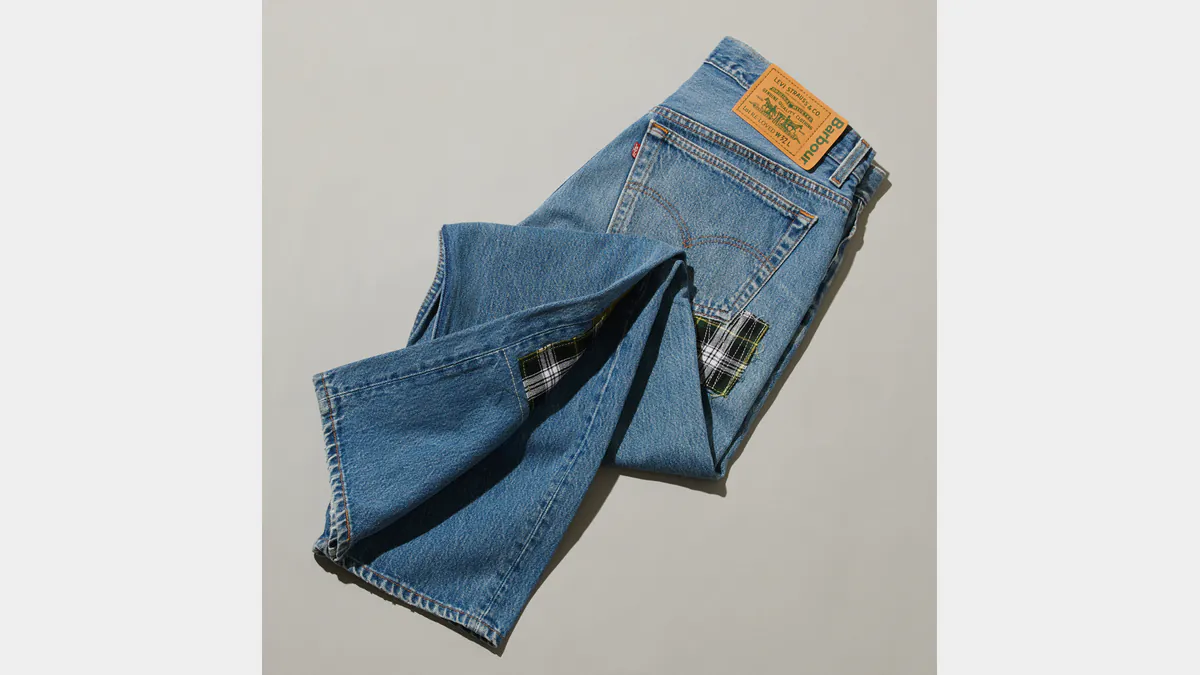
The back pocket gives the eye a familiar starting point. A checked insert beside it interrupts the faded blue, and a collaboration patch sits above. In the official photograph of Levi’s and Barbour’s Re-Loved 501s, small changes to a recognizable jean make you want to look at the joins.
Levi’s Japan and Barbour announced the Re-Loved capsule for a September 11 release in Japan. Vintage 501 denim meets waxed cotton, tartan and wide-wale corduroy associated with Barbour. Recovered cloth gives each pair a different arrangement, so the familiar shape becomes the beginning of the design rather than a promise of identical results.
The materials bring different kinds of visual information. Denim can carry a fade and an existing crease. Tartan adds a grid. Corduroy introduces parallel ridges, while waxed cotton offers another surface beside the blue. Reconstruction gives those differences a place within one garment, where their size and position affect how it reads.
The launch record gives the retail context too. Levi’s announced ¥38,500 jeans through its Harajuku flagship using an entry-order lottery. Barbour separately lists jeans at its Harajuku Cat Street store, with the same September 11 release date. Those details describe the limited launch, rather than the availability of a particular pair now.
One photograph cannot stand in for every pair
A campaign photograph shows one arrangement. Another pair may put the check, waxed fabric or corduroy somewhere else. The individual garment therefore deserves more attention than a standard product image can supply. This is closer to choosing a vintage piece, where condition and small differences belong to the decision.
The 501’s five-pocket structure provides a shape to recognize through the intervention. A patch can interrupt the surface while the pocket and straight leg keep the underlying jean legible. Look at the scale of that interruption. A small checked area may draw attention to one seam, while a larger panel can change the balance of the whole leg.
Read the pair in three passes. First, follow the base jean’s measurements, fade and condition. Then look at the added cloth and its placement. Finally, examine the joins that bring those parts together. That order keeps the appeal of an unusual patch from obscuring the garment it is attached to.
Fit belongs in the same close inspection. A familiar model name gives a useful reference, while a vintage base and reconstruction make the actual measurements more important. The pair with the most appealing layout still has to work for the person wearing it.
Let the joins become part of the look
Visible reconstruction lets a join become part of the finished appearance. A contrasting cloth can make the repair easy to follow, giving the eye a line or boundary that was not there before. It is an inviting design idea because another intervention need not be treated as the end of the garment’s visual life.
American denim and British country-clothing references meet in a Japan release. That setting gives familiar workwear materials a different conversation. The point is in the actual recombination: which surface sits beside the pocket, how a check meets a seam and how much of the original jean stays visible.
A plain shirt or quiet knit would leave the patches plenty of room. A denser workwear combination could connect them to other textures. Neither approach needs to be a rule. The particular pair supplies the colors and surfaces to respond to, and a wearer can choose how much company to give them.
The visible cloth is enough to begin that conversation. We do not need to invent the life of a previous owner to appreciate a fade, a repaired area or the change from denim to check. The evidence is in the garment and the brands’ account of its recovered inputs.
Keep the reuse claim close to the garment
Upcycling describes the conversion of existing materials into a new product, and the capsule offers a clear design example. Levi's says the pieces use collected and reused materials, while Barbour's Re-Loved programme is built around recovering, cleaning, repairing, rewaxing, and reselling unwanted wax jackets.
The announcements describe reuse and reconstruction without a comparative environmental-impact measurement for the finished capsule. Those are different kinds of claim. The documented action is specific: existing jeans and recovered materials have been selected and joined into another garment.
Care is another reason to follow the exact pair. Denim, waxed cotton and corduroy can need different handling. Use the garment’s instructions for the assembled piece, rather than assuming the usual routine for a standard jean applies to every inserted material. Future repair belongs beside that attention to present condition.
This emphasis connects with the Newsroom's Redress Design Award coverage, where circular design becomes most meaningful when an idea reaches a real product and a wearer. Here, the product is deliberately individual from the outset.
The familiar pocket gives the change a frame
The broader Levi's denim family provides the stable reference against which the reconstruction reads. Readers exploring that standard range can visit the Levi's Amazon store (paid link). The Japan Re-Loved capsule is a separate, limited retail proposition and is not presented as available there.
The familiar pocket, waistband and leg give the changes a structure to work against. Follow one join and the collaboration becomes more specific than two names on a patch. A small grid of tartan can change how a broad area of faded denim is seen.
In the featured photograph, the folded leg leaves part of the checked insert tucked between layers. There is more to find as the garment opens. That is a pleasing reason to give the individual pair time: its design reveals itself through placement, rather than through a uniform finish repeated across every example.