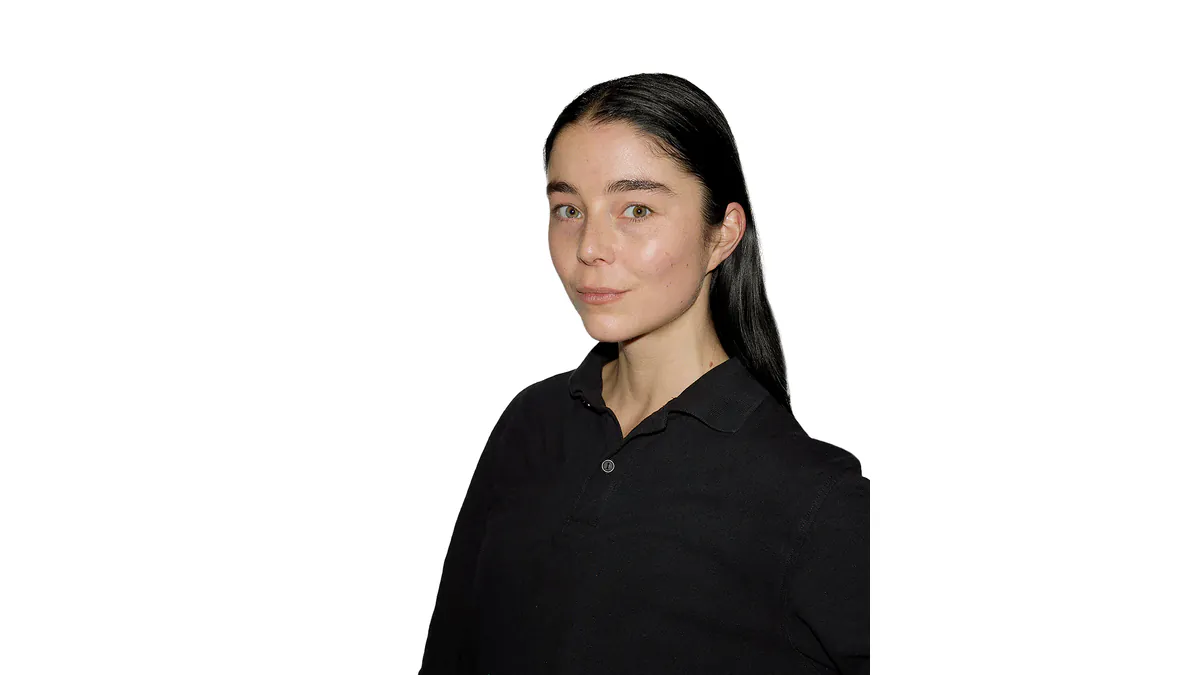
A garment that changes shape or plays a trick on the eye asks a lot of the people who make it. The pattern has to preserve the idea, the sample has to work on a body and a manufacturer has to carry it into production. Julie Kegels’s 2026 LVMH Prize gives her young label more resources for that passage from an experiment to something someone can wear.
Vogue’s report names Julie Kegels as the main winner, receiving €400,000 and a year of tailored mentoring. Zane Li’s Lii won the Karl Lagerfeld Prize for Innovation, while Anil Padia’s Yoshita 1967 took the Savoir-Faire Prize. Le Monde independently confirms Kegels’s award.
The Belgian designer established her Antwerp label in 2024 after graduating from the city’s Royal Academy of Fine Arts. Her work explores feminine identity, transformation and perception through clothing. It gives the construction a creative role: the way a piece is assembled can change how it appears and how a wearer encounters it.
The prize brings money and specialist time
LVMH’s terms for the 2026 edition set out the €400,000 main award and one-year mentorship. The Karl Lagerfeld and Savoir-Faire winners each receive €200,000 with the same mentoring period. Cash and specialist time offer two different forms of support for the work around a collection.
Kegels’s official prize profile places craftsmanship and experimentation within her Antwerp practice. The design interest is clear in that pairing. Experiment leaves room for a new construction or visual effect. Craft is what lets a promising idea become a piece that can be fitted, finished and made again.
A grant can pay for some of that less visible work: technical development, production planning, sales administration or the people who coordinate suppliers. Mentoring can help the designer decide which obstacle to tackle first. The value comes into view at the place where a particular collection is getting stuck.
The complex detail needs people who can make it
Kegels identified team, financial-management and manufacturing needs in the award reporting. Harper’s Bazaar describes the winners’ plans for teams and infrastructure . The ambitions attach the prize to recurring work around the clothes, rather than a general wish to become bigger.
Complex construction can need several rounds of decisions. A pattern may preserve a visual effect while creating a fit problem. A sample can look right while being difficult to repeat at the intended cost. A production partner has to understand which part of the idea must survive those adjustments. These are general design problems that help explain why the right specialist can matter to an experimental label.
More support could leave room to retain a difficult detail instead of removing it for convenience. That possibility gives the business side a creative purpose. An additional person or better-matched manufacturer can help a small team realize the work it already wants to make. Whether that happens will be visible in the clothes and their delivery.
At the September announcement, her next Paris show was close. The award arrived within a working calendar of collections, fittings, casting, sales and communication. New attention joins the tasks already on the table. For a small label, deciding who can absorb which part of that work becomes part of protecting the collection.
A grant ends while the work continues
The grant is finite. A salary, supplier relationship or production commitment continues beyond the moment it begins. A bounded development project might resolve one construction problem. A recurring role might release time across several collections. Each use needs a timetable and a cost the label can support afterward.
Mentoring works through decisions that may be hard to see from a runway seat. A specialist can help compare manufacturers, strengthen financial control or assess whether an opportunity would stretch the team too far. Sometimes useful advice leads to a more deliberate timetable. The visible result may be fewer rushed compromises.
That makes capacity an interesting companion to growth. Can the team repeat a technically demanding piece? Does the supplier understand the finish? Can the label plan the next collection without abandoning the one it is completing? Those questions connect the prize to the continued freedom to design.
Follow the sample toward its wearer
The LVMH Prize brings industry attention to emerging designers. What an award makes possible can take longer to see. A collection still needs to reach its wearer with the construction, fit and finish its idea depends on.
Kegels’s interest in transformation gives that next stage something specific to preserve. As the label builds, its experiments need people who can work through the adjustments without losing the original curiosity. A strong working structure can make space for that conversation between a sketch, a sample and a body.
Our Redress Design Award analysis follows another route from recognition toward a concrete result. The programmes offer different resources. In each case, the later object and its route to a wearer reveal something an award announcement cannot yet show.
For Kegels, one future sign could be modest: an intricate sample reaches the manufacturer with its intended effect intact, and the finished piece keeps it. The prize gives the team more ways to work toward that moment. The interesting detail will still be in the clothes.