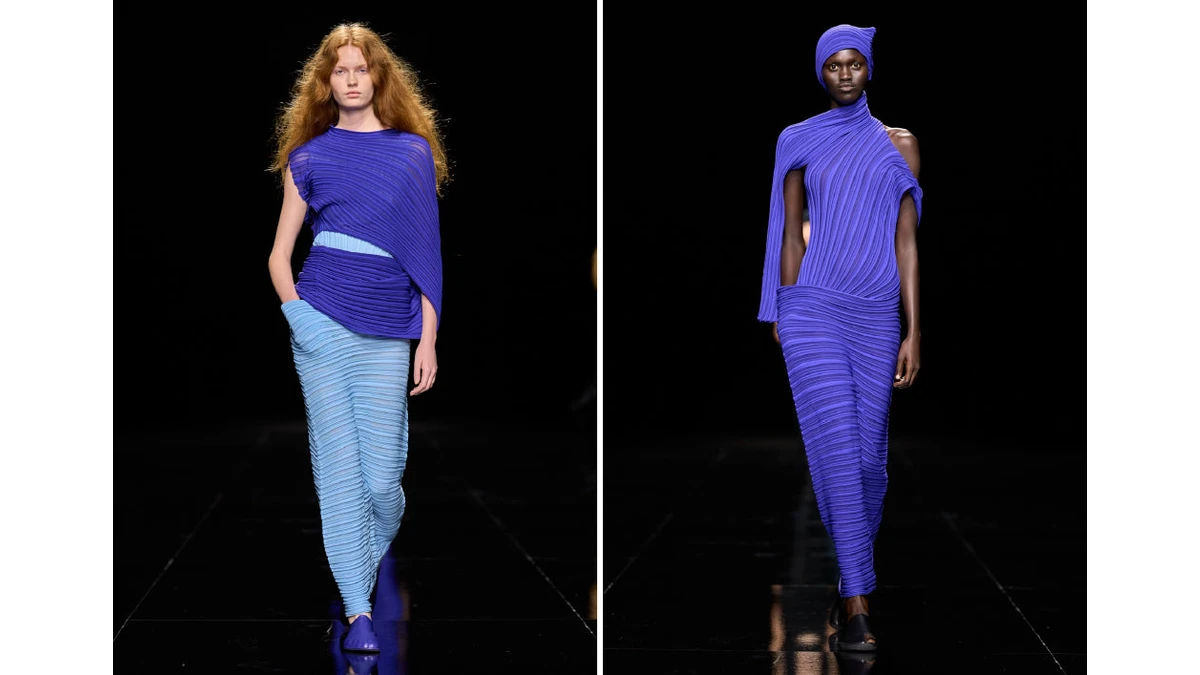
The house’s October 3 collection announcement connects each named series to a particular construction method. Diane Pernet’s account of the presentation places those clothes within the live exchange between fabric, performers, and piano. The common thread is the distance a garment creates around its wearer.
Satoshi Kondo and the design team began by handling a large piece of cloth before resolving it into garments. The collection’s title refers to ma, the space in between . Here that idea becomes a concrete relationship: cloth can cling to a body, stand away from it, gather around an opening, or hold the traces of an earlier pose.
Volume has more than one source
A garment can look generous because its pattern contains more cloth. It can also gain volume through a material that holds its shape, a gathered edge, a pleated structure, or the movement of its wearer. Those mechanisms produce different relationships between the body and the silhouette.
Ballooning combines a short front, a longer back, and a drawstring hem. Those decisions organize the outline at specific points. The light ripstop fabric provides the surface, while gathering gives the hem a controlled boundary. The result can be read as a shaped volume rather than simply a larger coat.
Tempo Pleats starts from a rectangular piece with openings for the body. Its horizontal pleats give movement a repeated structure. The geometry of the cloth remains legible, but the figure passing through it changes how the rectangle rounds and hangs.
These are useful distinctions for a viewer looking at runway images. Trace the edge of the garment, then locate the point where it meets or leaves the body. That sequence explains more than the broad impression of airiness. It identifies which part of the construction makes that air possible.
A fold can be structure and surface
The collection approaches folds in several ways. Caprice partly joins three rectangles in different colors. The composition lets color participate in the construction, with each panel contributing to the visual reading of the pleats.
Balloon Twist takes another route. The house describes fabric twisted and bound around inserted ball-shaped molds, producing a crinkled surface and rounded forms. That process connects the texture visible at close range with the larger silhouette visible from across a room.
A smooth surface can make volume seem abstract. A densely worked surface offers many smaller changes in light. The eye can move between the full outline and the individual ridges. Both readings belong to the same garment, but they operate at different distances.
Draped Ensemble adds styling possibilities to that relationship. The official notes describe twists and gathers through which scarves can be threaded. An accessory then becomes part of how the garment is read. It can follow a fold, interrupt a surface, or give the viewer another line to trace.
Cocoon Body preserves a prior encounter
The most distinct construction story comes from Cocoon Body, developed with Wacoal . The official account describes adapting the company’s Melooop molding technology for garments. A torso mold on a robotic arm catches melted resin, producing a form through the melt-blown process.
The starting form includes draped fabric on a mannequin, captured through 3D scanning and translated into a mold. That sequence is consequential for interpreting the result. A fold that would ordinarily depend on cloth hanging from the current wearer becomes part of a previously recorded surface.
The body form therefore introduces a different kind of movement into the collection. Some garments change visibly as their wearer moves. A molded form can carry the memory of an earlier arrangement while meeting a new body. Soft and fixed structures can coexist without doing the same work.
Issey Miyake says the material contains 60 percent plant-based resin pellets and that production trimmings can return to the raw-material stream. Those process details do not establish a complete environmental assessment of the garment. The design contribution is already concrete without expanding those claims: a method originally associated with intimate apparel has been adapted to produce sculptural wearable forms.
Music becomes a design relationship
Pianist Koki Nakano collaborated with Kondo’s team in an exchange between music composition and clothes-making. That gives the show’s movement a role beyond illustrating the finished garments.
Music and clothing both organize change over time. A viewer can read a look in a still image, but a pleated surface, trailing panel, or suspended volume also has a rhythm. The construction determines which parts move together and which lag behind.
A useful way to examine the collection’s moving images is to observe the garment through a full step or turn, then compare that sequence with the still silhouette. A single frame may reveal the outline while compressing the timing that produced it.
For a longer view of these material experiments, TASCHEN ’s Issey Miyake I may earn a commission follows the founder’s work from 1960 to 2022, with editorial direction by Midori Kitamura. It places his research into cloth, surface and volume within a broader career.
The space inside is part of the design
Figure of Ma offers several ways for the body and garment to negotiate their distance. Pleats organize a surface, gathers establish a boundary, and a molded form records an earlier encounter with cloth. The collection’s coherence comes from placing those different mechanisms around the same question.
The strongest reading keeps the construction specific. Rather than calling every form fluid or sculptural, identify where it touches the wearer, where it holds away, and what makes that relationship possible. That gives the collection’s space a visible structure of its own.