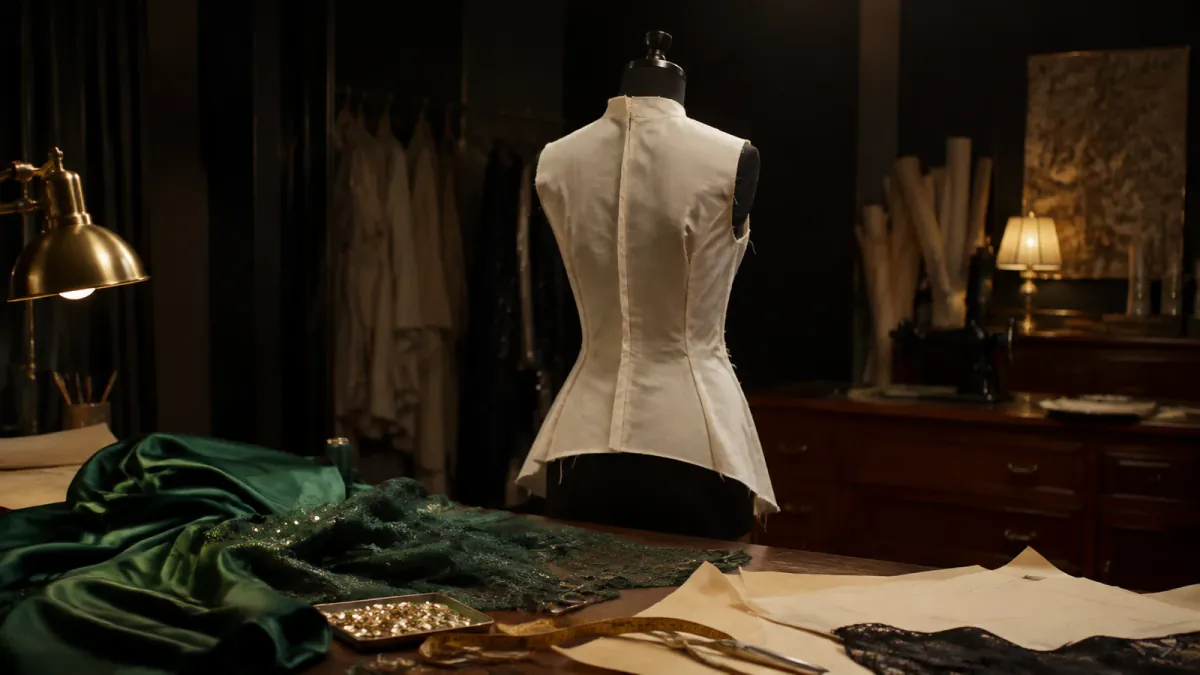
A piece of black cloth becomes a bustier dress on a mannequin. In Vogue’s account, Elie Saab makes the drape and H&M’s pattern-making team takes on the bow, train and smaller details. The scene gives the collaboration an interesting problem: preserve the gesture through the work required to make it repeatably.
Elie Saab and H&M set October 22 for a collection across womenswear, menswear, footwear and accessories. This analysis follows the September previews. Drape, embellishment and evening tailoring offer recognizable parts of the house’s language, with a different price and production system around them.
One range, several ways to carry the shine
Fashionista reports 54 pieces and US preview prices from $39.99 for a choker to $429 for a leather jacket. Vogue reports 55 items, describing gradient sequins, lace embroidery, faux fur, black tailoring, emerald chiffon, platforms and a chocolate leather jacket fading into black. The published counts differ by one, so roughly 55 describes the range without pretending to resolve the discrepancy.
TheIndustry.fashion reports selected-store and online distribution, with embellished gowns, separates, tailoring, lace, gradient sequins and accessories. Those choices give the range several ways to carry a dressed-up mood. One person might begin with a gown, another with a jacket or a small area of shine.
The prices belong to the September US preview and can differ by market and later availability. The physical pieces will provide another kind of information: how the surface is attached, how the garment fits and what happens as someone moves in it.
The drape still needs a pattern
Haute couture belongs to Elie Saab’s identity, alongside red-carpet and occasion dressing. At H&M’s scale, a recognizable line or decorative relationship has to work through another manufacturing process. The design question is which choices can carry the house’s character in that setting.
A long line, a cape back or a controlled gradient can remain legible across production methods. Made-to-measure adjustment, extensive handwork and hours of internal finishing are harder to carry into a broad retail range. The useful comparison follows the specific design decision and how the finished garment supports it.
The black-cloth dress gives that passage a concrete starting point. A drape on a mannequin still needs a pattern, secure construction and decisions about the bow and train. The pattern-making team’s interpretation is part of how the original idea can reach another body. A garment can keep a similar outline while changing the lining or support that holds it. Those internal decisions affect comfort as well as the shape someone sees.
The reported range also leaves room to use a smaller part of the drama. An embellished knit can sit beside plain trousers. A scarf can change the area around a face. A cape-backed jacket can make an otherwise familiar outline move differently. Those are styling possibilities to explore, rather than instructions to dress for a particular kind of entrance.
Let one detail find a place in another wardrobe
H&M’s designer-collaboration programme reaches back to Karl Lagerfeld’s 2004 partnership. A familiar format still gives each house a different translation problem. Materials, production volume, price and the expectations attached to the name all enter the design.
For the Elie Saab house , the project brings its occasion-dressing vocabulary to another retail audience. For H&M , it adds that vocabulary to the collaboration programme. Their shared task is visible in the clothes before it becomes a question about the label.
The October 22 date places evening pieces near the holiday-dressing season. Their use need not finish after one event. A tailored jacket, dark knit or scarf can meet other clothes already in a wardrobe. How often someone returns to a piece will depend on its fit, comfort and the ways they enjoy wearing it.
The fitting room adds the next evidence
The previews describe involvement from Saab, Elie Saab Jr. and H&M’s design team. That puts people on both sides of the transition from drape to retail piece. The collection still needs to carry their decisions through construction at the new scale.
A fitting room can make the comparison specific. Does the tailoring hold its intended line as you turn? Does the decoration pull or sit comfortably? Can you understand the care it needs? Availability and size information are part of access too, alongside the headline price.
The previews offer an account of design and appearance. Collection-specific labor and environmental claims would need their own evidence. You can enjoy a gradient of sequins while keeping those questions attached to the records that could answer them.
The bow in the black-cloth dress begins as a decision about where fabric should gather and fall. Pattern and construction give it another life away from the mannequin. If that relationship remains convincing on the person who chooses to wear it, a small part of the original gesture has traveled a long way.