A collaboration built into the house language
Burberry's Spring 2027 collection begins with a productive constraint. Daniel Lee keeps the trench, the check, and the practical associations of British outerwear, then asks what happens when those codes are drawn by a different hand. The answer comes through a collaboration with textile designer Celia Birtwell, whose flowers, faces, stripes, and irregular marks give the collection a less regulated pulse.
The partnership is not hidden in a single print story. Independent runway reports from W Magazine , Harper's Bazaar , and TheIndustry.fashion identify the same interplay between Birtwell's imagery and Lee's altered outerwear. The official Burberry Japan release provides the collection imagery and confirms the collaboration.
That agreement matters because the collection's strongest idea is structural. Birtwell does not merely decorate a stable Burberry silhouette. Her drawn irregularity becomes a cue for how the garments themselves should move.
The check stops behaving like a grid
A house check usually communicates control. Its horizontal and vertical lines make repetition visible, and its familiarity can turn even a new garment into a recognizable branded object. Birtwell's contribution disrupts that certainty. Reports describe the check slipping toward gingham and stripes, with floral and face motifs entering the same visual field.
The effect is not anti-heritage. The check remains legible enough to anchor the collection, but it no longer has to remain perfectly square, sober, or evenly paced. This is a useful distinction. Fashion houses often revisit archives by enlarging a logo, reviving an old bag, or reproducing a known pattern. Here, Burberry treats recognition as a material that can be bent.
Birtwell's documented career in textile design gives the collaboration additional coherence. Her work is associated with expressive, hand-drawn pattern rather than impersonal geometric repeat. Bringing that sensibility to Burberry lets the check keep its identity while admitting the evidence of a person making marks.
Lee makes the trench obey the same rule
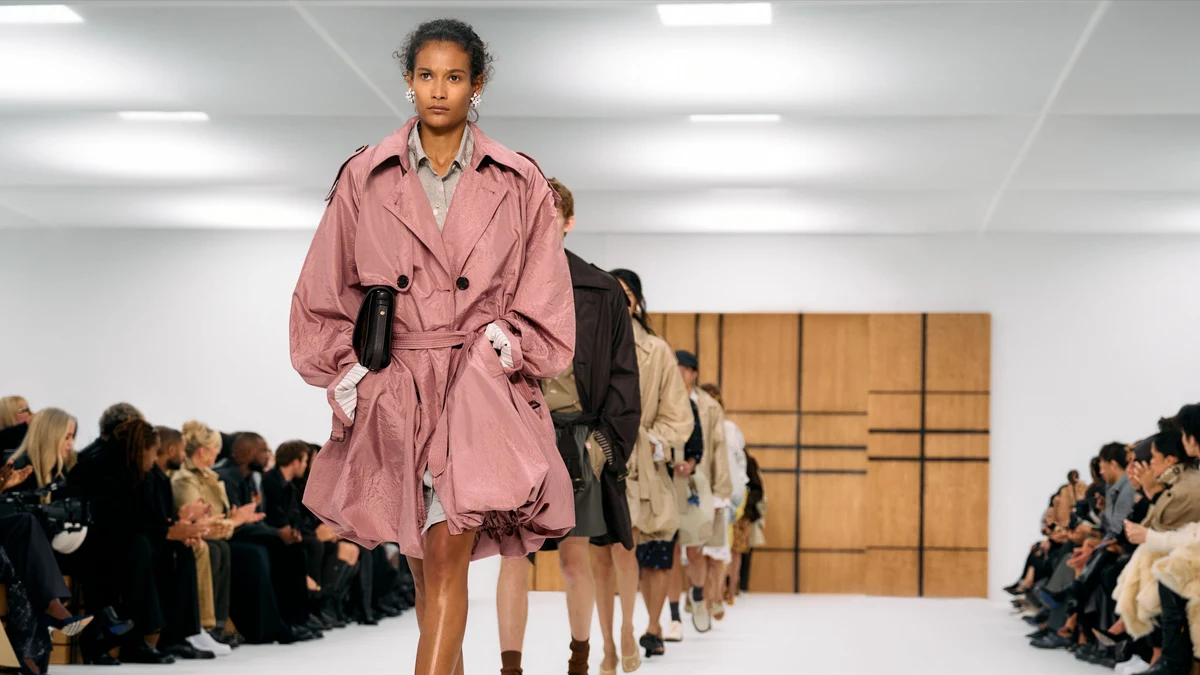
The opening pale pink trench sets out the construction argument. It has the familiar double-breasted front and belted waist, but the hem gathers into a bubble and the sleeves expand around the arms. The garment still reads as a trench, yet its volume is buoyant rather than military.
That move continues through yellow, green, and orange outerwear, floral embellishment, and layered looks. TheIndustry.fashion focuses on the trench rework, while W and Harper's Bazaar place the collaboration within a brighter, more relaxed view of the house. The repeated evidence is more persuasive than any one spectacular exit. Lee is not proposing a novelty shape and moving on. He is using volume, color, and surface to make a familiar category behave differently across the collection.
The closing cream trench, embellished with flowers and worn with trousers and sneakers, brings the idea into focus. Formal craft and ordinary movement occupy the same look. It is neither a pristine archive exercise nor a rejection of the brand's practical foundation.
Color changes the emotional temperature
Burberry's beige is among fashion's most recognizable neutrals. That recognition can be an asset, but it can also make every collection feel pre-edited by memory. Spring 2027 uses pale pink, yellow, green, and orange to change the emotional temperature before a viewer studies the details.
Color matters here because it reinforces the treatment of line and volume. A ballooned sleeve in beige might read primarily as a construction experiment. In pink or citrus color, it becomes lighter, more immediate, and less institutional. Birtwell's motifs then have room to feel conversational rather than precious.
The collection was shown at Chelsea College of Arts, according to the independent reports. The setting supports the hand-made register without needing to carry the interpretation. The clothes provide the stronger evidence: uneven drawing, visibly altered proportions, and house symbols that have been released from strict repetition.
Streetwear enters without flattening the tailoring
Central Cee's runway appearance gave the collection a direct streetwear signal, but the useful point is not celebrity casting by itself. His look placed casual layers and familiar urban styling inside the same collection as highly worked trenches. That contrast keeps the show from becoming a single-note celebration of decorative craft.
Lee has often worked through friction between polish and ordinary clothes. Here, the tension is controlled. Sneakers appear with embellished outerwear. Trousers ground sculpted coats. Practical bags sit against floral surfaces. The result does not erase category differences. It makes the tailored and casual elements share a pace.
Why the Birtwell collaboration holds together
Designer collaborations can become detachable marketing episodes when the guest's work sits on top of a collection without affecting its logic. Spring 2027 is more convincing because the same principle appears in both print and construction. Birtwell loosens the line. Lee loosens the trench. Each preserves recognition while resisting perfect order.
That parallel gives Burberry a way to use heritage without making reverence the only mood. The check is still a check, the trench is still a trench, and the British references remain visible. Yet the collection can be celebratory, bright, and slightly unruly.
The limit is equally clear. A runway can establish a coherent design language, not its commercial durability. The collection does not prove retail demand, a completed brand turnaround, or a permanent direction. Production fabrics, store edits, pricing, and customer response will determine how much of this looseness reaches daily wardrobes.
Related Newsroom coverage of Christopher Kane's Mulberry debut and the September 2026 fashion-week calendar places the show alongside another British-house reinvention and the wider London schedule.
For now, the creative result is legible. Burberry's Spring 2027 collection succeeds when Birtwell's mark and Lee's construction stop looking like separate contributions. They become one method: keep the code, disturb its discipline, and let the garment breathe.