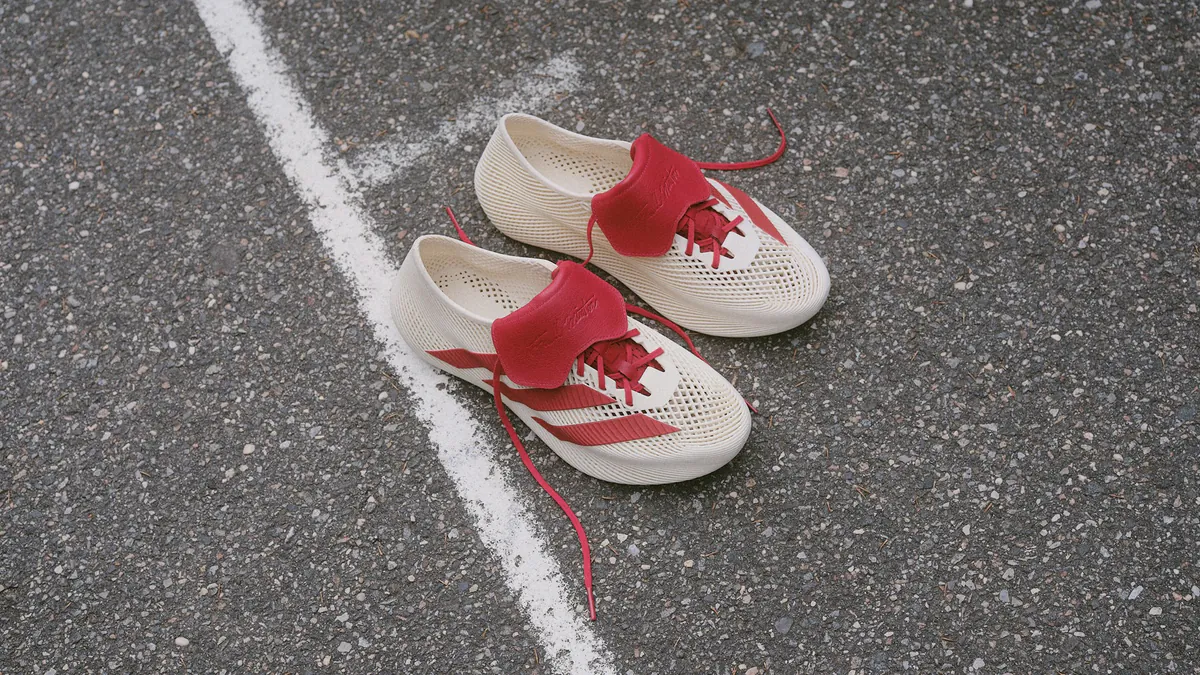
The cream shoe is a mesh of small openings. A red tongue folds over the top, and red stripes cut a clear path across its side. In Adidas and Tyrrell Winston’s The Athlete, that simple color contrast gives a very busy surface something the eye can follow.
The Fall/Winter 2026 capsule, launched on September 8, puts the 3D-printed CLIMACOOL beside relaxed clothing with inverted panels and raw hems. Read the pieces together and a useful styling idea appears: a technically intricate object can have more presence when the clothes around it leave some room.
The tongue gives the lattice a familiar shape
The official Adidas announcement describes the TW CLIMACOOL’s printed lattice and a folded tongue made with technical mesh and leather. The red stripes echo the tongue against the cream structure. The familiar sneaker details sit within an unusually open form.
Follow one row of openings, then look at the whole outline. The repeated structure gives the shoe a continuous surface, while the tongue and stripes interrupt it at a larger scale. That difference helps the design read from farther away, where the smaller lattice detail begins to merge.
3D printing builds physical objects from digital models in layers. Here, the construction is also the visible surface. Adidas describes airflow, lightness and a fit between a slide and sneaker as intended benefits. Those are wear-performance claims, separate from the shape and color relationships we can examine in the official photographs.
Let the clothes make room for the shoe
The clothing includes the TW Stadium Top and Pant, varsity-inspired pieces and a multipurpose tote. In the brand’s description, inverted panels and raw hems make construction visible, with small gold accents within the restrained palette. The pieces offer another kind of surface to place beside the shoe’s repeated geometry.
An exposed edge gives the eye a place to stop along an otherwise simple garment. A reversed panel can reveal how the shape was put together. These are deliberate finishes on new clothes. They connect the design to the act of making without requiring an invented history of earlier wear.
The seated tonal campaign look makes the clothing’s role clear. Wide trousers create the dominant line and gather above the shoes. Pale top and bottoms hold a broad, relatively quiet field around the body. The CLIMACOOL supplies a denser texture at the bottom, where the red details become easier to notice.
That is a useful relationship to explore in styling. An unusual shoe does not require every garment to become an unusual shape. A larger, simpler outline can let a small area of intricate construction remain visible. Here, the trousers give the footwear space rather than competing for the same kind of attention.
Imagine the same textured shoe under a narrower hem. More of the upper becomes visible. A wider leg can overlap it, leaving a smaller area at the toe. The garment changes how much of the object a viewer gets to read, even before the shoe itself changes.
Winston’s found objects offer another reference
Tyrrell Winston works with found objects and the histories they carry. Library Street Collective describes his basketball works as arrangements of recovered objects, linking individual worn surfaces into larger compositions. That practice gives the clothing collaboration a specific artistic context beyond a name attached to a label.
A newly finished hem has a different history from a recovered basketball. The connection lies in the attention given to surfaces, repetition and the evidence of handling. On the clothing, a visible seam turns construction into part of the finished appearance. On the shoe, repetition organizes the surface from one end to the other.
Adidas calls The Athlete the partnership’s second chapter after The Artist. Winston frames it around the daily effort shared by creative and athletic practice. The roomy separates give that idea a clothing form: something designed for the intervals around activity, rather than a claim that the outfit is specialist performance kit.
Three scales of detail in one outfit
Compare the scale of three details: the broad trouser leg, the small lattice openings and the larger red stripes. Each works at a different viewing distance. Their relationship explains more about the outfit than calling every piece a statement. There is room for one shape to recede while another becomes the focal point.
The September announcement gives the collection’s release context. For a particular piece now, use the local product listing for its measurements, materials, sizes and returns. The established Adidas Store on Amazon (paid link) offers the broader brand range. It is a separate route from this capsule, whose availability there was not verified.
In the featured shoe photograph, the court’s white line runs beneath the cream lattice while the red details hold their own direction above it. Small openings and bold stripes share the same object. That meeting of scales is what makes the shoe worth looking at before any claim about how it feels to wear.