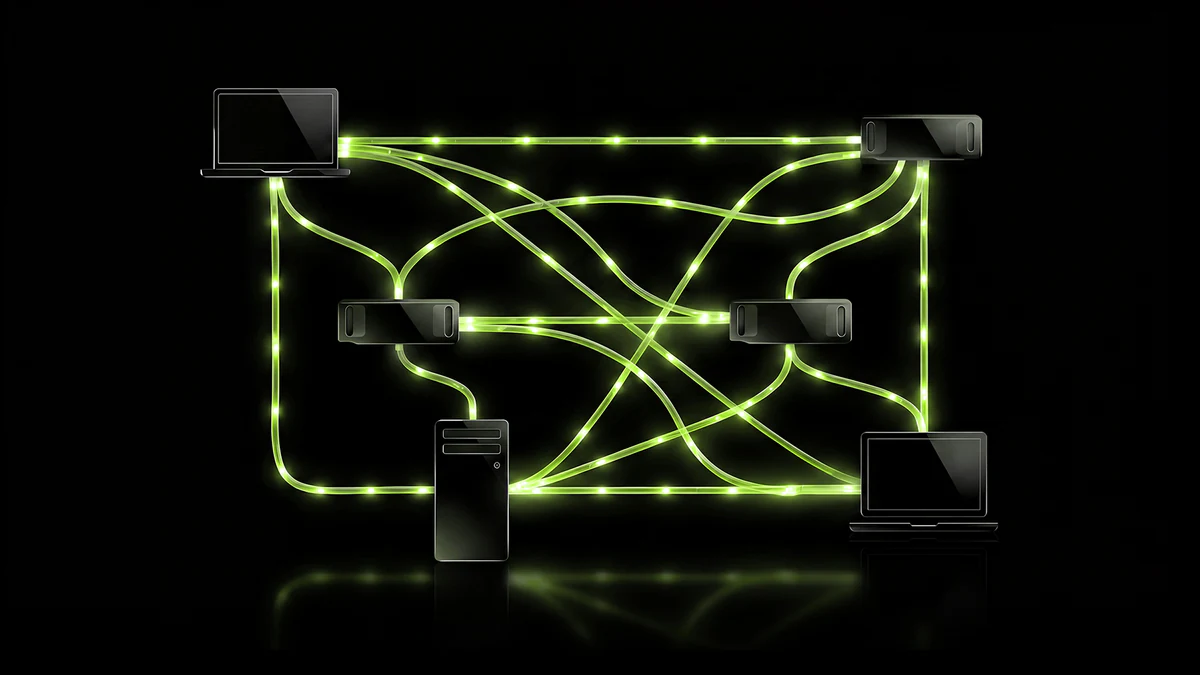
Your laptop has several AI requests waiting. Another compatible computer on the network has room to work. Nvidia’s Personal AI Router, or PAIR, gives an eligible request a route to that second machine. The useful first question is whether it already holds the model needed to answer.
This analysis revisits NVIDIA’s September 3, 2026 PAIR announcement, using documentation and coverage checked on September 7. It compares the available approaches without claiming hands-on performance testing.
The spare machine needs the requested model
Nvidia introduced PAIR at IFA 2026 to address that local queue. The software runs on participating computers and routes inference requests between compatible systems. Inference is the step where a trained model produces an answer. PAIR decides which eligible machine receives that step.
Imagine several workers summarizing separate documents. They can make independent model requests at the same time, giving the router work to spread across machines. A load balancing comparison is useful here, with model placement added to the decision: a destination needs to hold and serve the requested model.
The launch attracted attention from PCWorld’s Brad Chacos , who called PAIR a “thoughtful move by Nvidia.” His September 3 analysis connects the software to NVIDIA’s forthcoming RTX Spark computers, arguing that early adopters may already own hardware capable of contributing to local AI workloads.
Follow the request through three different jobs
Users install PAIR on participating machines, approve pairing through an invitation and six-digit PIN, and prepare the engines and models each machine will serve. Compatible applications send requests to a local endpoint. PAIR forwards each request to an eligible computer and streams the answer back through the same connection. Its official overview explains that Ollama or LM Studio still runs the model, while the Jobs view shows where the computation happened.
Nvidia’s Hermes example separates the jobs clearly. In Seth Schneider’s technical account , the agent organizes the task and combines its results. PAIR routes the model requests, and Ollama performs the model computation. Sending a request somewhere else does not decide how the larger job should be planned.
Place the model on three eligible computers and the router has three possible destinations. Place it on one and all requests for it still depend on that machine. Nvidia’s architecture documentation makes that preparation consequential. The useful spare computer is the one ready to serve this request, rather than simply one with an idle GPU.
A queue and a prepared second computer
The clearest audience has several requests arriving together and compatible spare machines. The launch material lists Windows, Linux and macOS configurations, including GeForce RTX 20 Series and newer GPUs, qualifying RTX PRO systems, DGX Spark and Apple M4 or newer silicon. The installation playbook still needs to be read beside engine and model requirements: every serving machine needs sufficient memory for the selected model.
Network World’s Maxwell Cooter identified another possible application in his September 4 report: using idle desktop capacity in a business. The idea is plausible where compatible machines already exist, but the report did not describe a tested enterprise deployment.
Household computing also introduces uncertainty. Tom’s Hardware’s Jeffrey Kampman noted that participating computers may be reclaimed for gaming, creative work or other tasks. As he wrote, “quality of service is not assured from a PAIR cluster.” His September 3 analysis suggests spare capacity may be particularly useful for work with flexible deadlines.
Keep the demo’s machines beside its time
NVIDIA reports that five Hermes subagents using Qwen 3.6 35B A3B completed a synthetic household-inbox planning workload in an average of 18 minutes on one RTX Spark laptop. A three-device cluster containing the laptop, a DGX Spark and an RTX 5090 completed it in 8 minutes 48 seconds. NVIDIA calls this an “unofficial, configuration-specific demo.” The result establishes what NVIDIA observed in that setup. It is not an independent benchmark or a general performance estimate.
The configuration gives the timing a place. Independent work created something to distribute, while the three machines supplied different resources. For another workload, record which model and hardware were used, inspect the jobs that reached each node and compare the quality of the resulting work beside the time. A different collection of computers needs its own result.
Two 16GB machines keep two separate memories
The repository defines a clear memory boundary. One independent request goes to one node. PAIR does not divide a model across machines or pool their graphics memory. Two computers with 16GB each therefore remain two separate places to serve a model, rather than becoming one 32GB GPU. The project uses the Apache 2.0 license.
That distinction also explains why a single long answer need not speed up. Its running request stays on the assigned machine. A sequence in which each step needs the previous answer has less independent work to distribute. The application still plans the work, uses tools and decides what to accept.
The architecture describes pending work combined with a coarse GPU-utilization signal. It is useful feedback rather than a full capacity model. A short completion and a long generation can each count as one job, and hardware speed, available memory and a model’s loaded state do not fully enter the ranking. Spare machines with different capabilities may therefore produce uneven results.
Match the alternative to the bottleneck
LiteLLM, GPUStack and Exo make the choice clearer because they answer different infrastructure questions. Do you need to route requests between endpoints, manage a model-serving service or fit one model across several devices? Start there before comparing the cluster terminology.
LiteLLM overlaps with PAIR for developers who already operate multiple model endpoints. Its proxy distributes requests across configured deployments of the same model, with routing strategies based on active requests, latency, usage or cost. Its gateway features include authentication and spending controls. PAIR emphasizes discovering and pairing local computers and managing their supported inference engines.
GPUStack addresses broader infrastructure management. The open-source platform manages GPU clusters and orchestrates inference engines including vLLM, SGLang and TensorRT-LLM across environments such as local servers, Kubernetes and cloud infrastructure. Its scope makes it relevant to teams building a managed model-serving service, beyond PAIR’s focus on personal computers.
Exo is relevant when the obstacle is fitting a model into memory. It supports splitting models across devices, enabling configurations that can run models too large for one machine. Its project documentation describes automatic discovery and model partitioning based on device resources and network connections, with substantial support for Apple silicon and MLX. That addresses a capability PAIR explicitly excludes. Hardware and interconnect requirements depend on the chosen configuration.
Follow the rest of the workflow beyond the router
SDxCentral’s Ben Wodecki highlighted trusted pairing and encrypted communication in his September 7 coverage of PAIR. NVIDIA’s security documentation adds a qualification: applications, inference engines, model catalogs and update systems may still contact external services. Mutual TLS protects participating cluster communications, but local routing alone does not establish that the entire workflow stays offline.
The router fits the wider software strategy in our analysis of Nvidia beyond AI chips. Its immediate usefulness can be smaller and easier to observe: a queue of independent requests gets another prepared machine that can answer them.
The spare computer has an owner too. It may return to a game, an edit or another job before your workload finishes. That makes availability part of the comparison alongside time and output quality. If PAIR’s job records show useful work reaching prepared nodes, you can follow exactly where the extra capacity came from.