Google has opened SynthID Detector to the public, giving people a direct way to check images, video and audio for a watermark embedded by participating AI systems. Its most useful answer concerns a file's origin or editing history. A watermark result is one piece of evidence to carry into a wider verification decision.
In Google's October 7 announcement , Pushmeet Kohli says the service is available globally in English. Supported partners include OpenAI, Nvidia and Kakao, with Apple described as coming soon. That wording leaves Apple's availability ahead of the launch rather than establishing a date.
Ivan Mehta's TechCrunch report covers the rollout. Juli Clover's MacRumors story explains that sign-in is required and that the tool does not distinguish creation from editing. Matt G. Southern's Search Engine Journal article develops the practical implications for content teams. Together, these reports point to an accessible provenance check whose interpretation matters as much as its availability.
A watermark check begins with a mark
Google DeepMind's technical overview describes an imperceptible signal embedded within generated media. For images and video, the mark is added during creation and designed to withstand common changes such as cropping, filters and compression. Audio uses an inaudible watermark. This is an embedded signal that software can look for, rather than a visible badge a viewer must recognize.
The underlying concept is digital watermarking : information carried within a work to help identify or trace it. That is useful background for understanding why two files with similar appearances can produce different detection results. The relevant question is whether the supported signal survives in the file being examined.
The public detector currently presents uploads for images, video and audio. Although the broader SynthID technology also covers text, that does not make this portal a general tool for checking written passages. Its public introduction identifies the three media categories explicitly.
This distinction gives the service a clear job. It can add a machine-readable observation to the information someone already has about a photograph or clip. The uploader's account, the accompanying caption and the depicted scene remain separate objects of investigation.
Read the result at the scope it establishes
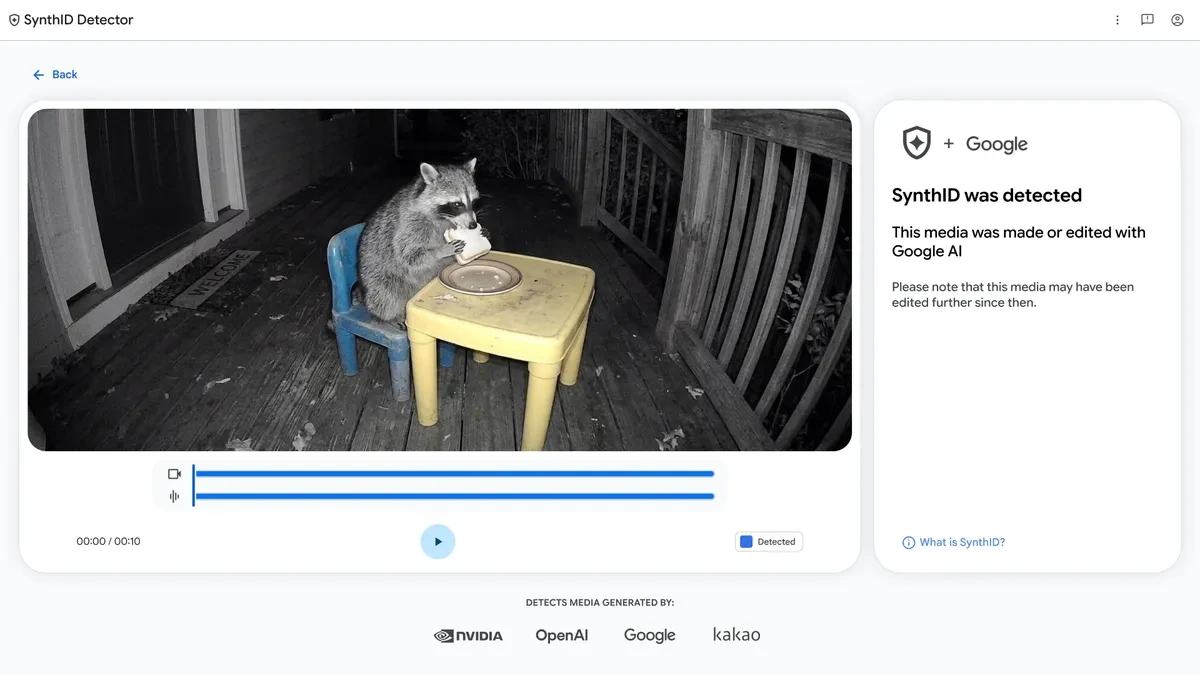
Google's published demonstration shows a positive result attributed to Google AI. Its wording covers media made or edited with the company's systems and allows for subsequent changes. The interface illustration accompanying this article reproduces that official demonstration, including its synthetic raccoon example.
MacRumors' creation-versus-editing distinction therefore changes the next question. Someone assessing a photograph needs to establish what was changed, rather than infer that every visible element was invented. A positive watermark alone does not supply a complete edit history or describe the size of an intervention.
Search Engine Journal also emphasizes the coverage limit: an undetected watermark can occur in AI media produced outside the participating system. The detector's own introduction likewise confines its reach to providers using SynthID. No detection is not proof of a camera original.
These boundaries are easier to apply when the result is kept separate from a verdict about the scene. A marked image can accurately illustrate an idea. A camera photograph can carry a misleading caption. The watermark concerns supported AI involvement, while the caption's claim needs evidence about the event, place or person it describes.
Three decisions a content team can make
Consider three hypothetical publication situations. They are examples of how to use the result, rather than tests of the detector's accuracy.
First, a contributor supplies an image as a camera photograph and the detector finds a watermark. The useful follow-up is to request the original capture, ask which editing tools were used and reconcile that explanation with the intended label. The contribution might need an editing disclosure, an illustration label or further investigation, depending on what those records establish.
Second, a promotional clip arrives without a detected mark. The team can continue checking who supplied it, whether the purported creator can provide an original and whether other evidence supports the claims in the post. The result belongs in that record, without replacing the source checks.
Third, an openly identified AI illustration produces a positive result. The mark can be consistent with the disclosed workflow. The publication decision then turns on whether the illustration is appropriate, accurately labeled and cleared for the intended use. Detection does not itself answer those editorial questions.
Across all three situations, preserve the submitted file and record which version was checked. Ask for the best available copy rather than relying on a repeatedly recompressed social preview. The detector recommends high-quality uploads, and version discipline also makes a later explanation easier to assess.
Public access makes provenance easier to inspect
The launch's practical value is a shorter route from encountering a file to checking for a supported origin signal. It gives individuals and content teams another observation they can retain alongside a contributor's explanation and original material.
Newsroom's earlier analysis of AI's authority gap examines how presentation can grant an output more trust than its underlying evidence earns. SynthID offers a concrete way to inspect one part of that gap. The next step remains matching the evidence to the exact claim being published: who made the content, what changed and what the audience is being asked to believe.