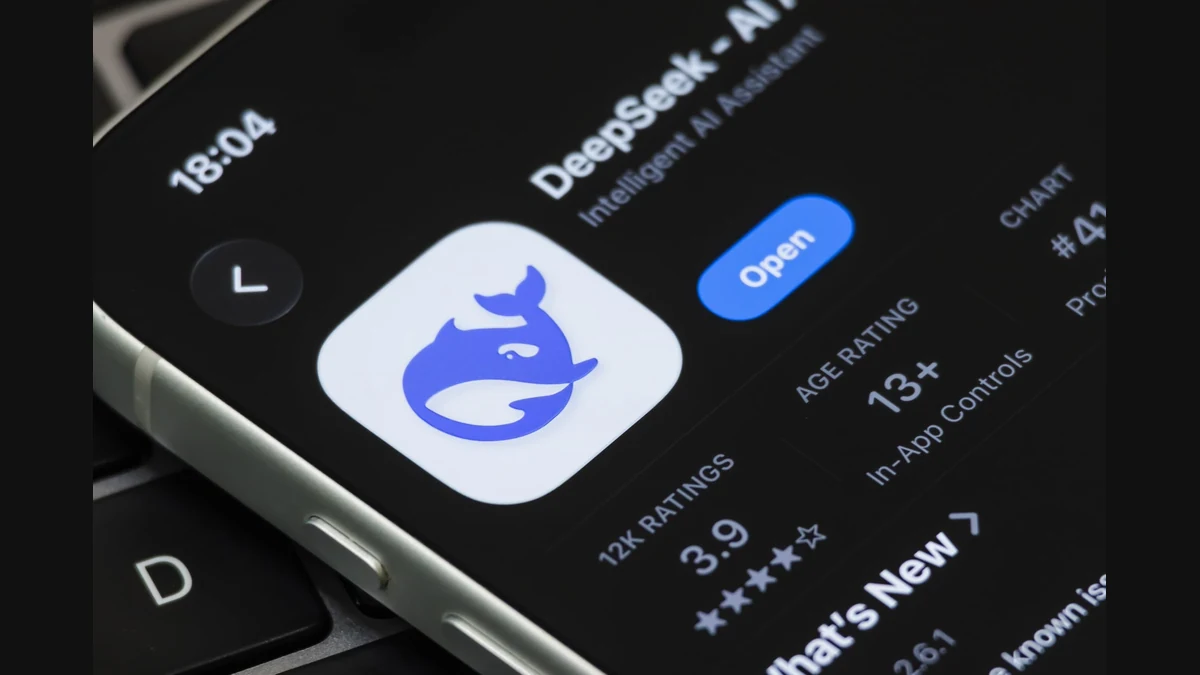
That distinction matters because the AI race is moving beyond who can train a capable model. Once a model is in use, every answer has to be computed. That recurring work, called inference, depends on how software schedules requests, uses chips, reuses earlier calculations, and keeps response times acceptable. DeepSeek’s October 20 release makes some of that engineering inspectable.
Inference is the work after training
Training creates a model by adjusting its parameters across data. Inference is what happens when a deployed model receives a prompt and produces an answer. A service may handle a single request or thousands at once, and the cost of running it depends on both the model and the system serving it.
The distinction is becoming more consequential as AI tools move into everyday products. McKinsey’s forecast for data center power demand estimates that AI inference demand could rise from 31 gigawatts in 2025 to 93 gigawatts by 2030, while AI training demand rises from 31 to 62 gigawatts. Those are projections, not a measurement of what every provider will spend. They do show why improving the serving layer has become a major engineering goal.
DeepSeek says DeepInfer is the high performance inference framework used in its production service. The public repository describes this release as offline inference software with core features for serving at scale. In its current form, the supported model list names DeepSeek V4.1 Flash, also identified in DeepSeek’s current API documentation as the 1017 version.
What DeepInfer puts in public view
The repository includes optimized kernels and model runtime components, parallel processing for mixture of experts models, asynchronous scheduling, deterministic sampling, structured output support, and DSpark, DeepSeek’s speculative decoding system. The code is under the Apache 2.0 license, according to the project page.
Speculative decoding is a way to reduce wasted work during generation. A smaller draft process proposes several possible next tokens. The main model checks them, accepts the useful ones, and continues from there. DeepSeek’s deployment notes describe a confidence based scheduler that varies how many draft tokens it checks, aiming to spend verification compute where it is more likely to be useful. This is an optimization technique, not proof that every deployment will be cheaper or faster.
DeepInfer also includes SWA bounded replay. In the documented approach, when part of a prompt’s key value cache is unavailable, the system can recompute a limited recent window instead of rebuilding a much longer history. A key value cache stores intermediate calculations so a system can reuse them across related steps. DeepSeek’s documentation says its approach can reduce repeated prefill work in its V4.1 Flash deployment.
The technical ideas are easier to understand in the context of a mixture of experts model . Such systems route different inputs through selected expert components instead of activating every parameter for every token. The benefit depends on the routing, memory, and communication around those components. A software framework can influence how efficiently those parts work together, but it cannot remove the cost of running the hardware itself.
Open code is not the whole service
DeepSeek’s deployment documentation draws an important boundary. The release provides an offline inference framework, and the company has also released DeepSeek Recipe for converting between model tokens and common API formats. But DeepSeek says its key value cache management and load balancing components remain closely tied to internal infrastructure and are not fully open sourced.
The repository also lists parts required for a complete inference service that are not included in this release, including a key value cache system, separation of vision encoding, prompt processing, and decoding across different resources, and load balancing across data parallel replicas. In other words, developers can inspect and run a meaningful part of the engine, but a production service still needs more than this code repository.
The hardware list sets another boundary. DeepInfer currently names NVIDIA SM100 GPUs and Huawei Ascend 950 NPUs. Its setup instructions call for Linux, Python 3.12, GCC 13 or later, and CUDA 13 or CANN 9.2 depending on the accelerator. That is a specialized deployment environment, not a one click local install for an ordinary laptop. Open source makes the framework available to examine and adapt. It does not make the required compute, engineering work, or operations free.
The framework’s license also should not be treated as a blanket license for every artifact used with it. Operators still need to check the terms for the specific model checkpoint and dependencies they deploy.
The competitive pressure is real, but bounded
DeepInfer gives developers a view into an inference system built by a model company for its own large scale service. That may help other teams learn from its runtime design and give experienced operators a starting point for deployments on supported hardware. DeepSeek says future model inference code and additional performance work will be added over time.
But this release does not show that an organization can replace a hosted service from OpenAI or Anthropic simply by downloading a repository. The software currently supports one named DeepSeek model, it requires substantial accelerator infrastructure, and the public release omits service components DeepSeek says are internal. A real comparison would need to measure cost per completed task, response speed, reliability, energy use, and the engineering effort required to keep a deployment running.
That is why the release is better read as an opening of part of the infrastructure layer than as a finished cloud alternative. The broader question is who can make useful AI less expensive to serve, under what hardware and workload conditions, and whether those savings reach users. A public framework creates room to test those questions. It does not answer them by itself.
For readers seeking a broader, earlier introduction to DeepSeek and enterprise applications, Dr. Utpal Chakraborty’s 2025 book, DeepSeek AI: A Comprehensive Guide for Enterprise Implementation , is listed by Amazon in paperback and Kindle editions. The book predates DeepInfer, so it is background on DeepSeek rather than a current guide to this framework.