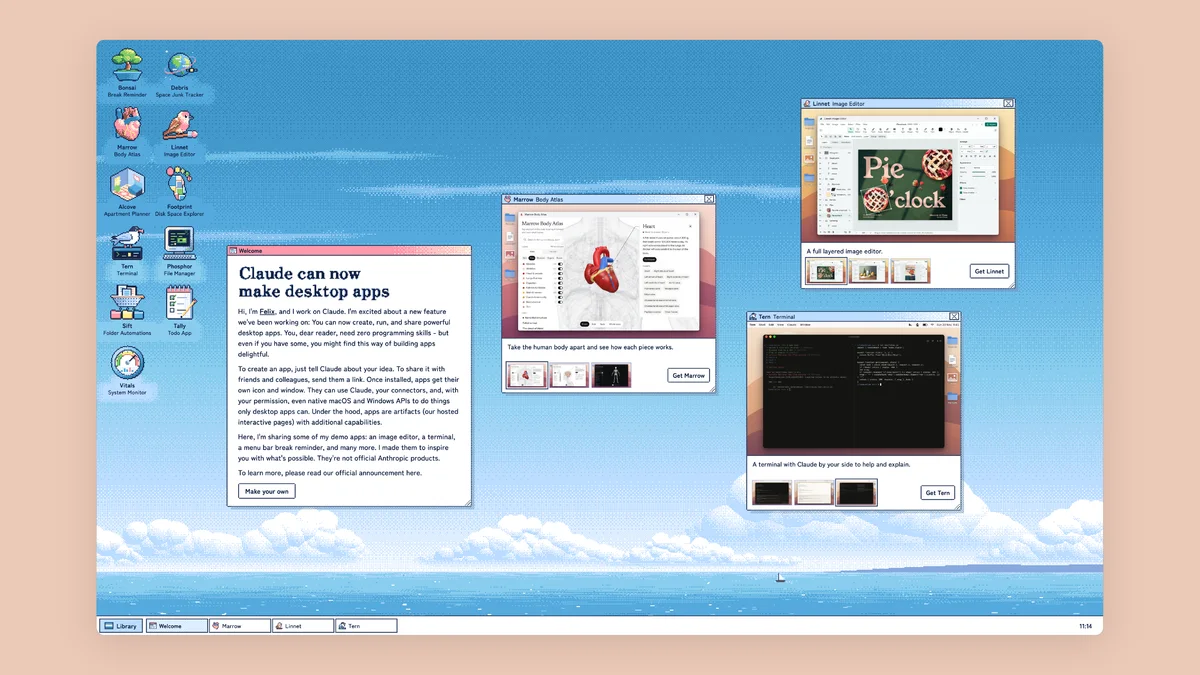
A small tool has a better chance of becoming a habit when opening it takes one click. A timer buried in a conversation may be useful. A timer sitting beside the other applications you open every morning is easier to remember.
That is the practical appeal of Anthropic’s November 24 announcement . Eligible Claude artifacts can become Mac and Windows apps through a beta feature called “Install as app.” The artifact is the interactive tool or page made in the conversation. Installation gives it a place outside that conversation.
SiliconANGLE frames the release as a challenge to traditional desktop software. The Wall Street Journal describes Claude output becoming installable software. The Verge highlights the permission choices, while Adafruit points makers toward the new capability. They trace back to Anthropic’s announcement, rather than four separate demonstrations of reliability.
A useful icon still has a platform behind it
Anthropic says users can install an artifact without packaging or signing software themselves. That removes a layer of work between making something useful and returning to it tomorrow.
The company’s examples range from a meeting preparation page to an order tracker. These suggest a particularly interesting role for personal software: a small interface shaped around a recurring task, without needing to become a general application for everyone.
Yet “installed” needs a little unpacking. Anthropic’s installation guide says the app remains the same artifact. Editing it changes the installed version, and opening it requires an internet connection and a Claude Desktop sign-in. Requests it makes to Claude count toward the user’s plan limits.
The window becomes separate. The dependency remains. That distinction matters when deciding whether a tool belongs in an occasional experiment or an everyday workflow.
Give the tool a job before giving it access
The sharper change is that an artifact can ask to do things beyond its browser setting. Anthropic describes browser-level defaults, optional desktop capabilities such as notifications, and full computer access. That last level can allow programs to run and files to be read, changed or deleted without a prompt for each action.
Consider two illustrative tools: a stretch reminder and a utility that renames photographs. The reminder has a reason to request notifications. The renaming utility has a reason to touch files. Giving both the same broad access would ignore the difference between their jobs.
This is a practical application of the principle of least privilege : start with the access the task requires. Our earlier explanation of Mac Full Disk Access explores the related distinction between a narrow request and a much larger permission. Claude’s permission tiers are their own system, so the controls should not be treated as interchangeable.
Anthropic does not review these apps before installation. Approval normally applies to one version, with permission requested again after changes. Code loaded from another website can change without that fresh request, according to its documentation. An app’s familiar icon therefore tells you where to open it, rather than how thoroughly someone has checked it.
Start with something small enough to understand
The most useful question is whether a recurring task becomes easier to complete and easier to inspect. A narrowly defined tool gives its owner a clearer way to notice mistakes. If the output is wrong, can you recognize it? If it changes something, can you recover?
Those questions also put the broader software-replacement claim in proportion. Installation makes generated tools easier to keep using. It does not establish that they have the reliability, support or continuity of the applications they might replace.
The promising part is modest and concrete: a person can describe a small need, shape a tool around it, and give that tool a familiar place on the desktop. The next decision is what it should be trusted to do there.
FAQ
Can installed Claude artifacts work independently of Claude?
They have their own windows and icons, but opening them requires an internet connection and a Claude Desktop sign-in. Calls to Claude use the existing plan allowance.
Who can use “Install as app”?
Anthropic says the beta is rolling out across plans on Mac and Windows, with Claude Desktop version 6.28899.0 or later required. Team and Enterprise access also depends on organization settings. Some artifacts, including Claude Docs, Slides and Sheets, cannot be installed.