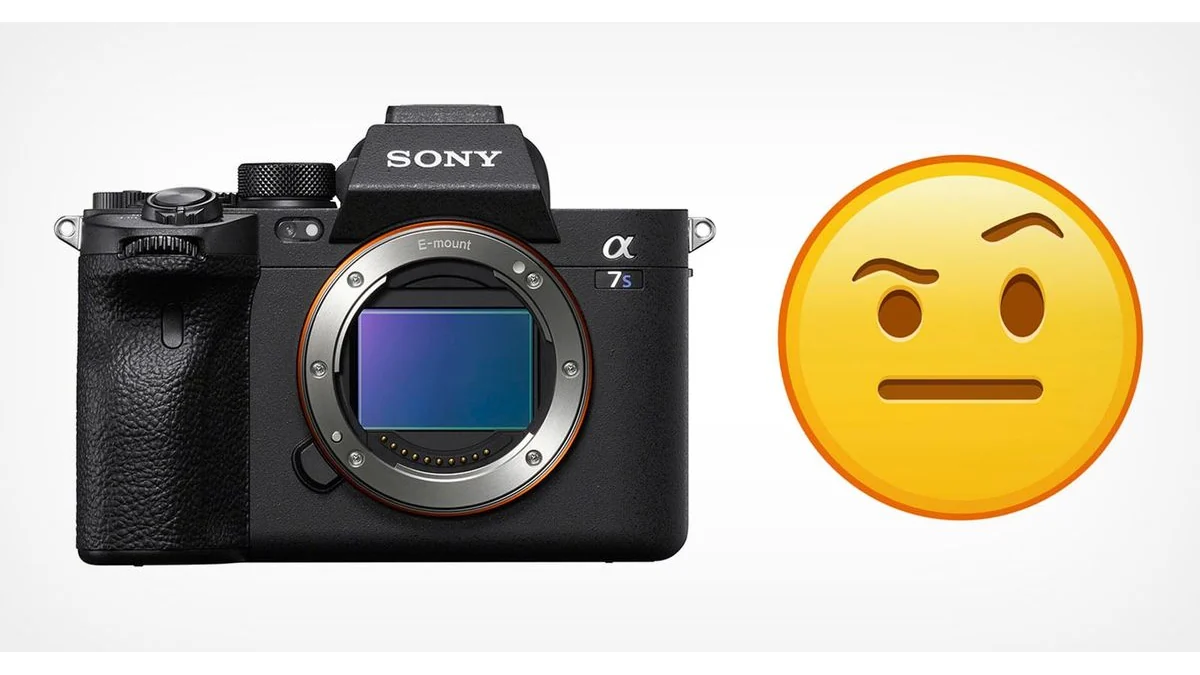
A registration lead leaves the model unresolved
Source: SonyAlphaRumors.com reported on September 28 that Sony registered camera code WW261362 in China, with Wi-Fi 6 support and Sony Japan named as applicant. Sony Alpha Rumors, the originating report for this story, interprets that information as a possible A7S IV. Its proposed sensor, viewfinder and launch timing are explicitly speculative.
The A7S IV name, specifications and announcement date remain unconfirmed. The report establishes an attributable rumor to examine. It does not provide an official product identity, and a wireless registration alone cannot describe how a camera will perform or which photographers it will serve.
That distinction gives the story its practical shape. A product code can suggest development activity, but a purchasing decision depends on the finished camera. Resolution, autofocus behavior, recording limits and handling each answer a different question. Treating one registration as a complete specification sheet would hide those distinctions.
The A7S III provides a confirmed baseline
Sony's original A7S III announcement , published in July 2020, documents a 12.1-megapixel full-frame sensor, 4K recording at up to 120p, a 9.44-million-dot electronic viewfinder and still-image bursts at up to 10 frames per second. These are specifications of the existing camera, not evidence for an A7S IV.
The combination explains the appeal of this kind of body. A photographer can frame through a built-in viewfinder, take a still photograph, then record moving footage without changing to a separately rigged camera. That can matter on a portrait assignment, during an interview or while documenting an event where the requested output changes throughout the day.
For stills, however, a modest pixel count limits how much room remains after cropping. A tightly composed photograph and a loosely framed image that must later be trimmed place different demands on resolution. The same file can be adequate for one delivery and restrictive for another. A successor's usefulness would depend on the intended output, rather than the model number alone.
A higher pixel count needs an output comparison
The rumor publisher speculates about a 16-megapixel sensor. If that were the eventual still-image resolution, it would represent roughly 32 percent more pixels than 12.1 megapixels. At the same aspect ratio, the linear increase would be about 15 percent, because image width and height scale with the square root of the pixel count. This is a conditional calculation, not a confirmed specification.
That difference is worth translating into an actual crop. More pixels can preserve additional detail after reframing, but the gain would be smaller than the percentage increase in total pixels might suggest. A reader considering a successor could compare the longest image dimension required by a client with the dimensions left after the usual crop.
Noise deserves the same discipline. Compare finished images at matching sizes, with comparable exposure and processing. A larger individual pixel does not by itself establish a visibly cleaner final photograph. Exposure, sensor design, readout and the chosen output all contribute. Newsroom's explanation of high-ISO limits develops the exposure and output decisions behind that comparison.
Readout and handling are separate questions
A fast sensor readout can be valuable when the subject or camera moves. Rolling shutter describes the effect of recording different parts of an image at different times. A faster scan can reduce the time difference across the frame, but the benefit depends on the recording mode and on how the camera reads the sensor.
For a hybrid assignment, useful evaluation would therefore include moving subjects, handheld camera movement and artificial lighting. A specification describing sensor construction cannot substitute for those results. The still-image electronic shutter and a particular video mode may also have different behavior.
Handling remains a separate part of the decision. A viewfinder can help with framing in bright light or provide another point of contact during handheld shooting. A rear monitor can suit an interview rig, a gimbal or a camera placed away from the operator's eye. Neither arrangement serves every assignment equally well. The relevant question is which one makes the required photographs and footage easier to capture consistently.
The cinema lineup creates a credible counterargument
In his September 29 PetaPixel opinion article , Jeremy Gray argues that Sony's FX cameras reduce the commercial space for another A7S body. He also discusses Jordan Drake's preference for the A7S form factor despite that skepticism. Their disagreement concerns the likely product strategy, not confirmation of the rumored model.
Sony's July FX5 announcement provides confirmed context: the cinema camera has a fully stacked sensor, Open Gate shooting, internal RAW recording and an optional detachable viewfinder. Those features belong to the FX5. Their existence does not establish that Sony will transfer them to an A7S successor.
The practical distinction is the working system. A camera body, viewfinder, audio accessories and support equipment together determine what an operator carries and how quickly the setup changes. A compact body with integrated viewing may appeal to a photographer moving between stills and video. A dedicated cinema setup may better suit a production organized around recording. These are use cases to compare, without assuming either one determines Sony's next release.
Judge a successor by the assignment it improves
The rumor makes a useful prompt for assessing current limitations. Identify the photographs that lose necessary detail after cropping, the video modes that restrict delivery and the handling choices that slow a real assignment. Those observations create a clearer basis for evaluating an eventual announcement than a list of hoped-for features.
An A7S IV would need to improve a meaningful combination of those demands. Until Sony identifies a product, the registration report remains a lead and the specification proposals remain speculation. The valuable question for a hybrid photographer is concrete: which part of the stills-and-video assignment would a different camera actually make easier?