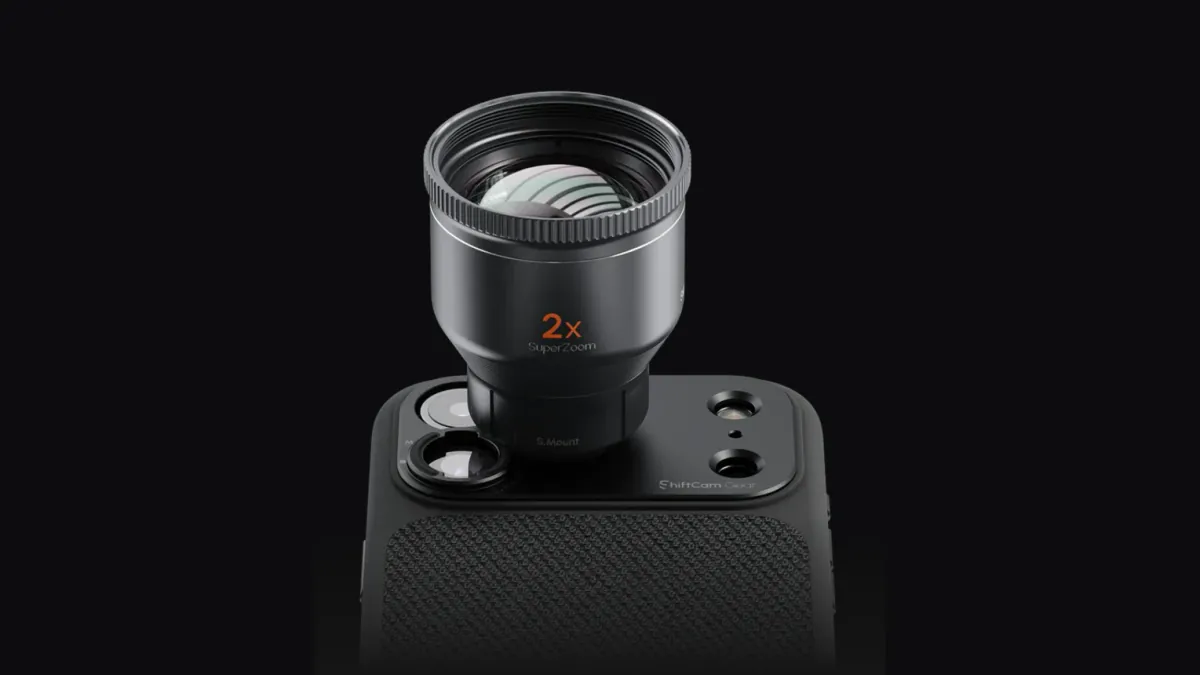
A Longer View From the Phone’s Telephoto Camera
ShiftCam’s X.Series adds an optical attachment to a compatible smartphone’s dedicated telephoto camera. The company specifies approximately 200mm-equivalent framing for its 2x SuperZoom and 350mm equivalent for the 3.5x SuperZoom , using the iPhone 17 Pro or Pro Max’s 4x telephoto camera.
The multiplier acts on the camera beneath the attachment. It is not a universal focal length for every phone, nor a continuous zoom range between the two lenses. The 2x and 3.5x are separate optics. Each narrows the view before the phone records and processes the image.
That changes the starting point for a composition. A distant architectural detail can occupy more of the frame. A small figure can become the subject rather than an incidental mark in a broad scene. The phone remains the camera, but its angle of view becomes more specialized.
Reach Changes What Belongs in the Frame
A telephoto view is useful for selecting relationships inside a larger scene. A row of windows, overlapping ridgelines, or repeated gestures across a crowd can become a photograph when surrounding distractions fall outside the frame.
Camera position still determines perspective. Working farther from a subject and framing tightly can make separated planes appear closer together. Nikon’s guide to telephoto landscape photography describes using distance and a long focal length to organize layers in this way. The useful creative decision is where to stand and which layers to include.
For a phone photographer, that suggests a different pace from the usual wide-angle snapshot. Scan a scene for a small arrangement of shapes, then move until the background supports it. A few steps sideways can separate a subject from a bright sign or place it against a more even patch of color.
The longer attachment also leaves less room around a moving subject. Anticipating where the subject will enter the frame becomes more important than reacting after it arrives. The 2x option offers a wider view than the 3.5x, which can make it easier to leave space for movement and context.
Working Distance Is Part of the Choice
ShiftCam lists a six-meter minimum focusing distance for the 2x lens and eight meters for the 3.5x. Those are substantial working distances. A distant façade or subject across a field fits the intended use more naturally than a nearby tabletop detail.
The official specifications list the 2x at 140 grams, with five elements arranged in four groups. The 3.5x weighs 190 grams and uses 12 elements in six groups. Both attach through the company’s S.Mount system, using an appropriate phone case or a supported universal mount.
The focus distances deserve attention before the focal-length numbers. At a compact venue, a subject can be too close for the attachment even when a tighter composition would be welcome. Leaving enough room to focus is a physical requirement of the setup.
ShiftCam offers macro converters as separate accessories or in bundles. These create another shooting configuration for closer subjects. The X.Series uses an M43 front accessory thread, distinct from the M37 accessories for the company’s earlier 240mm Super Zoom.
Keep the Correct Camera Active
A phone may contain several cameras, each with its own lens and sensor. The external attachment needs to sit squarely over the telephoto module that is actually recording the image. ShiftCam recommends a camera app that allows that module to remain selected, avoiding an automatic switch to another camera.
ShiftCam One is available for iPhone. Its App Store listing identifies ShiftCam Limited as the developer and describes model-specific mounting guidance, a lens picker, focus and exposure lock, and a zoom display adapted to the selected attachment. Version 1.1 is listed with a September 8 release date.
The useful preparation is straightforward: fit the correct mount, align the attachment, select the intended camera, and check the view before the subject arrives. Treat the phone, mount, optic, and app as one setup. A case that fits the handset is only one part of that fit.
Give the Narrow Frame Stable Support
Small angular movements become conspicuous in a long-lens view. Canon’s explanation of camera-shake blur identifies long focal lengths and slow shutter speeds as conditions that make the problem more pronounced.
For still subjects, stable support helps keep the framing deliberate. For moving subjects, shutter speed also needs to suit the motion. A steady camera can still record a blurred runner, bird, or moving hand.
At an event, it is worth settling the grip and shooting position before concentrating on expressions. For architectural details, take a moment to inspect the frame edges and vertical relationships. Reach is most useful when it serves a specific arrangement rather than simply filling the screen.
Lens, Mount, and Kit Are Separate Decisions
At the August announcement, PetaPixel reported preorder prices of $256 for the 2x and $351 for the 3.5x, with planned regular prices of $269 and $369.90. Those were launch-era lens prices. The current store separates lens-only, macro, filter, and full-kit configurations, with a mounting solution also required.
X.Series is most interesting as a deliberate change in framing. It brings distant details into a phone-based workflow while asking for the working distance, alignment, and support associated with long-lens photography. The choice between its two optics begins with the photograph: how far away the subject is, how much surrounding space matters, and how tightly the frame needs to hold it.