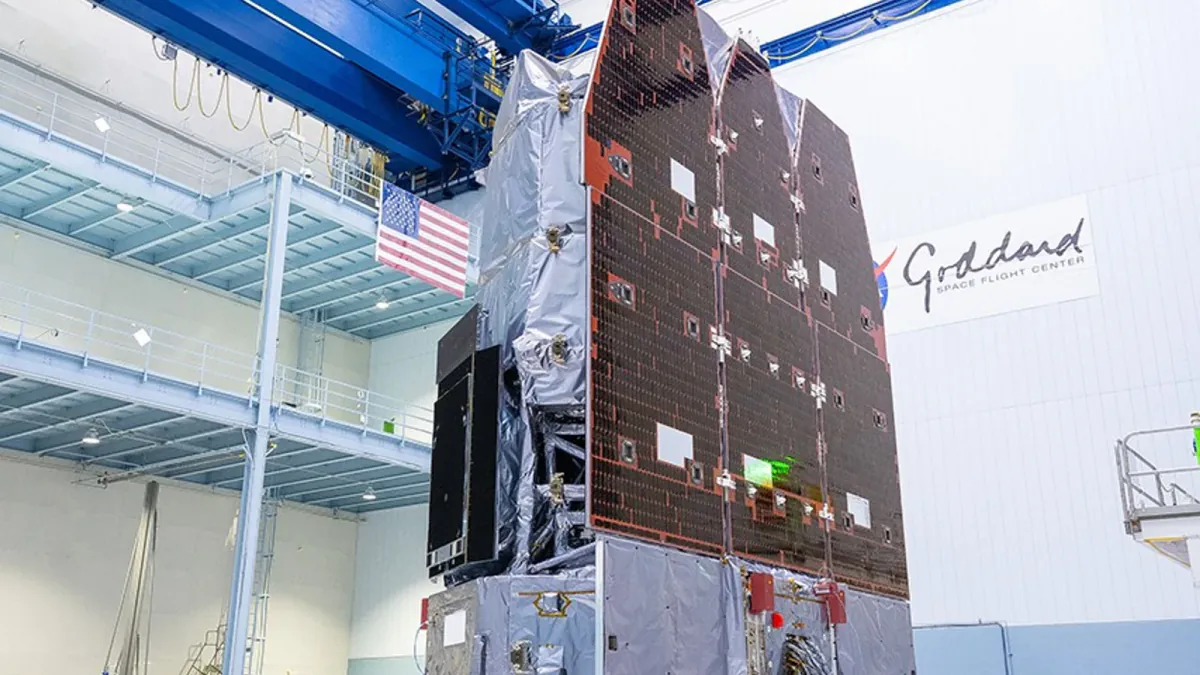
A Survey Camera Leaves the Launch Pad
NASA cleared the Nancy Grace Roman Space Telescope for flight at its August 28 readiness review . Two days later, the observatory launched aboard a SpaceX Falcon Heavy from Kennedy Space Center at 7:26 a.m. EDT. Its principal photographic instrument is a 300-megapixel camera built to record detailed views across unusually large areas of sky.
The camera gives Roman a distinctive role among space observatories. A narrow view can isolate a compelling subject. A broad, detailed view records the surrounding population, placing individual stars and galaxies within a larger structure. Roman brings that second approach to astronomical imaging, with surveys designed around repeated, comparable observations.
Its flight and instrument activation are covered in Roman’s journey to L2. The enduring interest of the camera lies in how its optics, detector array, filters, and observing strategy work together.
Resolution and Coverage Share the Frame
Roman’s Wide Field Instrument combines 18 detectors with a field larger than the apparent area of the full Moon. NASA compares that field with two different Hubble instruments: roughly 200 times the area covered by the infrared channel of Wide Field Camera 3, and nearly 100 times Hubble’s widest Advanced Camera for Surveys exposures.
Those comparisons describe area on the sky. Angular resolution describes the ability to separate closely spaced detail. Roman is designed to preserve infrared resolution similar to Hubble’s while fitting far more sky into an exposure. The large pixel count supports that combination of coverage and detail.
For a photographer, the distinction is familiar. Increasing the area inside a frame and increasing the detail resolved within it solve different problems. Roman’s design joins the two, making a wide survey useful at the scale of individual objects as well as across the whole field.
The practical benefit is fewer separate pointings for a given expanse of sky. That changes the time available for returning to a region, comparing exposures, and following events whose appearance evolves. A panoramic view becomes the basis for a sequence rather than a single, self-contained photograph.
Filters Make the Camera a Measuring Instrument
NASA’s technical description of the Wide Field Instrument identifies it as both a visible-to-near-infrared camera and a slitless spectrometer. A rotating element wheel places imaging filters or dispersing elements in the light path. The latter spread light into spectra across the instrument’s field.
Imaging records where light falls and how its brightness varies across the frame. Spectroscopy separates that light by wavelength, adding another way to examine the objects being photographed. The same broad field can therefore support different kinds of measurement.
NASA’s explanation of Hubble’s color images also offers a useful way to understand astronomical color. A filter selects a range of wavelengths before the detector records the signal. Translating observations into a visible picture involves deciding how those recorded bands will be displayed. The image’s filter information is part of its meaning, just as the exposure and processing choices are part of understanding a terrestrial photograph.
Infrared astronomy extends that idea beyond human vision. Roman’s infrared sensitivity helps it observe light from distant galaxies that has been stretched to longer wavelengths as the universe expands. Looking from space also avoids the atmospheric absorption and glow that complicate some infrared observations from the ground.
Repeated Frames Reveal Changes
A survey gains another dimension when the camera returns to the same field. A small change in brightness can become significant through comparison with earlier exposures. Consistent framing, calibration, and timing make those comparisons informative.
Roman’s planet-search strategy includes gravitational microlensing. When a foreground object passes close to the line of sight to a background star, gravity bends the star’s light and temporarily increases its apparent brightness. The signal can reveal an intervening object without a resolved photograph of that object itself.
Roman will monitor crowded stellar fields toward the center of the Milky Way. Here, the combination of a wide frame and repeated observations is essential: the camera needs to follow many stars while capturing changes that can be brief. The photographic result is a time series as much as a map.
The observatory’s separate Coronagraph Instrument tackles a different imaging problem. It is a technology demonstration designed to suppress a star’s glare so that fainter planets and dusty material nearby can be studied. Wide-field monitoring and high-contrast direct imaging serve complementary purposes.
A Public Archive With Many Readers
NASA’s mission briefing says Roman’s observations will become public as soon as they are processed. Different teams will be able to examine the same material at the same time, asking questions that extend beyond the mission’s initial survey goals.
That makes the archive part of the camera’s value. A field recorded for one investigation may contain objects relevant to another. Repeated observations preserve changes that later researchers can revisit. The usefulness of the photographs grows through their relationships with one another.
NASA expects the first science images in early 2027, following commissioning on Roman’s journey to its orbit around the second Sun-Earth Lagrange point. For photographers following the mission, its central idea is already clear: detailed images can describe individual subjects, while a carefully built sequence of wide views reveals the structure and change around them.